Any useful Endor Labs review has to start with the problem the company is selling against, and the numbers say executives already feel it: 78% of CEOs at highly resilient organizations name supply chain and third-party dependencies as the single biggest obstacle to strengthening their security posture (Source: World Economic Forum). That is not a developer complaint. That is a board-level one.
Endor Labs sits squarely in that gap. The Palo Alto company builds an application security platform that scans open source dependencies, first-party code, and container images, then tries to answer a question most scanners dodge: of the thousands of vulnerabilities in your build, which ones can an attacker actually reach? The answer determines whether your security team spends the quarter fixing real exposure or chasing ghosts.
Table of contents
Key Takeaways
- Endor Labs prioritizes vulnerabilities by whether attackers can reach them
- Reachability analysis is the core differentiator, not breadth of scanning
- Pricing is per code contributor per year, quoted by sales
- A free local-only Developer Edition exists for individual engineers
- Independent review volume remains thin compared with older competitors
What Endor Labs Actually Does
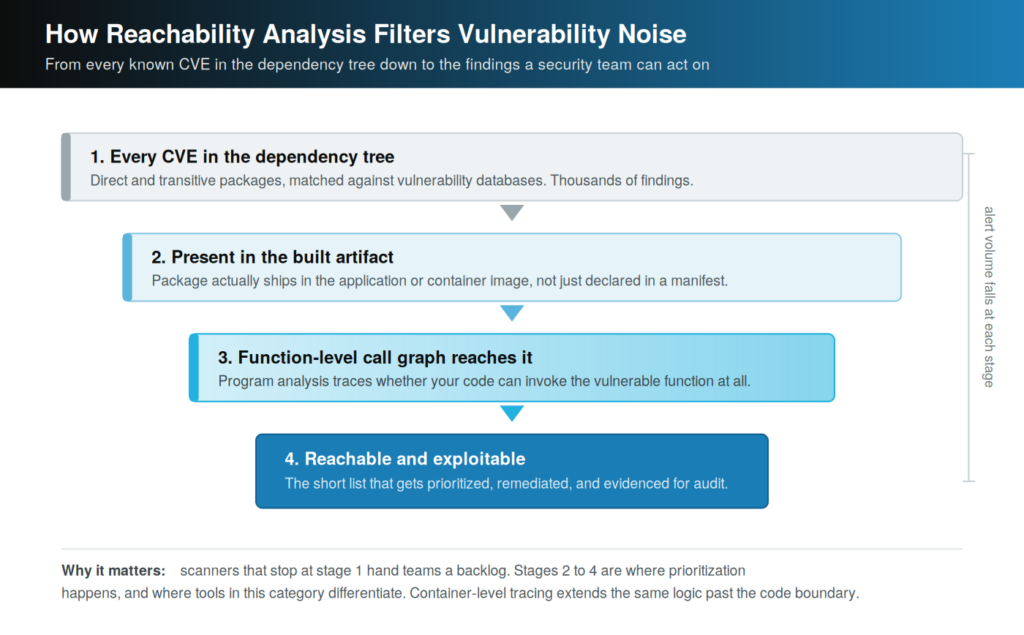
Start with the mechanics. Traditional software composition analysis tools inventory the packages in your project, cross-reference them against a vulnerability database, and hand you a list. The list is enormous. Most of it does not matter, because the vulnerable function inside a flagged package is never called by your application.
Endor Labs builds a function-level call graph across your codebase and its dependencies, then traces whether execution paths actually reach the vulnerable code. Findings that cannot be reached get deprioritized instead of filling a queue. The company was founded by Varun Badhwar and Dimitri Stiliadis, who previously led Prisma Cloud at Palo Alto Networks, and the product reflects that background: it treats prioritization as the hard problem, not detection.
The platform has widened considerably since launch. It now covers first-party static analysis, secrets detection, container image scanning, AI model governance, and SBOM generation for compliance reporting against frameworks including FedRAMP, PCI, SLSA, and NIST SSDF.
The AI Code Problem It Is Built Around
Endor Labs repositioned hard around AI-generated code, and the timing was not accidental. When engineers accept dependency suggestions from a coding assistant, they inherit packages nobody on the team evaluated. Some are outdated while some do not exist, and some are typosquats planted specifically to catch that behavior.
The tendency of AI-generated code to pull in outdated or unsafe packages is exactly the wedge Endor Labs uses in its pitch. The company also argues that scanning artifacts in isolation stops working once agents generate code, dependencies, and container images together as one unit.
In February 2026, Endor Labs acquired Autonomous Plane, a cloud-native security company that Kyle Quest founded after building DockerSlim. Neither side disclosed financial terms. The deal bought full-stack reachability: the platform now traces a vulnerability from source code through to whether a running container image actually loads the affected package.
Container scanners have historically told teams which packages a build includes rather than which ones an attacker can exploit. Closing that gap counts as a real technical advance, not repackaging.
Key Features
Reachability-based prioritization
The flagship capability. Program analysis determines which vulnerable functions your code can invoke, which collapses the finding count dramatically for most teams. This is where Endor Labs wins or loses a proof of concept.
Full-stack reachability to the container
Added through the Autonomous Plane acquisition. Combines static source analysis with dynamic techniques applied to container images, so findings carry evidence about runtime exposure rather than package presence.
Broad language and build system coverage
The company emphasizes support ranging from legacy C++ through modern Bazel monorepos, plus a native Bazel integration that several reviewers single out. Language breadth matters here because reachability analysis is expensive to build per ecosystem, and coverage gaps are the usual failure point for tools in this category.
AI agents and MCP integration
Endor Labs ships AURI, a catalog of security agents that run inside AI coding assistants through a local MCP server. The agents triage findings, remediate vulnerable dependencies, and diagnose failed scans. Mutating actions require approval, and the server runs on your own infrastructure with your own model keys.
SBOM and compliance reporting
First-party and third-party SBOM management, with reporting aimed at regulated buyers. Given that Gartner published its first Magic Quadrant for software supply chain security in June 2026, formalizing the category as a standalone market, this reporting layer is becoming a procurement requirement rather than a nice extra.
Who It Is For
The best fit is a mid-to-large engineering organization drowning in SCA alerts, where the security team is outnumbered by developers and cannot review every finding. If your backlog has thousands of open CVEs and nobody trusts the severity ratings, reachability is the feature that changes the conversation.
It also fits regulated buyers who need audit-ready evidence for every finding, and organizations moving fast on AI-assisted development who want dependency governance before the problem compounds.
It is a poor fit for very small teams. A five-person startup does not have enough dependency sprawl to justify a per-contributor enterprise contract, and free or lower-cost tools will cover the basics adequately.
Pricing
Endor Labs licenses per code contributor per year, with Core and Pro tiers across its Open Source and Code product lines. A code contributor is defined as a developer who has made at least one commit to a monitored private repository in the previous 90 days, which means your bill tracks active engineers rather than seats or repositories.
There is no published list price. Every tier routes through a sales conversation, though the platform can be purchased through the AWS, Azure, and Google Cloud marketplaces to simplify procurement. A free Developer Edition exists for individual engineers: it runs the MCP server locally with default policies and read-only access to vulnerability data, but ships without a web interface, custom policies, scan history, or team management.
Pros
- Reachability analysis meaningfully reduces false positives, and this is the most consistent theme in user feedback
- Deep coverage of awkward ecosystems, including C++ and Bazel monorepos that many competitors handle badly
- Full-stack tracing from source code through container images after the Autonomous Plane acquisition
- Compliance reporting mapped to FedRAMP, PCI, SLSA, and NIST SSDF
- Free local Developer Edition lets engineers evaluate the scanning quality before procurement gets involved
- Well capitalized, with $188 million raised including a $93 million Series B led by DFJ Growth
Cons
Be honest about the tradeoffs, because they are real.
The independent review base is thin. On Gartner Peer Insights, Endor Labs sits at roughly 4 stars from a small handful of reviews, while Snyk carries hundreds. That is not evidence the product is worse. It is evidence that you have far less peer data to check your own evaluation against, and for a security purchase that matters.
Scan performance on large repositories draws repeated criticism from reviewers. Deep program analysis is computationally expensive, and the cost shows up in CI pipeline times on big monorepos. Test this against your actual codebase during evaluation, not a sample project.
Onboarding and interface polish have both been flagged. Several reviewers describe setup as more involved than expected and the experience as still maturing.
Pricing opacity is a practical problem. With no published rates and a per-contributor model, forecasting a three-year cost as your engineering headcount grows requires a conversation you cannot have on your own timeline.
Finally, scope. Endor Labs is deep on dependency and code risk rather than broad across pipeline posture. Teams looking for full application security posture management across every scanner and pipeline stage will find the focus narrower than they want.
Alternatives Worth Comparing
Snyk is the volume leader in developer-first SCA, with the widest ecosystem coverage and a real free tier, though its reachability support is narrower. Socket takes a different angle entirely, analyzing package behavior to catch malicious packages rather than known CVEs. Aikido bundles SCA, static analysis, container, secrets, and infrastructure scanning into one developer-priced platform, which suits teams whose scope is broader than Endor’s specialization.
On the platform end, Apiiro and Ox Security approach the problem from application security posture management, correlating risk across pipelines and multiple scanners. Chainguard attacks the problem upstream by shipping hardened, minimal open source images so fewer vulnerabilities enter the build at all.
Which of these belongs on your shortlist depends on whether prioritization, prevention, or breadth is the thing your team is short on. One practical note when you research: most head-to-head comparison pages in this category are published by one of the vendors being compared, so weight independent software coverage and peer reviews accordingly.
Conclusion
Endor Labs is a focused product with a defensible technical claim. If your problem is that your security team cannot tell which of ten thousand findings deserve attention this sprint, reachability analysis addresses that directly, and the container-level extension makes the evidence stronger than most competitors can offer. The customer roster and funding suggest the technical claim holds up under real load.
Weigh it against the friction, though. Run a proof of concept on your largest repository and time the scans. Ask for reference customers at your size, since the public review pool is small. Model the per-contributor cost against your hiring plan for the next three years before you sign anything. And remember that dependency risk is one layer of a broader program that also depends on zero-trust access controls and runtime monitoring, because no scanner catches what it was never pointed at.
Read Next
More coverage on securing modern development and enterprise systems:
- What’s Powering Modern KYC Technology
- AI Cybersecurity: Protecting SaaS-Based Companies
- Can AI Detectors Protect Your Business from Deepfakes and Fake Data?
Frequently Asked Questions
Endor Labs is an application security platform that scans open source dependencies, first-party code, and container images for risk. Its defining capability is reachability analysis, which determines whether a vulnerable function can actually be invoked by your application. The company is based in Palo Alto and has raised $188 million.
Endor Labs pricing is not publicly listed. Licensing works per code contributor per year across Core and Pro tiers, where a contributor is any developer who committed to a monitored private repository in the past 90 days. A free local-only Developer Edition is available for individual engineers, and paid tiers require a sales quote.
For most small teams, no. The per-contributor enterprise model and sales-led procurement suit organizations with substantial dependency sprawl and a dedicated security function. Teams under roughly twenty engineers will usually get adequate coverage from tools with self-serve pricing and free tiers.
The strongest Endor Labs alternatives are Snyk for developer-first breadth and ecosystem coverage, Socket for malicious package detection, Aikido for consolidated scanning at developer pricing, and Apiiro or Ox Security for posture management across pipelines. Chainguard offers a prevention-first option through hardened base images.
Yes. Endor Labs has built its recent positioning around AI-assisted development, scanning dependencies suggested by coding assistants and offering agents that run inside AI coding tools through a local MCP server. Its February 2026 acquisition of Autonomous Plane extended that coverage from source code through container images.