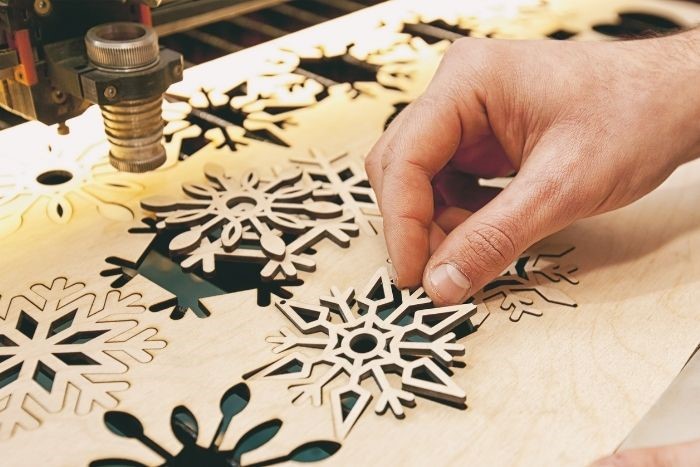
Lasers capture the imagination of children and adults alike, but the idea that focused beams of mere light can cut through objects is truly mind-blowing. If you’ve ever wondered, “What are laser cutters, and how do they work?” you’re not alone. These precision tools have moved from industrial settings into classrooms, maker spaces, and small businesses, transforming how we design, prototype, and manufacture almost anything.
At their core, laser cutters use highly concentrated light energy to slice, engrave, or vaporize material with extreme accuracy. This process allows for intricate shapes, detailed patterns, and smooth edges that other tools simply can’t replicate. Understanding how they operate—along with the types of lasers, the materials they can handle, and the safety considerations involved—opens the door to a fascinating world of creativity and engineering. Here is a clear and accessible overview of lasers, laser cutters, and their many real-world applications.
Key Takeaways
- Laser cutters use concentrated light energy to cut, engrave, or vaporize materials with high precision.
- Types of lasers include CO₂ lasers for non-metal materials and neodymium lasers for metals, each serving different functions.
- Laser cutting involves detailed control over speed and intensity, allowing for various operations like cutting and engraving.
- These versatile tools find applications in manufacturing, art, and education, enhancing consistency and creativity in projects.
- Laser cutters deliver quick and repeatable results, making them ideal for professionals and hobbyists alike.
Table of contents
What Are Laser Cutters?
The word “laser” is a household term nowadays, but it actually began as an acronym. LASER stands for Light Amplification by Stimulated Emission of Radiation, a phrase that describes how lasers amplify and control light. In simple terms, a laser focuses light waves into a tight, powerful beam using mirrors and lenses. When this beam is concentrated at a single point, it creates enough energy to cut, melt, or vaporize different materials.
To manage the intensity and safety of these beams, lasers are grouped into a laser classification system. These classes range from harmless, low-power devices (like barcode scanners) to high-powered industrial systems that require protective eyewear and controlled environments. The wattage of a laser determines not only its power but also its potential injury hazard to human eyes and skin, which is why proper safety protocols are essential in any setting where cutting lasers are used.
There are dozens of types of laser cutters and configurations, but in the world of cutting, CO₂ lasers and neodymium (Nd:YAG) lasers dominate.
- CO₂ lasers are excellent for non-metal materials such as wood, acrylic, leather, and fabric because they create smooth, clean cuts.
- Neodymium lasers deliver extremely high energy in short bursts, making them ideal for metals or materials that require precision at microscopic levels.
Together, these technologies allow manufacturers, makers, and creators to produce incredibly detailed work at incredible speeds.
What Is Laser Cutting?
Laser cutting uses the same fundamental laser technology but applies it specifically for cutting, engraving, etching, or marking materials. The process begins inside a sealed chamber where light is repeatedly reflected between mirrors until enough energy accumulates to escape as a single, highly focused beam. Once released, the beam passes through a focusing lens that concentrates it onto an exact point on the work surface.
When the beam touches the material, it generates enough heat to melt, burn, or vaporize it. By adjusting the beam’s speed, intensity, and focal point, the machine can:
- cut entirely through a material,
- lightly engrave a design on its surface, or
- score guidelines for folding or shaping.
For example, cutting through a thick piece of wood requires slower movement and more heat, while engraving a simple surface pattern takes far less time and energy. This precise control is what makes laser cutting so accurate and repeatable, even for highly detailed or complex designs.
When Are They Used?
Laser cutters are remarkably versatile, which is why they are used across countless industries. These machines can cut through or engrave wood and other materials, including:
- acrylic and plastics
- paper and cardboard
- metal
- leather
- glass (for engraving)
Because of this flexibility, laser cutters appear everywhere—from large-scale manufacturing plants to small business workshops, art studios, and even educational makerspaces.
In manufacturing and engineering, laser cutters shine when producing consistent, repeatable parts. For instance, companies often rely on lasers to engrave serial numbers, product IDs, or measurement marks on metal components like pipes, bolts, gears, and machine fittings. The engraving is permanent and precise but shallow enough not to weaken or deform the part—making it ideal for industries that require both durability and traceability.
Laser cutting is equally important in creative fields. Designers use it to make custom signage, jewelry, packaging prototypes, architectural models, and personalized gifts. Its ability to replicate a design exactly, hundreds or thousands of times, makes it invaluable for both small and large production runs.
Laser cutting works on all sorts of materials, and, because of this versatility, professionals use them in various industries. Lasers can cut through or engrave wood, metal, acrylic, and even paper. Though the laser cutter itself usually resides in manufacturing facilities, laser-cut products and parts supply many businesses. Industries that must repeatedly produce the same parts utilize laser cutters to mark or engrave items like metal piping and bolts with product numbers. The power of the laser allows it to make a permanent mark on a piece of metal without harming its integrity, so you can trust that your laser simply spelled out the number but did not cut through the metal pipe.
Now, if anyone ever asks you what laser cutters are and how they work, you’ll be ready with an answer. Though manufacturing is their most common application, these spectacular tools can work in all kinds of environments. If you are looking for precise, quick, and easily replicable results, consider switching to laser cutting for your business or personal needs!
Conclusion: Why Laser Cutting Matters
Now, if anyone ever asks you what laser cutters are and how they work, you’ll be ready with a clear and confident answer. While manufacturing remains the most common environment for these machines, laser cutters are becoming increasingly accessible to hobbyists, educators, and small business owners. Their ability to deliver precise, fast, and endlessly repeatable results sets them apart from traditional cutting tools.
Whether you’re mass-producing components, crafting custom artwork, or exploring new fabrication methods, laser cutting offers a level of accuracy and efficiency that can elevate nearly any project. If you value detail, speed, and reliability, you may find that switching to laser cutting is the perfect move for your workflow—whether for professional or personal use