
I didn’t “choose” technical writing as a career path; I kind of fell into it (but that’s a story for another day)! Yet, I quickly came to understand the important role it plays in building the foundation of every business!
Companies rely on written policies, processes, and procedures to govern the business and communicate their expectations to staff. Together, these documents form the foundation of your business operations. You must have policies to communicate the company’s operating standards. Additionally, processes and procedures ensure all staff are performing their jobs as expected.
Key Takeaways
- Technical writing plays a vital role in businesses by creating clear documentation of policies, procedures, and processes.
- It translates complex information into accessible content, enhancing communication within the organization.
- Many companies neglect documentation until forced by triggers like compliance audits or legal issues.
- Hiring technical writers ensures accurate and effective documentation, including conducting gap analyses and following best practices.
- Overall, technical writing helps businesses comply with laws and enhance operational efficiency.
What is Technical Writing?
Technical writing is a specialized form of writing that translates complex information into clear, concise, and easy-to-understand content.
To produce clear, comprehensive documents, the technical writing process involves working with subject matter experts (SMEs), staff, system users, management, and stakeholders. This collaboration helps gather information, knowledge, and content. It also involves shadowing staff, interviewing SMEs, holding discussions, updating policies, and creating diagrams and flowcharts.
Clarity and accuracy are key objectives in technical writing, so technical terms, concepts, and processes are described using plain language. This approach helps ensure the information is accessible to everyone.
Some examples of documents that technical writers produce include company policies, employee handbooks, and user guides. They also include standard operating procedures, hiring and onboarding processes, training guides, procurement processes, proposals, and marketing materials.
That short list of sample documents can help you see their value in building the foundation of your business!
Why Companies Don’t Have Policies and Procedures
Many companies operate without written policies and procedures. In most cases, in the busyness of building a business, documentation either gets overlooked. Or, it is created only as needed along the way.
Companies also put this very critical aspect of business on the “back burner”. They give it the lowest priority, both in terms of budget allocation and hiring.
However, in our experience, we have observed the following common triggers that force companies to buckle down. These triggers focus on creating company documents.
- Applying for a business loan or grant may require providing the company’s Business Plan, Organization policies, Contingency Plan, or operating procedures.
- Compliance audit – this is especially applicable to government agencies, but all industries can be affected. Here, your organization may need to show proof of documented data privacy policies, cybersecurity protocols, or system backup procedures.
- Lawsuits filed by a current or former employee accusing another employee or manager of discrimination, harassment, or other inappropriate workplace conduct. In this situation, you may be required to prove that the company has strict policies and disciplinary procedures. These are intended to protect employees from such conduct.
- An employee quits without notice. No other staff member can immediately step in to backfill the position because no one knew exactly what the former employee was doing daily. If the company had a Standard Operating Procedure (SOP) in place, that SOP could be used to train a new or temporary employee. This allows the work to continue without a lapse in service or support.
It is important to know that, at a minimum, all established businesses are required by law to put certain policies in place. These include anti-discrimination and health and safety in the workplace. Thus, the importance of technical writing. Also, it must be noted that it is not sufficient to “say” you have policies; they must be in writing to be effective and enforceable. Non-compliance could result in legal penalties, expose the company to liability, and affect employee morale.
Who to Hire to Write Your Policies and Procedures
Companies generally hire Technical Writers to write and update documents that fall in the category of “technical documentation”. Technical Writers have the knowledge and skills to create, edit, and update company documents. They can also conduct a gap analysis. This involves reviewing the documents you have, identifying what’s needed, and creating a plan, a list of documents, and a schedule to close the gaps.
Technical Writers manage the entire documentation process. This includes developing templates, identifying documents needed, writing content, and incorporating industry regulations, standards, and best practices.
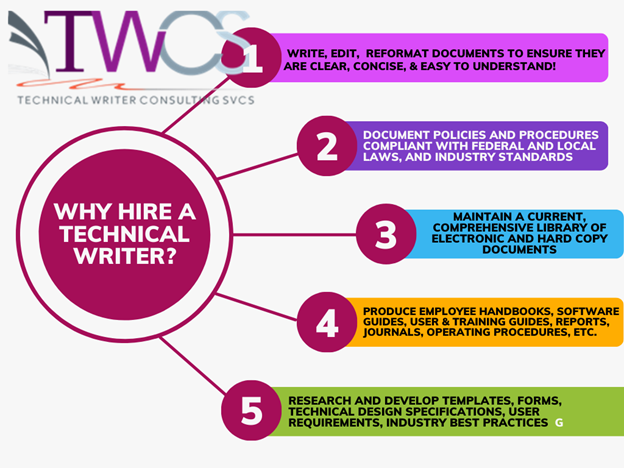
Technical Writer Consulting Services’ (TWCS) network of exceptional technical writers and business analyst professionals is available to help you meet the ever-increasing demands. These include comprehensive, documented policies, processes, and procedures.
TWCS collaborates with your team to develop a systematic approach for improving and enhancing your mission-critical systems, processes, and operations. We follow the Business Process Reengineering (BPR) methodology. Thus, our process involves assessing the current state, defining requirements and objectives, and eliminating redundancies. We also minimize risk, improve performance, and suggest future enhancements. Moreover, we help reduce overall costs. TWCS’s professionals help you meet the increasing demands for comprehensive, documented policies, processes, and procedures that are necessary. These validate your organization’s compliance with applicable laws, meet audit and cybersecurity requirements, and ensure functional policies.
Join TWCS on our new YouTube channel @writetechs, where we will discuss and give more in-depth guidance on developing policies and procedures.
Overall, technical writing helps build a strong foundation for your business. It helps you to communicate effectively, ensure consistent and efficient operations, incorporate industry best practices, facilitate training, and comply with applicable laws and regulations.