In industrial IoT, digital security directly affects physical operations and safety: a cyber breach can halt an entire factory floor or compromise machinery. To avoid such consequences, security has to be designed into the system architecture from the ground up, including hardware roots of trust, firmware integrity, secure edge-to-cloud communication, and long-term IIoT maintenance.
In this article, we leverage Lemberg Solutions’ embedded software development and engineering expertise to discuss cybersecurity risks across the full IoT system — devices and firmware, connectivity, infrastructure, and its lifecycle. We’ll explain not only what can go wrong but also how an experienced embedded software development company can help reduce the risk: the technical measures, development practices, and relevant compliance considerations.
Key Takeaways
- Industrial IoT security is crucial; breaches can disrupt operations and endanger safety.
- Identify and prioritize cybersecurity risks using structured assessments and threat modeling.
- Top threats include compromised legacy devices, insecure communication, third-party vulnerabilities, and poor monitoring.
- Implement a Security-by-Design approach in embedded software development for resilience against attacks.
- Maintain cybersecurity throughout the device lifecycle with continuous monitoring, secure updates, and proper decommissioning.
Table of contents
Identifying and Prioritizing Industrial IoT Security Risks
Identifying cybersecurity risks in industrial IoT isn’t something you can accomplish with a quick automated vulnerability scan. It is a structured, step-by-step security assessment that helps understand where the system can be attacked and what the consequences would be.
Step 1: Map the complete attack surface. Analyze every component of your system — MCUs, firmware, sensors, third-party services — and for each, specify the data they process or transfer, who can access them, how, and what happens if this component is compromised.
Step 2: Threat modeling. Consider different attack scenarios like gaining access to a device, compromising a network connection, or exploiting a vulnerable library, paying attention to their operational and safety impact. For example, manipulation of a temperature sensor may turn out far more serious than simply exposing telemetry data.
Step 3: Examine the implementation for concrete weaknesses. For embedded system security, it’s particularly important to check secure boot, firmware signing, debug interfaces, hardcoded credentials, key storage, privilege boundaries, memory-safety issues, and exposed network services.
For industrial environments, the best strategy is to prioritize cybersecurity risks based on potential operational impact, not simply on how common an attack is. For example, a remotely exploitable vulnerability that can stop a production line or manipulate an actuator should receive much more attention than a low-impact information disclosure on an isolated device, although it’s more common. This makes sense as putting out a higher-priority fire automatically makes lower-level risks manageable, while ignoring them makes addressing secondary outbreaks pointless.
Top Cybersecurity Risks for IIoT applications
Here are the top 5 risks you can identify, listed based on the severity of their impact on operations, safety, data integrity, and business continuity for industrial IoT applications.
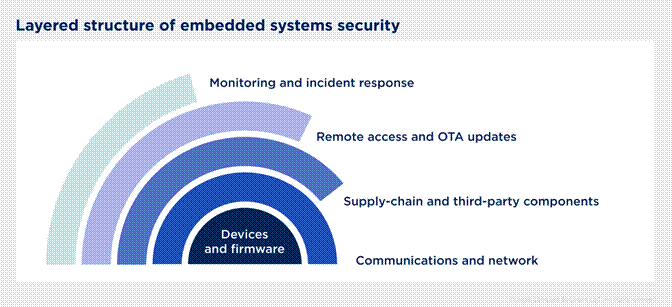
- Compromised legacy devices and firmware
Industrial devices are designed to work for years. Over time, their legacy code accumulates vulnerabilities while vendors stop releasing security patches. Older devices often have too little processing power to run modern security controls. When deployed in unmonitored, remote, or field-accessible locations, such systems are easily exploitable, allowing an attacker to gain device access or install malicious firmware, eventually manipulating sensors, actuators, or the entire industrial process.
- Insecure communication and network access
IoT devices continuously exchange data with gateways, other machines, and cloud systems. If the connected elements have over-privileged access rights, static or hardcoded credentials, or insecure storage, they automatically become low-hanging fruit for hackers. Compromising a single device, for example by stealing unprotected access credentials, provides the attacker with a way to intrude your entire backend infrastructure.
- Supply-chain and third-party software vulnerabilities
IoT products rarely consist entirely of code developed by the engineering team — they also include RTOS, Linux packages, connectivity stacks, third-party libraries, and so on. So even if your proprietary code is secure, but there’s a vulnerability or malicious component somewhere in the stack, your entire production fleet becomes under threat.
- Vulnerable remote access and OTA update mechanisms
Remote management is essential for industrial deployments, but without a fail-safe OTA mechanism, it becomes a convenient attack surface. With stolen update packages or device-management APIs, an attacker gains control over thousands of devices simultaneously.
- Poor monitoring and incident response
If the IoT system manufacturer hasn’t taken care of the product lifecycle, deem your industrial system under continuous threat. Without proper vulnerability monitoring, fleet-wide device inventory, and a defined incident-response/patching process, you won’t be able to detect suspicious behavior, identify affected devices, or push a security fix.
An important point is that these risks are interconnected. For example, a vulnerable third-party library becomes more dangerous if devices have no secure OTA mechanism than with it. So, a secure-by-design architecture and a secure development lifecycle around the entire IIoT product provide the means to protect every link in the chain.
Building Security into Embedded Software Development
When it comes to embedded systems, the Security-by-Design approach is the gold standard for ensuring they are protected against outside threats. Proactively weaving safety into the software’s DNA from the beginning has proven to be the most cost-saving and efficient way to prevent attacks or data leaks. Instead of relying on the surrounding network, secure software makes the device itself resistant to compromise.
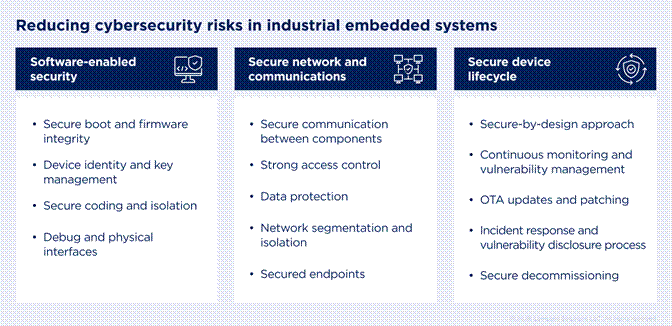
Here are the key layers of software-enabled security in embedded systems:
- Secure boot and firmware integrity. Using cryptographic signatures and a hardware root of trust, the system verifies the firmware source before executing it. This layer disarms an attacker trying to pull off a rootkit attack replacing legitimate firmware with a malicious version.
- Strong device identity and key management. Unique identity for every device and cryptographic credentials ensure they can be trusted by other devices on the network. Keys should be protected using special hardware means, such as a secure element or MCU security features.
- Secure coding and isolation. Development practices should address known security risks like memory corruption, input validation, privilege escalation, unsafe interfaces, and vulnerable third-party libraries. Separating critical functions into isolated processes or security domains provides additional protection.
- Attention to debug and physical interfaces. Make sure to disable, restrict, or authenticate JTAG, SWD, UART, USB, or bootloader modes appropriately when transitioning to production. While useful during development, these interfaces can later become convenient attack vectors.
Securing Devices, Data, and IIoT Communications
Moving to the network level, we want to prevent attacks exploiting the connections around an IIoT device to intercept data, impersonate other devices, or move deeper into the industrial environment. In this section, we discuss efficient measures to address such risks.
Secure communication between devices, gateways, cloud services, and enterprise systems
Industrial protocols such as MQTT, OPC UA, Modbus, or proprietary industrial protocols may connect systems with very different security capabilities. Therefore, it’s important that data be encrypted in transit using industry-standard protocols like TLS, while devices and services authenticate each other. In legacy systems, additional protection might be needed at the gateway or network layer.
Strong identity and access control
The principle of least privilege limits the damage if an account, device, or service is compromised. When a device, service, user, and application has a defined, unique identity and only has the permissions it actually needs, an attacker cannot move deeper into the system, even if they gained access to one of its components.
Data protection
Sensitive industrial data should be protected both in transit and at rest, with proper encryption-key management and access controls. You also need to think about data integrity: in an industrial system, even the fact of a temperature reading manipulation can have dramatic consequences. Audit trails and tamper-resistant logging can help establish what happened when something goes wrong.
Network segmentation and isolation
Field devices shouldn’t sit on the same network as critical controls. By segmenting industrial networks with firewalls, gateways, access-control policies, and carefully controlled communication paths, you limit a potential attack. For example, having compromised an IoT sensor, an attacker still won’t be able to directly access a production-control system.
Secured endpoints
Every connection point, like an API, cloud platform, gateway, or web interface, can become potential attack surfaces. That means each of them should be secured: with API authentication and authorization, input validation, secrets management, vulnerability management, security logging, and continuous monitoring. For an IIoT deployment, it’s also good to have visibility into which devices are connected, what they are communicating with, and whether their behavior suddenly deviates from the expected pattern.
Maintaining Cybersecurity Throughout the Device Lifecycle
An IIoT device is not secure just because it was secure when it left the factory. Deployed for 5, 10, or even 15+ years, industrial devices inevitably become vulnerable. This means cybersecurity has to be managed throughout the entire device lifecycle: from design and manufacturing through deployment, operation, maintenance, and eventual decommissioning.
During design and development, security requirements, threat modeling, and security architecture take place before implementation. An inventory of third-party components and dependencies — an SBOM (Software Bill of Materials) — provides clear visibility into the software inside the device and helps determine whether (and how) a newly discovered vulnerability affects the product.
When deployed, the system should be under continuous monitoring and vulnerability management. These activities inform you which devices are in the field, what firmware versions they run, what credentials or certificates they use, and which devices have become vulnerable. Without accurate fleet visibility, even having a security patch is not enough, as you may not know which customers or devices need it.
In production, secure OTA updates and a defined patching process provide a controlled mechanism for developing, testing, signing, distributing, and monitoring device updates. For an industrial system, updates also need to consider operational constraints: you may not be able to reboot a production controller immediately or update thousands of devices simultaneously. Thus, safe rollout strategies, staged deployment, rollback mechanisms, and recovery procedures become part of the entire system’s cybersecurity.
For incident response and vulnerability disclosure, manufacturers should have in place a defined process for assessing the severity of the issue, identifying affected products, developing a fix, communicating with customers, and deploying the remediation. This is one of the areas where long-term embedded software development services matter considerably.
Secure decommissioning requires that an IIoT device’s credentials, certificates, stored data, and access rights should be revoked or securely erased. Otherwise, an old device can remain an entry point into the organization’s infrastructure even after it has stopped performing its intended function.
Conclusion
Industrial embedded systems security is a multi-layered, lifecycle-long responsibility. Its goal is to protect IIoT devices, data, and industrial infrastructure from unauthorized access, manipulation, and disruption while limiting the impact of any potential breach. This requires security to be built into the technology stack and supported by controls that protect communications, services, and the broader industrial environment. Ultimately, the objective is not to make an IIoT system “perfectly secure,” but to make it resistant to attacks, resilient when vulnerabilities emerge, and manageable throughout its operational lifetime.
Security, however, does not end when the product is shipped. Industrial devices often operate for many years, so organizations need continuous vulnerability monitoring, SBOM and dependency management, secure OTA updates, fleet visibility, incident response, and secure decommissioning. The choice of an embedded engineering vendor, therefore, is a strategic decision: the right partner should be able to identify risks and build security into the device, its network, and entire lifecycle.