Introduction
As the core foundation of modern digital services, software has reshaped the operational logic of four major industries: healthcare, finance, retail, and education. In the vertical scenario of online ophthalmic care, software not only supports merchants in handling complex operational tasks, but also delivers convenient digital service experiences for users. Behind the user-facing front ends of websites
and mobile apps, back-end systems take on core functions including running automated workflows and organizing data. To address two core demands related to monthly disposable contact lenses their fixed replacement cycle and precise prescription management software can be adapted to fit these needs through four optimization measures. These systems only provide support for routine administrative
work, and do not replace professional ophthalmic care. This paper explores the enabling value of five types of software technologies, including cloud computing and artificial intelligence.
Table of contents
- Introduction
- Why Software Matters in Monthly Contact Lens Management
- Integrated Software Platforms for Online Eye Care
- Automating Monthly Contact Lens Workflows
- Artificial Intelligence in Online Eye Care Software
- Cloud Computing Improves Data Management
- eCommerce Technology Behind Online Eye Care
- Mobile Applications and Digital Accessibility
- Data Analytics Supports Better Decision-Making
- Cybersecurity Protects Customer Information
- The Future of Software Technology in Online Eye Care
- Conclusion
Why Software Matters in Monthly Contact Lens Management
Monthly contact lenses differ from daily disposable lenses because they require ongoing management. Users must remember replacement schedules, maintain valid prescriptions, reorder products before supplies run out, and keep track of purchase history. Managing these tasks manually becomes inconvenient, particularly for customers with busy schedules.
Modern software platforms simplify these recurring processes by automating routine workflows. Instead of relying on spreadsheets or manual customer records, businesses can use centralized systems that monitor customer activity and trigger appropriate actions throughout the purchasing lifecycle.
Integrated Software Platforms for Online Eye Care
Running an online eye care business involves coordinating multiple systems simultaneously. Customer information, prescription records, product inventory, payment processing, shipping, customer support, and marketing all generate data that must remain synchronized.
Modern software platforms integrate these functions into a single ecosystem rather than relying on disconnected applications. Integration reduces duplicate data entry, minimizes administrative errors, and allows teams to manage operations through centralized dashboards.
An integrated platform commonly supports:
- Customer relationship management (CRM)
- Inventory management
- Order processing
- Payment gateways
- Shipping integrations
- Email and SMS communication
- Customer support systems
- Analytics dashboards
This unified approach enables businesses to scale operations while maintaining consistent service quality.
Automating Monthly Contact Lens Workflows
Automation is one of the most valuable technologies in modern eye care software. Monthly contact lens users typically reorder products on predictable schedules, making automation particularly effective.
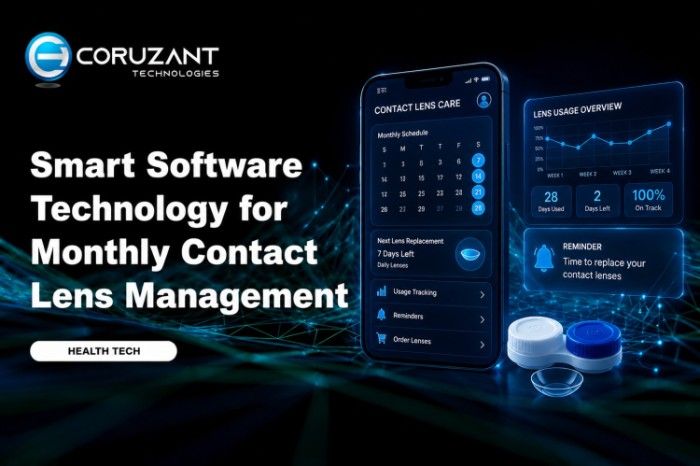
Instead of requiring customers to remember replacement dates, software can automatically generate reminders based on previous purchases or subscription schedules. Automated workflows reduce missed replacements and simplify repeat ordering.
Common automation features include:
- Replacement reminders
- Prescription renewal notifications
- Automatic reorder suggestions
- Subscription billing
- Shipping confirmations
- Delivery tracking updates
- Customer follow-up messages
For businesses, automation reduces repetitive administrative work and allows support teams to focus on more complex customer needs.
Artificial Intelligence in Online Eye Care Software
Artificial intelligence has become an important enhancement to modern software platforms. Rather than replacing healthcare professionals, AI helps software process information more efficiently, improve user experiences, and automate routine interactions.
Intelligent Search and Product Discovery
AI-powered search helps users quickly locate products based on prescription details, brand preferences, or previous purchasing behavior. Instead of browsing extensive product catalogs, customers receive more relevant search results and personalized recommendations.
Personalized Reorder Experiences
Machine learning algorithms can analyze purchase history to estimate when customers are likely to need replacement lenses. Software can then generate timely reorder suggestions that align with expected usage patterns.
For monthly contact lens users, this creates a more convenient purchasing experience while helping businesses maintain customer engagement.
AI-Powered Customer Support
Many online eye care platforms now use AI-powered chat assistants to answer common customer questions, including:
- Order status
- Shipping updates
- Account management
- Product availability
- Basic lens care information
By handling routine inquiries, AI allows customer service representatives to focus on cases requiring human expertise.
Human Expertise Remains Essential
Although AI improves operational efficiency, healthcare decisions should continue to rely on qualified eye care professionals. Software supports administrative and informational tasks, while clinical evaluations, prescriptions, and treatment decisions remain the responsibility of licensed practitioners.
Cloud Computing Improves Data Management
Cloud computing has fundamentally changed how online eye care platforms manage information. Instead of storing data on individual office computers, organizations can securely maintain customer records, prescriptions, transaction histories, and operational data within centralized cloud environments.
Cloud infrastructure provides several advantages:
| Software Component | Purpose |
| Cloud storage | Stores customer and operational data securely |
| Customer database | Maintains account information and preferences |
| Prescription management | Organizes digital prescription records |
| Order management | Tracks purchases and shipping status |
| Communication systems | Coordinates customer notifications |
Cloud-based systems also improve collaboration by allowing different software applications to exchange information automatically. For example, when a customer places a new order, inventory, payment processing, shipping, and customer account systems can update simultaneously without manual intervention.
eCommerce Technology Behind Online Eye Care
Online eye care platforms rely on sophisticated eCommerce software to coordinate every stage of the purchasing process. Behind a simple checkout interface, software manages:
- Product inventory
- Pricing
- Prescription verification workflows
- Secure payment processing
- Fraud prevention
- Shipping coordination
- Customer notifications
- Order history
For monthly contact lens customers, recurring ordering features are particularly valuable. Software can maintain subscription schedules, generate recurring invoices, notify customers before shipment, and simplify repeat purchases with minimal user effort. These automated workflows improve operational efficiency while creating a more seamless customer experience.
Mobile Applications and Digital Accessibility
Mobile applications have become a primary interaction point for many online eye care customers. A well-designed application allows users to access important account information without navigating multiple systems.
Analytics software enables businesses to evaluate customer purchasing behavior, product demand, subscription renewal rates, search activity, customer support trends, website performance, and mobile application usage. By analyzing these metrics together, organizations can identify opportunities to improve user experience, optimize software performance, and make more informed operational decisions.
From a software engineering perspective, successful applications prioritize usability over excessive functionality. Simple, intuitive interfaces often produce better customer satisfaction than feature-heavy designs that increase complexity.
Data Analytics Supports Better Decision-Making
Every interaction on a digital eye care platform generates valuable operational data. Analytics software enables organizations to transform this information into actionable insights.
Businesses can analyze:
- Customer purchasing behavior
- Product demand
- Subscription renewal rates
- Search activity
- Customer support trends
- Website performance
- Mobile application usage
These insights help software teams optimize platform performance while allowing businesses to make evidence-based decisions instead of relying solely on assumptions.
Predictive analytics can also improve inventory planning by forecasting demand for popular monthly contact lens products, reducing stock shortages and improving order fulfillment.
Cybersecurity Protects Customer Information
Because online eye care platforms process customer identities, payment information, and prescription records, cybersecurity is an essential component of software development.
Modern platforms typically implement multiple security layers, including data encryption, multi-factor authentication, secure APIs, role-based access controls, continuous software updates, security monitoring, and privacy-focused development practices. Together, these technologies help protect sensitive customer information, reduce cybersecurity risks, and support compliance with data protection requirements.
Strong cybersecurity protects customer trust while helping organizations comply with applicable data protection regulations.
The Future of Software Technology in Online Eye Care
Software technology continues to evolve as cloud computing, AI, automation, and data analytics become more sophisticated. Future online eye care platforms are expected to provide increasingly connected digital ecosystems that simplify routine administrative tasks while supporting personalized customer experiences.
Emerging technologies may further improve predictive reorder scheduling, intelligent inventory management, AI-assisted customer support, cross-platform integration, personalized digital services, and operational analytics. As these technologies continue to mature, online eye care platforms will become increasingly efficient, scalable, and capable of delivering more personalized digital experiences while maintaining simplicity and security.
Despite these advancements, the most successful software solutions will remain focused on solving practical business problems, improving usability, and maintaining strong security standards.
Conclusion
Software technology has become an essential component of modern online eye care platforms. From automating monthly contact lens management to integrating customer accounts, cloud infrastructure, AI-powered support, analytics, and cybersecurity, software enables businesses to deliver more efficient and reliable digital services.
For software professionals, online eye care demonstrates how intelligent system design can simplify recurring workflows, improve operational efficiency, and enhance customer experiences without replacing professional healthcare expertise. As digital health platforms continue to evolve, scalable, secure, and user-centered software will remain the foundation of effective online eye care solutions.