Almost every guide to fintech social media marketing gives the same advice: optimise the bio, post educational carousels, run polls, add a call to action, collaborate with finance influencers. None of it mentions that for a regulated firm, each of those posts is a communication a regulator can ask to see.
That omission is the difference between a marketing plan and an enforcement exposure. The tactics are mostly fine. The workflow around them is what separates firms that grow on these platforms from firms that get examined over them.
Key Takeaways
- A post reaching more than 25 retail investors in 30 days is a retail communication.
- Retail communications generally need principal approval before publication, not after.
- Sharing or liking third-party content can make that content yours under adoption and entanglement.
- Records include comments and replies, not just the post.
- Paid creator posts are the firm’s communications and the firm carries the obligation.
Your Posts Are Regulated Communications
Which framework applies depends on what the business does, and most fintechs sit under more than one.
Broker-dealers fall under FINRA Rule 2210, which governs communications with the public and requires that they rest on principles of fair dealing and good faith, be fair and balanced, provide a sound basis for evaluating the facts, and include the material facts needed to avoid being misleading. It prohibits false, promissory or exaggerated claims.
Registered investment advisers fall under the SEC’s Marketing Rule, Advisers Act Rule 206(4)-1, with recordkeeping under Rule 204-2. Dual registrants deal with both. UK firms operate under the FCA financial promotions regime with the Consumer Duty on top, and crypto services in the EU face MiCA.
A fintech that is not itself registered may still be captured, either through a bank partner’s obligations or because the activity being promoted is regulated regardless of who is promoting it. The question is never whether it feels like marketing. It is what the content says and who receives it.
The Line Sits at 25 People
Rule 2210 splits communications by audience size, and the threshold is lower than most marketers expect.
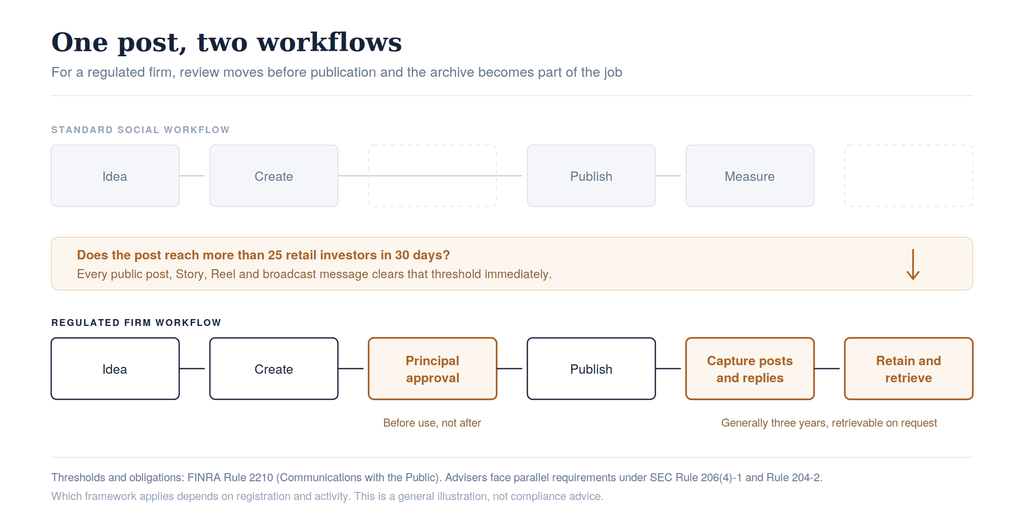
Correspondence means a written communication made available to 25 or fewer retail investors in any 30 calendar-day period. Anything reaching more than 25 is a retail communication, which generally requires approval by an appropriately qualified registered principal before it is used, and must be retained with a record of who approved it and when.
Every public post clears 25 immediately. So does a Story, a Reel, and a broadcast channel message. The practical consequence is that the pre-approval workflow has to run at the speed of social publishing, which is the operational problem nobody solves by buying a scheduler.
Where the Standard Advice Creates Exposure
Take the recommendations that appear in every guide and read them against the rules.
“DM me for a free consultation” in the bio. Fine as a CTA, and it moves the conversation into a channel where replies are business communications that must be captured and retained. Most firms have retention on email and nothing on Instagram Direct.
Testimonials and client success stories. Permitted for advisers under the Marketing Rule, subject to conditions and disclosures. The SEC’s Division of Examinations published a risk alert in December 2025 on persistent failures to make required disclosures at the point of dissemination, specifically across websites, social media, lead-generation firms and referral networks. Point of dissemination means in the post, not in a linked policy.
Collaborations with finance influencers. A paid creator’s post about your firm is treated as the firm’s own communication, which the firm must review, approve and retain. The material connection has to be disclosed, with the FTC’s endorsement rules layered on top. In September 2024 the SEC settled with nine investment advisers over Marketing Rule violations including unsubstantiated statements and undisclosed endorsements.
Bite-sized actionable financial advice. The format that performs best is the one that most easily fails the fair-and-balanced standard, because compressing a recommendation into fifteen seconds usually means dropping the qualifications that make it accurate.
Giveaways. Common in generic guides, awkward in regulated finance, and worth running past compliance before design rather than after.
Likes and Shares Can Become Your Content
The provision that catches firms with otherwise decent processes. The adoption and entanglement doctrines mean third-party content can become the firm’s own communication.
If a representative shares an article whose claims would breach the content standards had the firm made them, that share is treated as the firm making them. Liking, resharing and quote-posting all carry the same risk. Using a personal account to discuss the firm’s products brings that account under supervision too, which is the rule people find hardest to accept.
Written policy on what representatives may share, and from whom, is worth more than a content calendar here.
The Records Include the Replies
Social posts are business records and must be captured and retained in the same way as any other written communication, generally for at least three years and retrievable on request.
Retention covers comments and replies that constitute business communications, not only the original post. A comment thread where a representative answers a question about a product is a record. Deleting it does not solve the problem, it creates a second one.
Archiving tools exist for this and connect through the platforms’ official APIs. If your firm engages on social media and cannot produce a comment thread from eighteen months ago, that is the gap to close before the next campaign, not after it. It is also a reason to be careful about the growth vendors that target this sector heavily, since a regulated firm caught with purchased engagement has a supervision problem on top of everything covered in what those services actually sell.
One Change Worth Tracking
Rule 2210 currently prohibits projections of performance and targeted returns in communications with the public, subject to limited exceptions. That has long sat awkwardly against the Marketing Rule, which permits advisers to present hypothetical performance under conditions.
On 10 February 2026, FINRA filed proposed amendments with the SEC that would allow members to present projected performance or targeted returns subject to conditions requiring a sound basis. It is a proposal rather than a rule, the general standards would continue to apply regardless, and nothing about it changes what you can publish today. Worth watching if performance content is central to your marketing.
What Works Inside the Constraints
The constraints point toward a specific kind of content, and it happens to be the kind that performs.
Explanatory content about how something works carries far less regulatory weight than recommendations about what to buy, and it is what people actually search for. Process transparency, showing how a decision gets made rather than what the decision should be, builds credibility without making a claim that needs substantiating.
Batch production also fits the approval cycle better than reactive posting. A month of content reviewed in one pass is workable. Chasing a trending audio on a Tuesday afternoon is not, and trying to make it work is where most compliance failures start.
Conclusion
Fintech social media marketing is not harder than any other kind. It is differently shaped, because the review step sits before publication rather than after and the archive matters as much as the calendar.
Firms that treat compliance as the thing slowing marketing down tend to produce both bad marketing and bad compliance. Firms that design the workflow around pre-approval and retention from the start find the constraint pushes them toward explanatory content, which is what performs on these platforms anyway.
Read Next
- Engagement Rate vs Follower Count: What Brands Actually Pay For
- What an SMM Panel Actually Is (And Why It Isn’t a Scheduling Tool)
- Building an Instagram Community: Why It Now Happens in the DMs