The modern enterprise is operating under a paradox of visibility. Organizations spend millions of dollars mapping out their ideal business architectures, implementing standardized enterprise resource planning (ERP) systems, and drafting exhaustive standard operating procedures. Yet, the moment a human operator sits down in front of a dual-monitor workstation, the pristine clarity of the corporate blueprint dissolves into a complex web. Undocumented workarounds, spreadsheet cross-connections, and split-second manual interventions take over the actual flow of work. In fact, employees spend approximately 20–28% of their workweek searching for information across fragmented systems. Executives look at high-level dashboards and assume operations are following the intended path, completely unaware of the invisible cognitive load their workforce must carry to keep those systems functioning.
This hidden layer of daily activity represents the true execution reality of any business. When a system fails to deliver on its promised efficiency, leaders traditionally blame the software or demand more training for the staff. However, the root cause is almost always an unmapped delta between how leadership thinks. To build a resilient corporate infrastructure, organizations must move past static diagrams and capture the fluid, real-time context of everyday business interactions.
Key Takeaways
- Organizations face a visibility paradox; despite investing in standardized systems, real workflows often diverge from plans.
- Traditional event logging fails to capture vital human interactions and undocumented workarounds in business processes.
- Task mining software provides insights into employee interactions, revealing hidden bottlenecks and operational challenges.
- Combining event logs with user interactions creates a Digital Twin, enabling predictive simulations and informed decision-making.
- A culture shift towards valuing workarounds as feedback fosters agility, resilience, and innovation in organizations.
Table of contents
The Limitation of Traditional Event Logging
For years, process mining was heralded as the definitive answer to enterprise opacity. By ingestion of transactional event logs from core applications, security and operations teams could reconstruct a visual lifecycle of business processes. This approach works remarkably well for structured, server-side data movements, such as tracking when an invoice is generated or when a cloud database updates. It creates an objective map based on hard data rather than subjective manual surveys.
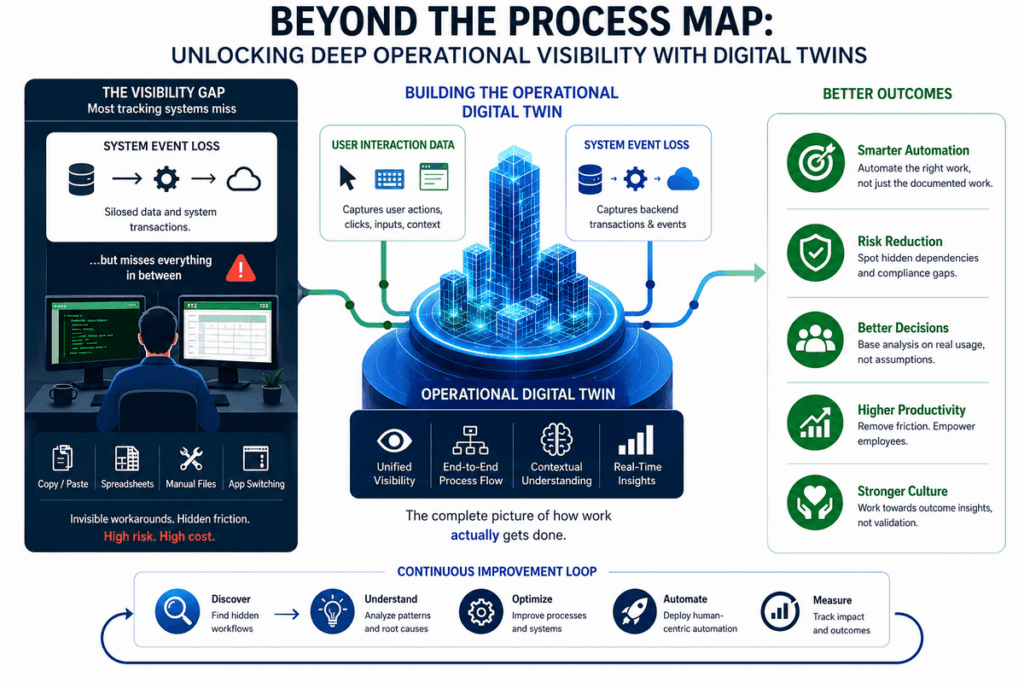
The challenge is that server logs only catch the moments when a worker interacts directly with a major enterprise platform. They miss everything that happens in the white spaces between those systems. When an employee copies data from a legacy terminal, pastes it into a local spreadsheet to format it, runs a custom macro, and then uploads the result to a cloud portal, the traditional log sees two separate, disconnected events. It leaves the entire middle section of the actual human problem-solving and operational friction completely dark.
Illuminating the Workforce Blindspots
To capture those critical white spaces, modern digital transformation strategies require visibility into the exact interface patterns used by employees. This is where deploying advanced task mining software becomes an essential architectural choice. By securely observing user-level interactions such as clicks, scrolls, data inputs, and application switches, this category of tooling captures the micro-steps that server logs miss entirely.
Instead of relying on guesswork, operations leaders can see exactly where employees encounter repetitive bottlenecks. They can also understand why employees resort to unmonitored shadow IT solutions. When applied ethically and transparently, with strict data-masking protocols to protect privacy, this granular discovery turns invisible work into structured, actionable insights. It reveals the undocumented exceptions and manual patches that keep the enterprise running day to day.
Constructing the Operational Digital Twin
The true breakthrough occurs when an organization bridges the gap between macro-level event logs and micro-level user interactions. Combining these two distinct datasets allows enterprises to build a comprehensive operational digital twin. This twin is a dynamic, living simulation of the company’s workflows, reflecting both systemic transaction health and human behavioral realities simultaneously.
With an operational digital twin, a company can run predictive simulations before making sweeping architectural changes. If an IT department plans to deprecate a legacy application. They no longer have to cross their fingers and hope they did not break an undocumented departmental process. The twin can immediately flag how many secondary workflows rely on that specific interface, showing exactly which team. This proactive intelligence eliminates the costly cycle of deploying an enterprise solution only to quietly roll it back months.
Designing Human-Centric Automation
This unified visibility layer fundamentally changes how organizations approach automation and digital optimization. Historically, robotic process automation (RPA) and AI agent deployments failed because they were wired into unstable, poorly understood processes. Teams automated the idealized workflow found in the corporate handbook rather than the chaotic, exception-heavy workflow that existed in reality. The automation would inevitably break the first time it encountered a real-world variation that nobody had bothered to document.
By leveraging a complete operational map, engineering teams can design automations that work alongside human judgment rather than trying to overwrite it blindly. They can identify the exact decision boundaries where an automated script can handle repetitive data entry and do so precisely. Automation transitions from a disruptive, top-down mandate into an organic utility that removes friction from an employee’s day.
Cultivating a Resilient Operational Culture
Ultimately, closing the enterprise execution gap requires a shift in how corporate leadership views deviations from standard procedures. Workarounds and ad-hoc spreadsheets are rarely created out of malice or laziness; they are created by productive employees trying to solve problems in real-time despite rigid or broken software infrastructure. Treating these deviations as compliance failures to be punished only incentivizes teams to hide their shadow workflows deeper out of sight.
When organizations use data to gain a transparent view of real-time operations, they can treat workarounds as valuable feedback indicators. A recurring manual intervention points directly to a missing feature in a core platform or an unrealistic step in a corporate policy. By building strong partnerships between technical teams and operational leaders. These insights can be woven directly back into the continuous improvement lifecycle. The organization becomes uniquely agile, shifting away from rigid, outdated control mechanisms. This is moving toward a culture of proactive, data-driven resilience that keeps digital assets secure while allowing innovation to move at maximum speed.