Any serious Evertas review has to start with the number that created the company’s market: crypto losses hit $1.315 billion across 344 on-chain incidents in the first half of 2026 (Source: Forbes). Almost none of that was insured. The protection gap is the product.
Evertas underwrites digital asset risk for institutions. Not a wallet, not a monitoring tool, not a mutual. An actual insurance company with policy paper behind it, writing coverage for custodians, exchanges, funds, and mining operators who cannot get a traditional carrier to look at them. If you run an operation holding other people’s crypto, this is one of a very short list of places you can go.
Key Takeaways
- Evertas underwrites institutional crypto risk as a Lloyd’s coverholder.
- Seven policy types span theft, insider fraud, hardware damage, and D&O.
- Coverage runs up to $600 million on hardware property declarations.
- Policies sell only through licensed brokers, and pricing is never public.
- Retail holders should look at Coincover or AnchorWatch instead.
Table of contents
What Evertas Actually Does
Founded in 2017 and based in Chicago, Evertas built itself around a specific bet: that crypto risk is insurable if the people underwriting it understand cold storage, key ceremonies, and slashing conditions rather than treating a custodian like a warehouse full of jewelry.
That bet took a while to pay off. Traditional carriers avoided the sector for years, partly because the assets were young and volatile, partly because nobody inside a legacy underwriting shop could tell a well-run multisig setup from a disaster waiting to happen. Evertas positioned itself as the translator. Its underwriters assess the technical controls, then convert what they find into a conventional policy form that a reinsurer will actually stand behind.
The company has raised $22.6 million across three rounds, including a $14 million Series A led by Polychain Capital. Headcount sits in the 11 to 50 range. It is a small firm doing a job that requires enormous balance sheets, which is why the backing arrangement matters more than the headcount does.
The Lloyd’s Position
Evertas became a Lloyd’s of London coverholder in early 2022, the first for digital wallet coverage. Its policies are underwritten by Arch, a Lloyd’s syndicate member, and by other insurers. Evertas has also held a Bermuda Monetary Authority Class 3A insurer license.
Coverholder status is the part institutional buyers care about. It means Evertas has delegated authority to write and service policies directly rather than shopping each risk around, which compresses the timeline from months to something closer to weeks. Policies carry A- (IX, Excellent) or A+ (XV, Superior) creditworthiness ratings from AM Best and Standard & Poor’s. For a fund whose LPs ask who is behind the paper, those letters do real work.
Policy Types and Coverage Limits
Seven products, and they cover more ground than most people assume crypto insurance touches.
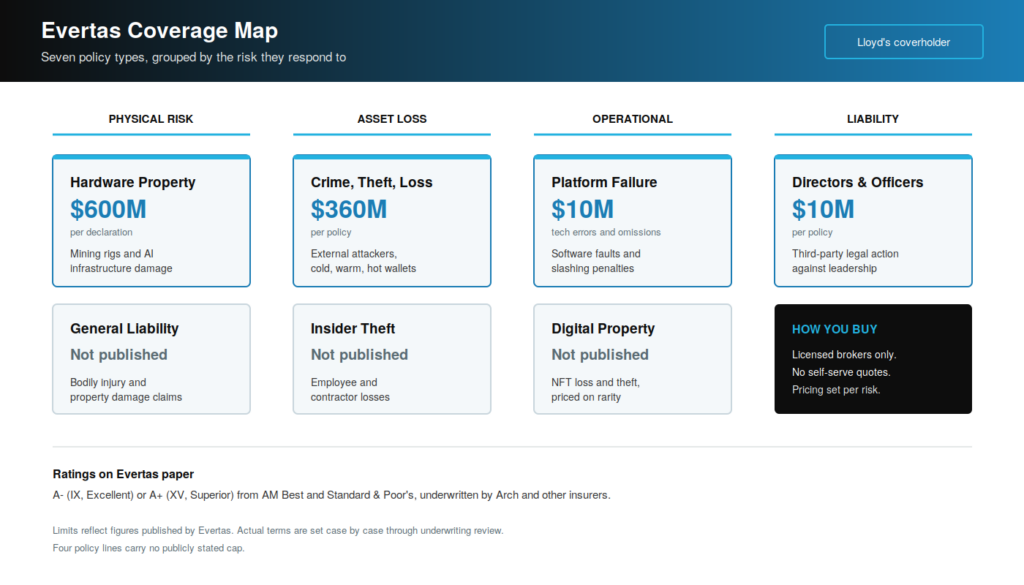
Hardware Property. Physical damage coverage for mining hardware and AI infrastructure, written up to $600 million per declaration. Built for industrial miners, co-location providers, and hosting operators. If you have modeled the real ROI behind crypto mining operations, you already know a fire or flood at a hosting facility can erase a year of margin.
Crime, Theft and Loss. The flagship. Covers digital assets and cash stolen or destroyed by external attackers, with terms that vary across cold, warm, and hot wallet architectures. Evertas markets limits up to $360 million per policy here.
Insider Theft and Loss. Fidelity coverage for losses caused by employees and contractors. Underrated. A meaningful share of custodial failures trace back to someone with legitimate access.
Platform Failure. Technology errors and omissions, up to $10 million. This is the slashing policy. If a validator client misbehaves or a software fault triggers a penalty, this is the line that responds.
Directors and Officers. Up to $10 million against third-party legal action aimed at company leadership. In an enforcement-heavy sector, expect this to be a condition of hiring anyone senior.
Digital Property. NFT loss and theft coverage, with valuation handled through rarity and price analysis.
Commercial General Liability. Standard bodily injury and property damage cover, added for operators running physical sites.
The spread matters. Most competitors sell one narrow thing. Evertas is closer to a full program, which is exactly what a custodian needs when a broker asks them to consolidate.
Who Evertas Is Built For
Institutions. Full stop.
Exchanges, qualified custodians, crypto funds, family offices, traditional financial institutions moving into digital assets, industrial mining operations, and increasingly AI infrastructure operators. The company added AI data center hardware to its property line, which tracks: the risk profile of a warehouse full of GPUs is not far off a warehouse full of ASICs.
There is a regulatory pull here too. Under MiCA, European crypto asset service providers face prudential requirements that insurance can help satisfy, and brokers have built products specifically to address that. If you are licensing in the EU, coverage stops being optional risk management and starts being a filing requirement.
Retail holders are not the customer. If you are protecting a personal wallet, this is the wrong door.
Pricing and How You Buy
Evertas does not publish pricing. Nothing on the site, nothing in any filing, no rate card. Every policy is bespoke, priced off an underwriting review of your specific controls.
Policies are issued only through licensed brokers. Evertas has posted a fraud notice on its own site making that explicit, which tells you something about how many people have been approached by fake Evertas agents. There is no self-serve path, no online quote, no instant bind. You engage a broker, you submit to a technical review, you get terms.
That process is slower than buying software. It is also the reason the coverage is credible. The underwriting review is a real audit of your key management, business continuity, and storage architecture, similar in spirit to the security features modern trading platforms use to demonstrate operational maturity. Firms that pass tend to be firms worth insuring.
Where Evertas Is Strong
The capacity is the headline. Getting a full high-limit underwriting from one source, instead of stitching together a tower across five carriers, saves months. For a growing custodian, it also means the policy can scale without a fresh underwriting cycle each time assets under custody climb.
Product breadth is the second advantage. Hardware, crime, insider, tech E&O, D&O, NFTs, and general liability from one counterparty is rare in this sector. Consolidation reduces the coverage gaps that appear at the seams between policies, which is where claims usually die.
Third, the paper is rated and the regulatory posture is clean. Lloyd’s coverholder status plus A-rated capacity is a materially different proposition from a discretionary protection fund or an on-chain pool whose payout capacity depends on token holders voting.
And the underwriting is genuinely crypto-native. The team knows what a slashing event is without needing it explained twice.
Where It Falls Short
The public numbers do not line up cleanly. Coverage limits reported in 2023 press coverage sat at $420 million on custodial assets. The current site says $360 million per policy in one place and $600 million in another, with the higher figure attached to hardware property. Some of that is product structure rather than contradiction, but a buyer reading the marketing will need a broker to explain which number applies to them. For a company selling certainty, the messaging is muddled.
The tech E&O and D&O limits are small. Ten million dollars is a rounding error against the losses a mid-sized protocol can absorb from a software fault. If platform failure is your primary exposure, Evertas caps out well below where the risk lives.
Nothing is self-serve, and nothing is fast. Broker-only distribution plus bespoke underwriting means weeks of process before you know what coverage costs. Startups pre-revenue or pre-audit will often find they are not underwritable yet, and Evertas will not tell you that until you have already spent the time.
Company scale is worth naming too. This is a firm of under fifty people intermediating hundreds of millions in capacity. The capacity comes from Lloyd’s syndicates, not from Evertas, so the counterparty question is really about the syndicates. Still, if you want a carrier with a century of claims history and its own balance sheet, this is not that.
Last, funding has been quiet. The Series A closed in 2022, and no significant round has followed publicly. In a sector where competitors have raised recently, that is worth asking a broker about.
Alternatives to Weigh
Coincover targets the retail and small-enterprise end with Lloyd’s-backed wallet protection, key recovery, and theft prevention, sold on published annual plans. Much cheaper, much lower limits.
Relm Insurance, Bermuda-licensed and focused on emerging industries, underwrites crypto alongside AI, cannabis, and other sectors traditional carriers avoid. A closer peer to Evertas than anything else on this list.
Nexus Mutual runs the on-chain model: a member-owned mutual covering smart contract failure, custody, and depegging, with claims assessed by token holders. Cheaper and faster to access, but it explicitly excludes phishing, malware, and key loss, and the capacity depends on the pool. Worth reading alongside how smart contracts are automating DeFi coverage more broadly.
Broker-led facilities from Marsh and Native aggregate Lloyd’s capacity into dedicated crypto programs, including products aimed specifically at MiCA compliance. If your broker already has access, this may be the faster route to the same underwriters.
AnchorWatch covers Bitcoin specifically for US holders, requiring assets to sit in its own vault structure. Narrow by design.
The Verdict
If you run an institution that custodies crypto or operates mining and AI infrastructure at scale, Evertas belongs on your shortlist, and probably at the top of it. The breadth of policy types, the Lloyd’s coverholder status, and the willingness to write nine-figure limits in a single underwriting solve problems that most alternatives do not touch. You will pay for it in process time and you will not know the price until a broker walks you through underwriting.
If you are anywhere else on the spectrum, look elsewhere first. Retail holders get better value from Coincover or AnchorWatch. DeFi-native protocols may find Nexus Mutual’s coverage fits their actual failure modes more closely. And if platform failure is the exposure that keeps you up, check the $10 million cap against your worst realistic day before you assume this policy covers it.
Read Next
More coverage on digital asset infrastructure and risk:
- Self-Sovereign Identity Explained: Benefits, Challenges, and Use Cases
- Tokenization Platforms: The Future of Digital Assets
- CryptoDirectories Safety Check: Navigating Web3 Securely
Frequently Asked Questions
Evertas is a crypto insurance company that underwrites digital asset, mining hardware, and AI infrastructure risk for institutional clients. Founded in 2017 and based in Chicago, it writes policies as a Lloyd’s of London coverholder, with capacity provided by Arch and other insurers. Its customers are custodians, exchanges, funds, and mining operators rather than individual holders.
Evertas is a legitimate, regulated insurance provider and was the first crypto-focused company to gain Lloyd’s of London coverholder status. Its policies carry A- or A+ creditworthiness ratings from AM Best and Standard & Poor’s. Note that Evertas issues policies only through licensed brokers, so anyone contacting you directly claiming to sell an Evertas policy should be treated as suspect.
Evertas pricing is not publicly listed. Every policy is underwritten individually based on a technical review of your custody architecture, key management, and operational controls, so premiums vary widely by risk profile and coverage limit. You obtain a quote through a licensed insurance broker.
Evertas covers seven categories: hardware property damage for mining and AI infrastructure, crime and external theft, insider theft, platform failure from technology errors, directors and officers liability, digital property such as NFTs, and commercial general liability. Limits reach up to $600 million per hardware property declaration, while platform failure and D&O cap at $10 million.
The strongest Evertas alternatives depend on your size. Relm Insurance is the closest institutional peer, Coincover serves retail and small enterprises with published pricing, Nexus Mutual offers on-chain coverage for DeFi-specific risks, and broker facilities from Marsh or Native provide access to similar Lloyd’s capacity through a different route.