Then communication is falling through the cracks, people are just going through the motions – if your team seems disconnected, then you have a near certainty of an engagement dilemma. And if you are reading this one, already asking: is there a rescue tool that can fix it for real?
The short answer is yes. But first, before you jump into evaluating software, it is useful to know what employee engagement platforms for businesses really do, how they work on the ground for people that need to use them day-in and day-out, and why so many organizations are now treating them not as an expensive add-on but mission-critical infrastructure.
Table of contents
- What Is an Employee Engagement Platform?
- Why Most Businesses Are Still Losing the Engagement Battle
- What an Employee Engagement Platform Actually Doe s
- How Employee Engagement Platforms Help Employees Directly
- What to Look for When Choosing a Platform
- The Link Between Engagement and Knowledge Management
- Final Thoughts: Fix the System, Not the People
What Is an Employee Engagement Platform?
Employee engagement platform is a digital tool to assess, boost, and maintain employees’ connectedness to their work, their teams and the business collectively.
It is not just a survey tool. It’s not a group chat with a feedback survey slapped on. And it certainly is not a digital noticeboard upon which public announcements are made and left to flake away.
A well designed platform incorporates several, really important layers of feedback into a single feature set we call the system: real-time feedback collection, consolidated internal communication, people analytics dashboards, knowledge transfer and employee recognition based on goal achievement all in perfect cohesion with each other rather than pulling in every direction.
Consider it to be the operating system of your people, like a CRM for your sales pipeline or an ERP for your finances. Except this one powers your most critical asset: your people.
Why Most Businesses Are Still Losing the Engagement Battle
Here is the uncomfortable truth: the data on employee engagement has barely moved in a decade. Despite billions of dollars spent on HR technology, training programs, and culture initiatives, many organizations still struggle to keep employees connected and motivated.
According to Gallup, only 23% of employees of employees worldwide are actively engaged at work. That means roughly three out of every four people in many workplaces are either passively disengaged or actively checked out. The consequences are not just cultural; they are financial. Disengaged employees cost organizations an estimated $8.8 trillion in lost productivity globally every year.
On top of that, McKinsey research shows employees can spend a significant part of their workweek searching for information across disconnected tools and platforms. For a growing team, that can mean hours lost every week hunting for documents, chasing answers, and navigating scattered systems.
The problem is rarely a people problem. In most cases, disengagement is a systems problem, and that means it is fixable.
What an Employee Engagement Platform Actually Does
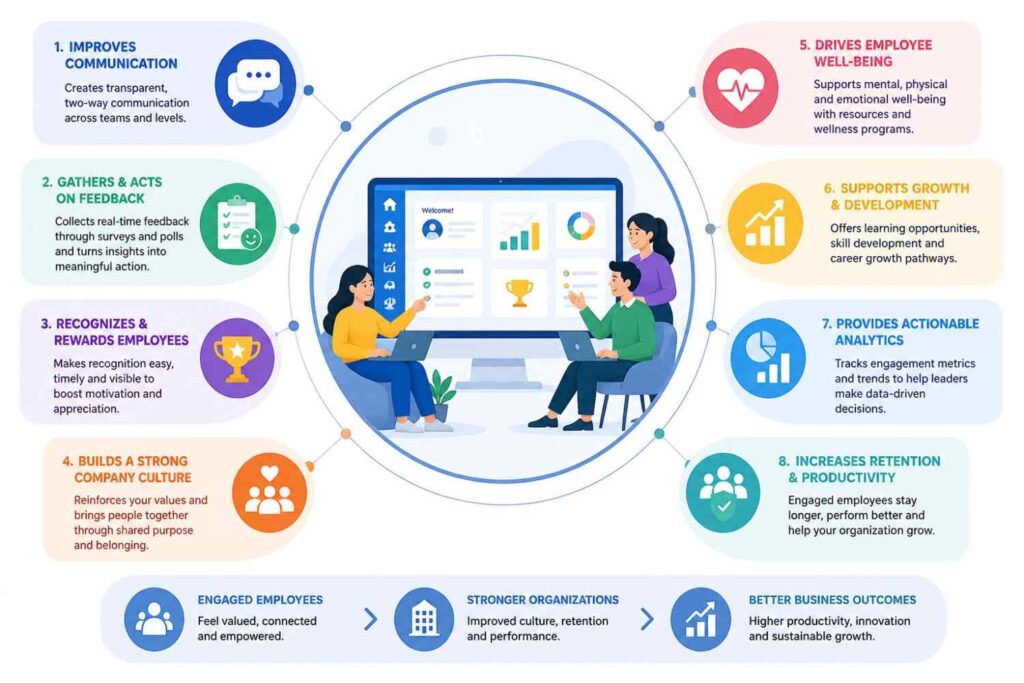
Let’s move past the marketing language and look at what these platforms deliver day-to-day.
Pulse Surveys and Continuous Feedback
Annual engagement surveys are outdated. The issues they raise are months old by the time results come in, and the people who experienced them may have moved on already.
Instead of these, they use pulse surveys: short, frequent check-ins that give leaders a real-time view of how the workforce is actually feeling.
If pulse surveys are designed well, they can highlight issues before they escalate. It could be that a team is losing faith in the leadership, a department is unclear on its priorities, or remote employees feel unseen. That early visibility is what transforms reactive HR into proactive people management.
360-Degree Feedback
Engagement is not just about happiness scores. It is also about how people grow, collaborate, and communicate with others.
360-degree feedback tools allow employees to receive input from managers, peers, and direct reports, creating a fuller and more honest picture of performance and working relationships across the organization.
This shifts performance culture from top-down judgment to ongoing dialogue. Employees who receive regular, balanced feedback often feel more valued, more confident, and more committed to their growth within the organization.
Centralized Internal Communication
One of the fastest ways to disengage employees is poor communication. When company updates are buried in email chains, important changes get missed, and team news is spread across multiple channels, people switch off.
Engagement platforms solve this by creating a single, organized communication hub. An employee communication platform can help centralize company updates, improve collaboration, and ensure employees receive relevant information without relying on fragmented communication channels. Employees see what is relevant to them. Executives can reach the full workforce quickly. Managers can share updates without scheduling unnecessary calls. Every announcement becomes discoverable, searchable, and easier to reference later.
Knowledge Management System Integration
This is one of the most underrated, and should not be.
When employees cannot find the information they need, such as policy documents, onboarding guides, process checklists, or internal FAQs, they either waste time searching or interrupt a colleague who has to stop what they are doing to help.
Modern employee engagement platforms that include or integrate with a knowledge management system solve two problems at once. Employees who can find answers quickly feel more capable, more trusted, and more independent. That sense of autonomy directly supports engagement.
People Analytics and Actionable Reporting
Data without action is just noise. The best platforms do not simply collect survey results. They surface trends, flag declining engagement in specific teams, and help HR leaders decide where to focus next.
With people analytics, organizations can see which departments have the highest engagement scores, where morale is dropping, how engagement may relate to turnover or absenteeism, and whether previous actions made a measurable difference.
Companies that close the feedback loop and visibly act on what employees share are more likely to build trust and improve engagement over time.
Employee Recognition and Rewards
Recognition is probably the most basic yet powerful tool available to any people leader. But so many organizations continue to miss this mark. These can only occur during annual reviews, only from managers, or maybe even in private conversations where no one else can see.
Engagement platforms integrate recognition into day-to-day operations. Shoutouts from peers, managers recognizing employees for their hard work or commitment to goals, milestones being mentioned and value-based recognition makeq employees feel valued.
All of these little moments add up to a kind of culture where everyone feels truly valued, and that makes an enormous difference for retention in the long run.
How Employee Engagement Platforms Help Employees Directly
It is easy to frame engagement platforms as management tools, but the reason they work is that they directly benefit the employees using them.
They Reduce Information Overload
Employees stop digging through inboxes and switching between multiple apps. Updates, documents, colleagues, and tools become easier to access from one organized place.
They Give Employees a Real Voice
Pulse surveys and feedback tools mean employees are not just being managed. They are actively shaping how the organization evolves. That sense of influence is a major driver of engagement and belonging.
They Make Onboarding Less Overwhelming
New hires who join a well-organized digital workplace with clear resources and easy communication can ramp up faster and feel less overwhelmed during their first few weeks.
They Help Remote and Hybrid Workers Feel Included
For distributed teams, an engagement platform is often one of the most consistent touchpoints with company culture. When that experience is strong, remote employees feel like full participants rather than an afterthought.
They Eliminate the “Nobody Told Me” Problem
One of the most common complaints in disengaged organizations is poor communication. Engagement platforms fix this at the structural level, not by sending more emails, but by building better systems.
What to Look for When Choosing a Platform
Not all employee engagement platforms are built the same. As you evaluate your options, focus on what actually drives adoption and long-term impact.
Ease of Use
If employees will not open it daily, none of the other features matter. Prioritize platforms with clean, intuitive interfaces that are easy to navigate.
Mobile Accessibility
This is especially important for deskless, frontline, remote, and hybrid workers. A platform that only works well on a laptop may exclude a large part of the workforce.
Survey and Analytics Depth
A good platform should help leaders move from survey results to clear action plans. Look for trend analysis, reporting, and practical insights, not just raw scores.
Knowledge Management Integration
Does the platform include or connect deeply with a knowledge management system? This feature can reduce daily friction and help employees work with more confidence.
Integration With Existing Tools
Your platform should connect with the tools employees already use, such as Microsoft Teams, Slack, HR software, project management tools, and internal communication systems.
Scalability
Choose a platform that grows with the organization. What works for 50 employees should still work well when the business reaches 500 or more.
The best platform is not the one with the most features. It is the one your team actually uses every day.
The Link Between Engagement and Knowledge Management
Employee engagement and knowledge management may seem like two different challenges. The first is related to feelings and culture; the second relates to documents and search. However, they are really so intertwined in practice.
It is not just time wasted but missed opportunities when employees have the right information, but cannot find the information they need to do their jobs with confidence. They feel unsupported. They get the sense that the organization is all over the place with its systems. Little by little that daily friction wears down engagement.
By contrast, when the employees can turn (relatively) easily to an organized, searchable, and up-to-date knowledge management system, then something much more significant happens. They feel trusted with information. They feel equipped. The amount of time they are taking to ask their collogues question which should already was documented is now less.
Organizations that approach knowledge management as part of the employee experience and not a tool used later on in succession planning have an advantage to strengthen engagement, improve the onboarding process communication and retention.
Final Thoughts: Fix the System, Not the People
A motivational all-hands meeting or team-building activity may not change anything if engagement is struggling inside an organization. What will matter even more is to give people better systems.
We train employees with tools that simplify conversations, make feedback relatable, provide instant access to knowledge, and recognition is a regular practice.
And that is what employee engagement platforms for business are designed to provide. They can and do improve engagement scores, but not if they are only implemented thoughtfully or with actual employee buy-in and consistent follow-through on the feedback. They dictate the way an organization communicates, works and keeps its best talent.
So no matter if you are an HR director at a nimble startup or a people Operations leader with teams across the globe, that begs the question not whether employee engagement matters. That raises the question if your organization has a system that supports the same.