
Scaling an enterprise globally is a massive operational undertaking. Expanding a workforce across multiple international jurisdictions usually results in a shattered HR technology stack. Patching together localized payroll providers, disparate benefits portals, and regional compliance tools creates massive data silos. It degrades the employee experience and introduces severe compliance blind spots into the organization.
When IT and HR architects rely on isolated point solutions for different countries, they lose their single source of truth. Managing a global team on fragmented software is a recipe for payroll errors, security breaches, and high employee turnover. The best employer of record platform acts as the centralized technical bridge to solve this fragmentation. It unifies international employee data into a single, cohesive software architecture.
Here is the exact technical blueprint IT leaders and HR tech architects should use to eliminate system fragmentation and build a truly unified global employee experience.
Table of Contents
Master Data Management (MDM) in Global HR
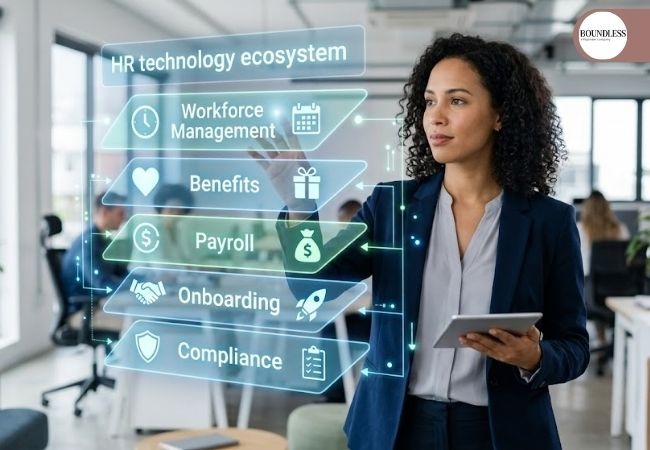
Establishing a strict Master Data Management hierarchy is the foundation of any scalable global HR tech stack. You must designate a primary system of record. This is usually your central HRIS, like Workday, SAP SuccessFactors, or BambooHR. A modern employment platform functions as a downstream system that perfectly mirrors this central directory.
You prevent dangerous data drift by automating employee attribute updates across all geographic locations simultaneously. Consider the complexity of a global workforce. An employee might change their marital status, update their emergency contacts, or receive a mid-year compensation adjustment.
If your systems are disconnected, an HR administrator must manually update the central HRIS and then manually notify the localized payroll provider in Germany, Spain, or Brazil. This manual reconciliation inevitably leads to payroll errors, miscalculated tax deductions, and legal liabilities. A unified stack automatically pushes these attribute changes down the pipeline. When a manager approves a promotion in the central directory, the global compliance engine automatically recalibrates the local statutory deductions and generates the updated localized contract addenda.
API-Led Connectivity vs. Fragile Middleware
The technical pipeline moving your data is just as important as the data itself. Relying on flat-file CSV transfers or custom-built middleware to handle international payroll syncs introduces severe operational risks. These outdated methods break during system updates. They require constant engineering maintenance and lack the security protocols necessary for enterprise financial data.
To architect a resilient HR stack, you must prioritize API-first connectivity:
- Bidirectional REST APIs: Your infrastructure requires bidirectional REST APIs and event-driven webhook architectures. This ensures the systems communicate fluidly and state changes are recognized immediately.
- Event-Driven Syncing: Real-time data synchronization ensures that state changes happen instantly. When a French employee changes their banking routing details in the local portal, the update routes securely to the central corporate ledger without manual intervention.
- Eliminating Middleware: Native integrations allow your IT team to deprecate fragile custom middleware. This reduces your overall technical debt, lowers server costs, and hardens your security posture.
- Payload Encryption: By utilizing modern APIs, you ensure that highly sensitive compensation data is encrypted in transit using strict TLS protocols, keeping personally identifiable information safe from interception.
Standardizing the Digital Employee Experience (UI/UX)
The front-end impact of your backend architecture directly affects employee retention. Forcing international hires to use clunky, poorly localized third-party payroll portals creates a massive negative cultural impact. It makes them feel like outsourced contractors rather than integrated, valued team members.
A unified user interface is absolutely critical for global culture building. A senior software engineer in Berlin should experience the same seamless digital onboarding, benefits enrollment, and self-service UX as an engineer sitting at the corporate headquarters in San Francisco.
- Dynamic Localization: The platform must automatically adjust currencies, languages, and statutory document requests based on the user’s IP and legal jurisdiction. The interface should feel native to the user’s location.
- Frictionless Self-Service: Employees need a single, highly intuitive portal to download local payslips, request statutory time off, and review localized tax documents.
- Brand Consistency: The portal should feel like a natural extension of your company. Disjointed, poorly branded third-party tools erode trust in the central organization.
The Architectural Flaw of Partner Networks
Evaluating the underlying physical and digital model of your vendor is non-negotiable for enterprise tech architects. The way your vendor processes data dictates the security of your entire HR stack.
Here is a critical industry observation. Many aggregator employment models look cohesive on the frontend but operate via fragmented third-party partner agencies on the backend. This structural flaw introduces severe data latency and privacy risks. Your highly sensitive employee data gets passed to third-party brokers completely outside of your security perimeter. You lose visibility over who is actually processing your global payroll.
Owning the full stack ensures end-to-end encryption. It eliminates third-party data brokers from your HR architecture. Providers building their technology on direct-entity infrastructure natively control the data flow from the local jurisdiction straight into your enterprise systems. By utilizing the robust architecture of Boundless, companies can rely on entity-owned infrastructure to guarantee secure data transfer, absolute operational transparency, and rapid localized onboarding.
Engineering the Borderless Organization
Architecting a global HR stack requires looking far beyond basic administrative features. You must scrutinize the data pipeline, the API documentation, and the underlying legal framework of the provider.
IT and HR tech leaders need to prioritize API extensibility and strict data centralization. Choosing the right infrastructure transforms international hiring from a technical nightmare into a scalable, automated utility. Build a system that protects your proprietary data, unifies your global workforce, and scales effortlessly across any border.