Security tokens are the part of crypto that Wall Street actually wants, and the numbers show it: Citi puts the tokenized securities market at about $17 billion today and projects $5.5 trillion by 2030 in its base case (Source: Citi).
Let’s just say that’s a long way from ICO-era white papers. Stocks, bonds, and fund shares now sit on blockchains, with the same legal rights they had on paper.
2026 has been the year regulators stopped circling. In March, the SEC approved Nasdaq’s rule to trade certain securities in tokenized form. In September, it issued an “innovation exemption” for on-chain trading of tokenized US stocks. Europe is rewriting its own framework.
If you issue, invest in, or build for capital markets, you need to know what a security token is, what it is not, and where the real friction still sits.
Key Takeaways
- A security token is a regulated security recorded on a blockchain.
- Securities law applies in full. The blockchain changes the plumbing, not the rules.
- Tokenized treasuries and money market funds lead real-world adoption.
- The SEC and Nasdaq opened on-chain paths for US stocks in 2026.
- MiCA does not cover security tokens. EU rules sit under MiFID II.
Table of contents
What Are Security Tokens?
A security token is a digital representation of a financial instrument, such as a share, a bond, or a fund unit, issued and recorded on a blockchain. The token carries the rights the instrument carries: dividends, interest, voting, a claim on assets. Owning the token means owning the security.
What makes something a security is the asset’s economic substance, not the technology. In the US, that test is usually the Supreme Court’s Howey standard: an investment of money in a common enterprise with an expectation of profit from the efforts of others. If a token passes that test, it is a security whether or not anyone calls it one. That is exactly how many 2017 ICO projects ended up in enforcement actions.
Europe takes a similar view. ESMA’s guidelines on crypto-assets set out when a token counts as a financial instrument, and once it does, it falls under MiFID II and the prospectus regime rather than MiCA.
There are two broad routes to a security token. A native security token is issued on-chain from day one, such as a bond whose official register is a blockchain. A tokenized security wraps an existing instrument, such as a share held by a custodian, with a token that mirrors it. The legal difference matters more than it sounds. With a wrapper, you rely on whoever holds the underlying asset.
Security Tokens vs Utility Tokens
People mix these up constantly, partly because both can run on the same blockchain and sit in the same wallet.
| Security token | Utility token | Stablecoin | |
|---|---|---|---|
| What you hold | A claim on an asset or cash flows | Access to a product or network | A claim on a fiat-referenced reserve |
| Main question | Is it an investment contract or financial instrument? | Does it have consumptive use? | What backs it, and who redeems it? |
| US regime | Securities laws (SEC) | Case by case – may still be a security | Stablecoin-specific rules |
| EU regime | MiFID II, Prospectus Regulation | MiCA | MiCA (EMT or ART) |
| Who can buy | Often restricted by jurisdiction or investor type | Usually open | Usually open |
The label on the white paper does not decide which column a token belongs in. Regulators look at how it is sold and what buyers expect to get from it. A token marketed as “utility” but sold on the promise that the team will make it go up in value is likely a security.
How Security Tokens Work
Strip away the jargon and a security token is a spreadsheet of owners that updates itself under rules nobody can quietly skip.
The rules live in the token’s smart contract. Standards such as ERC-3643 and ERC-1400 on Ethereum build compliance into the token itself. Before any transfer goes through, the contract checks both wallets against an identity registry: has this person passed KYC, are they allowed to hold this asset in their country, are they within the investor limits? If not, the transfer fails.
Some platforms go further and use purpose-built chains. Polymesh, the network behind security token pioneer Polymath, treats identity and compliance as protocol-level features rather than add-ons, and in May 2026 it added zero-knowledge “confidential assets” so institutions can keep positions private on a public ledger.
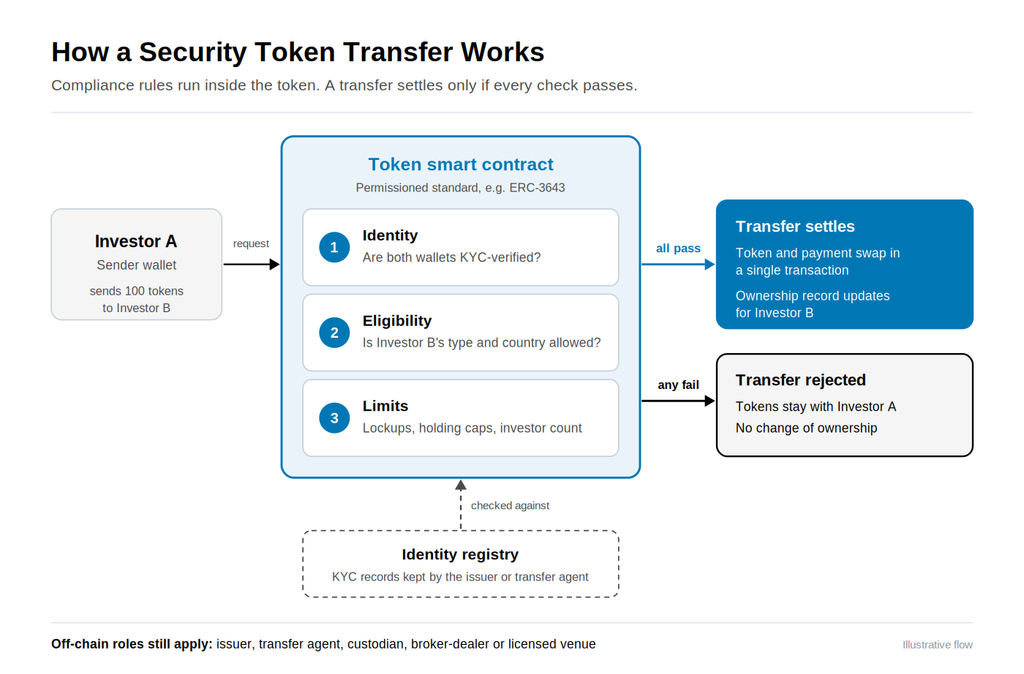
The traditional roles still exist around the token: issuer, transfer agent, custodian, broker-dealer, licensed venue. Tokenization can make those jobs faster and cheaper. It does not make them disappear.
What Is a Security Token Offering?
A security token offering, or STO, is a sale of security tokens to investors under securities law. Think of it as a private placement or IPO where the shares happen to be tokens.
In the US, most STOs rely on the same exemptions as any other private raise:
- Regulation D, Rule 506(c): unlimited raise, general solicitation allowed, accredited investors only.
- Regulation S: offerings to investors outside the US.
- Regulation A+: up to $75 million in 12 months under Tier 2, open to non-accredited investors, with SEC qualification.
- Regulation Crowdfunding: up to $5 million in 12 months through a registered funding portal.
In the EU, a public offer generally needs a prospectus, and secondary trading has to happen on an authorized venue. That friction is one reason the STO boom predicted around 2019 never really arrived. The compliance cost was the same as a traditional deal, and the promised liquidity rarely showed up.
Benefits of Security Tokens
The pitch has changed since the STO hype. Today’s case is less about democratizing everything and more about fixing slow, expensive infrastructure.
Faster settlement. US stock trades settle in one business day. Tokens can settle in minutes, or atomically, with the asset and the payment swapping in the same transaction. That reduces counterparty risk and frees up collateral.
Programmable compliance. Transfer restrictions, lockups, and investor caps are enforced in code instead of checked by hand after the fact.
Fractional ownership. A $10 million building or a private credit fund can be split into small units, which opens up minimums that used to be six or seven figures. Whether regulations let retail investors buy those units is a separate question.
Round-the-clock markets. Blockchains don’t close at 4 p.m. Some tokenized funds already allow near-instant redemption outside banking hours.
Collateral mobility. This is where institutional interest concentrates. A tokenized money market fund share can be posted as collateral on a trading venue and moved in seconds, earning yield the whole time.
Challenges and Risks
The honest version of this section is longer than most vendor decks admit.
Liquidity is the big one. Putting an asset on a blockchain does not create buyers. Many tokenized private assets trade rarely or not at all, and Europe’s own review of its DLT Pilot Regime conceded that participation and trading activity “remain very modest” more than three years after launch.
Fragmentation is the next problem. Tokens issued on different chains, under different standards, often can’t talk to each other. An investor may need separate wallets and onboarding for each platform.
Then there is legal certainty. With a wrapped security, what happens if the custodian holding the underlying share fails? Courts have tested few of these structures. Add key management, smart contract bugs, and conflicting cross-border rules, and you have plenty of reasons to ask hard questions before committing capital.
Real-World Use Cases
Tokenized Treasuries and Money Market Funds
This is where security tokens have found real product-market fit. Franklin Templeton’s OnChain U.S. Government Money Fund records shares as BENJI tokens, and BlackRock launched its BUIDL fund on Ethereum in 2024, tokenized by Securitize. Crypto-native firms use these to park cash in yield-bearing, regulated instruments without leaving the chain. Citi’s forecast assumes up to $1 trillion of US Treasury bills could sit on-chain by 2030.
Tokenized Stocks
Two 2026 decisions moved this from pilot to policy. In March, the SEC approved Nasdaq’s proposal to let certain securities trade in tokenized form, keeping the same ticker, CUSIP, and shareholder rights, with DTC handling clearing and settlement.
Then on September 17, the SEC issued a five-year innovation exemption allowing new “tokenized securities venues” to trade tokenized US stocks through permissioned automated market makers on public blockchains. The guardrails are tight: tier limits of 75 or 250 symbols per venue, volume caps tied to each stock’s trading activity, verified participants only, and a 30-day window for issuers to object to third-party tokenization of their shares.
Private Funds and Private Credit
Fund managers use tokens to cut the admin load of subscriptions, transfers, and investor reporting, and to lower minimums for feeder vehicles. Citi expects private markets to grow far more slowly than public ones, at around $100 billion globally by 2030, which tells you where the volume is likely to concentrate.
Real Estate and Alternative Assets
Property is the use case everyone mentions first. It works best for commercial real estate and funds rather than single-family homes, where legal title and local law make tokenization messy. You can compare active players in this roundup of real estate tokenization companies and a wider list of RWA tokenization platforms. Insurance-linked assets and carbon credits are smaller but active niches.
Regulation in 2026: US and EU
United States. Tokenized securities are securities, full stop, and the SEC has said so repeatedly. What changed in 2026 is that the agency started building on-ramps instead of only enforcing. The Nasdaq approval and the innovation exemption give issuers and venues a defined route for listed stocks. The exemption also invites public comment, so expect its conditions to shift.
European Union. This is where many people get confused. MiCA, the EU’s crypto rulebook, explicitly excludes crypto-assets that qualify as financial instruments. Security tokens live under MiFID II, the Prospectus Regulation, and settlement rules instead. If you want the MiCA side of the picture, see how MiCA is reshaping European crypto. For trading and settlement on DLT, the EU runs a DLT Pilot Regime with tight caps. The Commission’s December 2025 market integration proposal would remove the per-instrument caps and raise the aggregate limit per DLT market infrastructure to €100 billion. That proposal is still working its way through the legislative process.
How to Get Started
Your first step depends on which side of the market you’re on.
If you’re an issuer, start with the legal question, not the chain. Settle which exemption or prospectus route applies in each market and who acts as transfer agent and custodian. Then pick a platform that enforces identity and transfer rules at the token level and connects to venues your investors already use.
If you’re an investor, treat the token like the security it represents. Read the offering documents, confirm who holds the underlying asset, and check how you would sell. A token you can’t transfer is an illiquid investment wearing a modern badge.
Conclusion
Security tokens are regulated securities that settle on blockchains. The technology can make ownership records faster, cheaper, and programmable. It cannot make a bad asset good or an illiquid one liquid, and it doesn’t let anyone step around securities law. The 2026 moves by the SEC, Nasdaq, and the European Commission show regulators now treat tokenization as infrastructure worth accommodating, not a loophole to close.
For now, the momentum sits in the least exciting places: treasuries, money market funds, and listed stocks. If you’re evaluating a project, follow the same order. Get the legal structure right, confirm where the liquidity will come from, and only then worry about the chain.
Read Next
For more on how blockchain is changing financial markets, start here:
- DeFi Explained: How Blockchain Banking Is Transforming Finance Forever
- How Regulations Shape Cryptocurrency Markets
- The Growing Impact of Gold Tokenization on Digital Finance
Frequently Asked Questions
Security tokens are digital versions of financial instruments, such as shares, bonds, or fund units, issued and recorded on a blockchain. They carry the same rights as the underlying security, including dividends, interest, or voting. Because they are securities, they are regulated by securities law rather than general crypto rules.
Security tokens represent an investment, a claim on an asset or its cash flows, while utility tokens give access to a product or network. The difference is legal as well as technical. Security tokens fall under securities regulation, while utility tokens in the EU generally fall under MiCA, though a token called “utility” can still be a security if it is sold as an investment.
Security tokens are legal in the US as long as they are issued and traded under federal securities law. Most offerings rely on exemptions such as Regulation D, Regulation S, Regulation A+, or Regulation Crowdfunding. In 2026, the SEC also approved Nasdaq’s tokenized securities rule and issued an innovation exemption for on-chain trading of tokenized US stocks.
Security tokens do not fall under MiCA, because the regulation excludes crypto-assets that qualify as financial instruments. In the EU they are covered by MiFID II, the Prospectus Regulation, and related rules. ESMA’s guidelines help firms decide which regime applies to a given token.
Security tokens are bought through regulated platforms, such as broker-dealers, licensed trading venues, or the issuer’s own onboarding process. You typically need to pass KYC checks, and some offerings are limited to accredited or professional investors. Before buying, check the offering documents, who holds the underlying asset, and how you would sell the token later.