Self-sovereign identity is the idea that you should hold your own credentials instead of renting them from whichever company happens to store your data, and the market is finally moving that direction: installed digital ID apps are forecast to climb from 2.8 billion in 2025 to 6.2 billion by 2030, growth of 121 percent, with decentralized models cited as a main driver of government uptake (Source: Juniper Research).
That is not a fringe number. It describes most of the connected world carrying identity credentials in a wallet on a phone.
The concept has been circling since roughly 2016 and spent most of that time as a conference talk. What changed is regulation. The European Union set a hard date, the underlying web standards stopped shifting, and one country has run a national system on this model for over two years. If your organization onboards customers or verifies credentials of any kind, the mechanics below stop being theoretical inside the next eighteen months.
Key Takeaways
- You hold credentials in a wallet; no central database stores them.
- Three parties matter: issuer, holder, verifier. No middleman between them.
- Selective disclosure proves a fact without revealing the underlying data.
- EU member states must offer a digital identity wallet by December 2026.
- Adoption stalls on user experience and recovery, not on cryptography.
What Self-Sovereign Identity Actually Means
Strip away the manifestos and self-sovereign identity describes a specific architecture. Your identity data lives in a wallet you control, usually on your phone. Organizations issue you signed credentials. You decide which ones to show, to whom, and how much of each one to reveal. Nobody has to phone home to a central authority to check whether the credential is real, because the cryptography does that job.
Compare it to what happens now. You prove your identity to a bank, which keeps a copy of your passport scan. Then to a broker, a telecom, a healthcare provider, a rental agency. Five copies of the same document in five databases, each one a target, none guaranteed current. Traditional identity verification solutions work, but they multiply the copies every time they run.
Self-sovereign identity flips the storage model. The insurer signs a credential saying you are covered. That credential goes into your wallet. When a hospital needs proof, it reads the signature and confirms the insurer issued it. The hospital never stores your policy details, so it never has to defend them.
The word “sovereign” causes confusion. It does not mean you invent your own identity. Governments still issue passports, universities still issue degrees. What you control is custody and disclosure, not the underlying claim.
How the Three-Party Model Works
Every system built on this pattern has the same three roles.
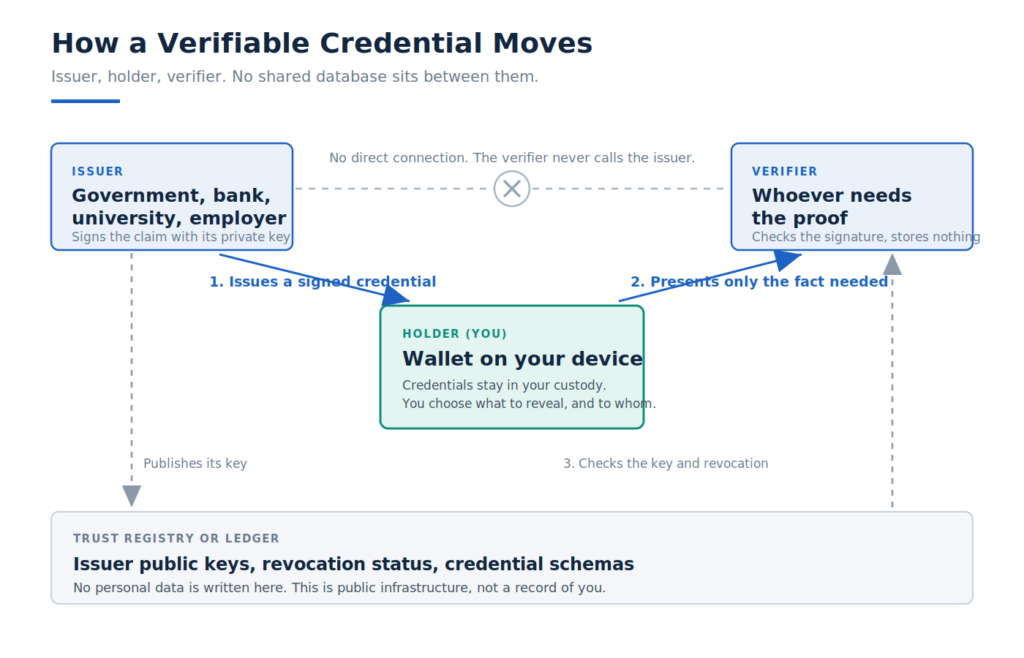
Issuer, holder, verifier
The issuer is an organization with authority to make a claim about you: a government, a university, an employer, a licensing board. It signs the credential with its private key and hands it over.
The holder is you. The credential sits in your wallet. You are not asking permission to use it, and the issuer does not get a notification every time you present it, which matters more than it sounds.
The verifier is whoever needs proof. A bar checking your age, a hiring manager checking your degree, a customs officer checking your travel document. The verifier checks the signature against the issuer’s published key and gets a yes or no in under a second.
Notice what is missing. There is no shared database in the middle. The issuer and the verifier never have to talk to each other, build an integration, or agree on an API. That is the whole architectural argument.
The pieces underneath
Three standards do the heavy lifting. Verifiable Credentials define the format of the signed claim itself; the W3C published version 2.0 as a full web standard in May 2025, which ended years of implementers building against a moving target. Decentralized Identifiers, or DIDs, give issuers and holders identifiers that nobody can revoke out from under them; the W3C moved DIDs v1.1 to Candidate Recommendation in early 2026. Zero-knowledge proofs handle selective disclosure, and this is the part that surprises people.
Selective disclosure means proving a fact without handing over the data behind it. Prove you are over 18 without revealing your birth date. Prove you earn above a threshold without revealing your salary. Every one of those is a data breach that cannot happen, because the data was never transferred.
Where the blockchain fits varies by system. Most designs put nothing personal on-chain. The ledger holds issuer keys, revocation status, and schema definitions, which is public infrastructure rather than private data. Anyone telling you their system writes identity records to a public chain has designed something you should ask hard questions about.
The Benefits That Matter to a Business
Privacy advocates sell this on user rights. Executives buy it for less romantic reasons.
You stop storing what you cannot protect. Every personal record in your database is a liability with a regulatory price attached. Verify a credential instead of copying it and the liability never lands on your balance sheet.
Onboarding collapses from days to seconds. The expensive part is document collection, manual review, and the drop-off while people wait. A pre-issued credential removes all three. Financial institutions running KYC and AML compliance programs feel this most sharply, since they repeat the same checks on the same people constantly.
Fraud gets harder in a specific way. A cryptographic signature cannot be photoshopped. Deepfaked selfies and doctored PDFs are a growing problem for document-based verification, and a signed credential sidesteps that attack entirely.
Credentials work across borders. A degree issued in Berlin verifies in Toronto without an accreditation body in the middle, assuming both sides support the same standard. Whether they do is a live question.
Where It Gets Hard
This section exists because most coverage of self-sovereign identity skips it.
Recovery is the unsolved problem. If you control your credentials and you lose your phone, what happens? Consumer crypto learned this lesson expensively. Wallet designs now use social recovery, biometric re-binding, and issuer re-issuance, and none of them is as simple as clicking “forgot password.” Any deployment that ignores recovery will generate a support queue that eats its savings.
Too many DID methods. More than 150 exist, most barely used. Supporting all of them is impossible, so implementers pick a handful and hope their counterparties picked the same ones. Interoperability improves yearly, but “verifiable credential” is not yet a guarantee that two systems will talk.
Nobody wants another app. An identity wallet only survives if it carries credentials people use weekly, so rollout sequence matters more than technology. Bhutan’s team put roughly twenty partner services behind its wallet before pushing adoption, and treated user education as a bigger workstream than engineering.
Use Cases Already in Production
Bhutan runs the clearest example. Its National Digital Identity program launched in 2023 as the first country-scale deployment built on this model, giving citizens a biometric-protected wallet holding verifiable credentials. In late 2025 the government began migrating the system’s anchor to Ethereum, targeting completion in early 2026 and making it the first national identity system anchored to a public network. Citizens prove age, residency, or citizenship cryptographically, with no central database queried.
Beyond that, four patterns show up repeatedly:
Healthcare intake. Insurance status, medication lists, and allergy records issued as credentials by the parties who actually know them. The new provider verifies in seconds and stores nothing.
Education and licensing. Degrees and certifications issued as signed credentials cut the transcript-request industry out of hiring, and diploma fraud stops being viable.
Financial onboarding. A reusable KYC credential issued once by a regulated institution and accepted by others, cutting duplicated checks without cutting rigor.
Workforce identity. Employee credentials issued at onboarding and used for building access, systems access, and help desk verification. This one is quietly the most common enterprise starting point, because you control both the issuer and the verifier and can pilot without waiting for an ecosystem.
Machine identity is the frontier worth watching. As AI agents start acting on behalf of people, something has to prove which agent is authorized to do what. Verifiable credentials for software agents are an active research area and a plausible second wave, tied closely to questions about digital ownership in automated systems.
The Deadline That Changes the Timeline
Here is why this stops being optional.
Regulation (EU) 2024/1183, generally called eIDAS 2.0, requires every EU member state to make at least one certified European Digital Identity Wallet available to citizens and businesses by December 2026. That is the first hard deadline. The second follows about twelve months later: large online platforms and organizations in regulated sectors including banking, healthcare, and telecoms must accept the wallet as an authentication method.
Twenty-seven member states. Roughly 450 million people. A legal obligation on the private sector to accept credentials from it. That combination creates the demand side every previous attempt at decentralized identity lacked.
If you serve EU customers, wallet acceptance lands on your compliance roadmap. If you do not, you still gain a large standards-based ecosystem to borrow patterns from, and vendors with real deployments rather than slide decks. Coverage across blockchain and Web3 keeps returning to identity for this reason: it is the use case with a regulatory forcing function attached.
How to Get Started
Start narrow. Pick one credential type where you are both issuer and verifier, and workforce identity is usually that place. Issue employee credentials, run one internal workflow on them, and learn what breaks before an external party is watching.
Audit what you store next. List the personal data you hold only because you had to verify something once. That list is your exposure and your business case at the same time.
On vendor selection, ask three questions. Which DID methods do you support? What happens when a user loses their device? Do you have a production deployment I can speak to? The third one filters the field fast.
Then watch the standards rather than the marketing. Verifiable Credentials 2.0 and DIDs v1.1 determine whether your investment interoperates in five years. Vendor-specific extensions are how you end up locked in to the thing you adopted to avoid lock-in.
Conclusion
Self-sovereign identity asks a simple question: why does proving who you are require handing your data to everyone who asks? For thirty years the answer was that no better mechanism existed at scale. That excuse is expiring. The standards are stable, one country has run the model nationally since 2023, and the EU has put a date on the calendar that 27 governments have to meet.
Your realistic move is a small pilot, not a transformation program. Issue one credential type to one group, solve recovery properly, and get honest about which of your data stores exist only because verification used to require copying. The organizations that start now will be adapting a working system in 2027. The ones that wait will be buying whatever is available at whatever it costs.
Read Next
More on identity, trust, and the infrastructure behind them:
- Blockchain and Identity Verification: Future of Secure Authentication
- Technology Growth and the Need for Strong Privacy Controls
- In the Age of AI Search, “Verified” Is Becoming the New “Advertised”
- Blockchain and Web3 News: Crypto, DeFi, and Decentralization
- What Is Crypto Trade Surveillance? A Complete Guide
Frequently Asked Questions
Self-sovereign identity is an approach to digital identity where you hold your credentials in a wallet you control rather than relying on companies to store them for you. Organizations issue you cryptographically signed credentials, and you choose which ones to present and how much of each to reveal. Verification happens by checking the signature, so no central database sits in the middle.
Self-sovereign identity does not strictly require blockchain, though most production systems use a distributed ledger for part of the job. The ledger typically stores issuer public keys, revocation lists, and credential schemas, not personal data. Some implementations use web-based identifiers such as did:web instead, which needs no chain at all.
Self-sovereign identity is secure at the cryptographic layer, since credentials are signed and tamper-evident, but the practical risk sits elsewhere. Device loss, weak recovery design, and social engineering are the realistic attack paths. A deployment is only as strong as its recovery flow.
A digital ID is any electronic version of an identity credential, and most are centralized, meaning an authority holds the record and answers verification requests. Self-sovereign identity describes an architecture where you hold the credential and verification happens without contacting the issuer. The EU Digital Identity Wallet is a digital ID built substantially on self-sovereign principles.
Adoption timelines depend on region, and the EU is furthest along because of a legal mandate. Member states must offer a digital identity wallet by December 2026, with private-sector acceptance obligations following roughly a year later. Outside the EU, expect enterprise workforce credentials and sector-specific schemes before general consumer use.