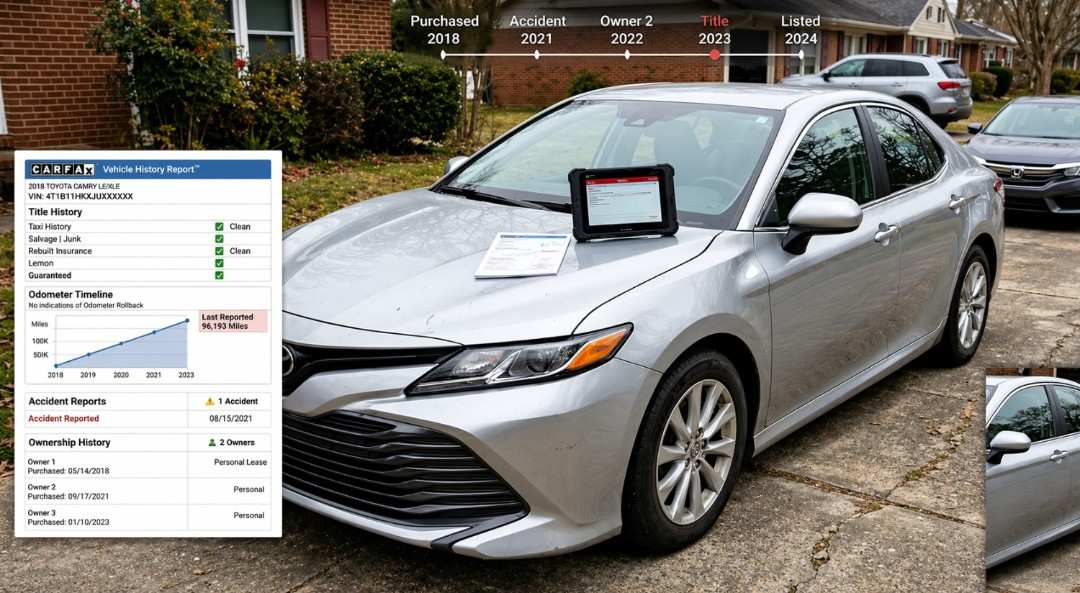
A used car isn’t just a physical object; it’s a record that has moved through multiple systems over time. Every registration, insurance claim, service visit, and inspection leaves a trace somewhere. What buyers see as a “vehicle history report” is actually the output of a distributed data system attempting to reconstruct that past.
Understanding how these systems work and where they don’t changes how much you can trust the result.
Table of contents
- The Hidden Data Layer Behind Every Report
- VIN as a Primary Key in Vehicle Data Systems
- Title Brands as Immutable System States
- Odometer Data as a Time-Series Problem
- Accident Records and the Limits of Structured Data
- Service History and Incomplete Data Networks
- Recall Data as a Dynamic System
- Data Transparency and Market Impact
- Where Data Ends and Reality Begins
- Conclusion
The Hidden Data Layer Behind Every Report
Services like Carfax and AutoCheck operate as aggregators, not sources. They pull data from government registries, insurance databases, auctions, and dealership networks, then attempt to unify it into a single timeline. In fact, over 151,000 data sources feed into vehicle history systems like CARFAX, including government agencies, insurers, auctions, and service shops.
The technical challenge here is consistency. Each source logs events differently, updates at different intervals, and follows its own standards. What you see in a report is the result of data normalization across fragmented systems. That’s also why reports from different providers can vary slightly—they are querying similar but not identical datasets.
So the report isn’t a perfect history. It’s a best-effort reconstruction based on available structured data.
VIN as a Primary Key in Vehicle Data Systems
Everything starts with the VIN. From a software perspective, it functions like a unique identifier in a database, linking all records associated with a vehicle across different systems.
VIN decoder is essentially a validation step. It ensures that the attributes tied to that identifier manufacturer, model, engine type match what’s being presented in the listing. At the core of this process, a VIN decoder plays a crucial role by translating the vehicle identification number into detailed specifications, helping buyers verify accuracy before making a purchase decision.When there’s a mismatch, it’s often not just a clerical error. It can signal inconsistencies in upstream data or even intentional misrepresentation.
This is why decoding the VIN before running a full report is more than a convenience it’s a data integrity check.
Title Brands as Immutable System States
Title brands are one of the most reliable parts of a vehicle history report because they behave like persistent flags in a database. Once applied, they are not meant to be removed.
A salvage or flood designation, for example, originates from a formal event usually an insurance total loss and is recorded across multiple systems. Even if the vehicle is repaired and resold, that state remains attached to its identity.
From a technical standpoint, this persistence increases trust. It’s difficult to alter because the same flag exists in multiple databases, not just one centralized system. That redundancy is what makes title data more dependable than many other parts of the report.
Odometer Data as a Time-Series Problem
Mileage records form a timeline rather than a single data point. Each entry whether from a service visit or registration adds to a growing sequence.
In a consistent dataset, the pattern is predictable: mileage increases over time. When it doesn’t, the system flags it. A drop in recorded mileage or an unusually slow increase introduces anomalies that suggest either data gaps or manipulation.
This is essentially a time-series validation problem. The system isn’t proving fraud; it’s identifying patterns that don’t fit expected behavior.
However, the limitation is clear. If data isn’t recorded for example, when a car is serviced outside reporting networks the timeline develops gaps. The system can only analyze what it receives, not what was entered the dataset.
Accident Records and the Limits of Structured Data
Accidents that appear in reports are those that passed through formal channels, such as insurance claims or police documentation. These become structured entries with timestamps and, sometimes, severity indicators.
But not all events are structured. Many repairs happen privately, without insurance involvement or digital reporting. From a systems perspective, this creates a blind spot. The database reflects only reported events, not all events.
This distinction matters. A report reduces risk by revealing documented incidents, but it cannot eliminate uncertainty where data was never captured.
Service History and Incomplete Data Networks
Service records illustrate another limitation of distributed systems: uneven participation. Dealerships often feed maintenance data into centralized platforms, while independent repair shops frequently do not.
The result is an incomplete dataset. Some vehicles show detailed maintenance timelines, while others appear to have long gaps. These gaps don’t necessarily indicate neglect they often reflect missing integrations in the data network.
Interpreting this correctly requires thinking in terms of data availability, not just vehicle condition.
Recall Data as a Dynamic System
Unlike most of the report, recall information is not purely historical. It’s pulled from manufacturer systems that are actively updated.
This makes recall data one of the more reliable and actionable components. It reflects the current status of known issues and whether they’ve been addressed for that specific vehicle. In contrast to static records, this is a live query against an evolving dataset.
Data Transparency and Market Impact
Vehicle history systems also influence pricing by reducing information gaps between buyers and sellers. When both sides can access the same dataset, pricing becomes more aligned with documented reality.
A clean record supports a higher value, while recorded incidents justify discounts. In effect, these systems act as market-level transparency tools, standardizing how risk is priced into a vehicle.
Where Data Ends and Reality Begins
Even the most comprehensive report operates within the limits of recorded data. The physical vehicle exists outside that system, carrying details that may never have been digitized.
No database can fully capture:
- undocumented repairs
- subtle structural issues
- real-time mechanical condition
This is where software reaches its boundary. The report provides a structured history, but it cannot replace direct inspection. The two operate on different layers one digital, one physical.
Conclusion
Vehicle history reports are often treated as definitive answers, but they are better understood as data models built on partial visibility.
They are highly effective at identifying recorded risks and inconsistencies across time. At the same time, they depend entirely on what enters the system. Missing data, delayed updates, and unreported events are all part of that reality.
Seeing the report as a product of interconnected systems not a complete truth allows you to use it more effectively. It becomes not just a document, but a tool for interpreting risk in a dataset that is always incomplete.