Every dollar counts when you’re running an e-commerce operation. Yet thousands of online brands quietly spend hundreds of dollars every month on stock photo subscriptions they’ve outgrown. The images look familiar because they are: your competitors are using the same library. If your product pages feel generic despite the effort you put into them, the stock photo treadmill is likely a major reason. AI image generators are changing the game.
The good news? A new category of tools built around the free AI image generator is giving e-commerce brands a smarter, faster, and more on-brand alternative. Here’s why the switch makes both creative and financial sense.
Key Takeaways
- E-commerce brands often overpay for stock photo subscriptions that don’t deliver unique visuals, leading to generic product pages.
- Image generators provide a cost-effective alternative, offering tailored images that meet brand needs without the limitations of stock libraries.
- AI image generators create original content quickly, ensuring consistency in brand aesthetics and improving e-commerce performance.
- FacyAI stands out among tools by delivering high-quality, realistic imagery specifically designed for e-commerce brands without the complexity of traditional platforms.
- Utilizing image generators enhances SEO, engagement, and brand identity, enabling businesses to create standout visuals efficiently.
Table of contents
- The Real Cost of Stock Photo Subscriptions
- The Hidden Problem Stock Photos Can’t Solve
- What AI Image Generators Actually Deliver for E-Commerce
- Where AI Image Generators Deliver the Biggest ROI
- How FacyAI Fits Into the E-Commerce Workflow
- FacyAI vs. the Alternatives: A Practical Comparison
- A Note on SEO and Image Generators
- Build a More Distinctive E-Commerce Brand with an AI Image Generator
The Real Cost of Stock Photo Subscriptions
On paper, an entry-tier stock plan sounds manageable. But e-commerce brands rarely stay at the lowest tier for long. Once you factor in extended commercial licenses (required for product marketing), premium image access, and the volume needed to keep storefronts, ads, email campaigns, and social feeds fresh, the bill climbs fast.
Shutterstock’s top-tier plans can run upward of $249 per month. Getty Images enterprise licensing reaches as much as $800 per month or more before you’ve touched a single product image. Adobe Stock adds another layer of cost when bundled with Creative Cloud. And at the end of every billing cycle, you own nothing. The moment you cancel, those images go dark.
For a direct-to-consumer brand spending several hundred dollars monthly on stock photos, that’s thousands of dollars per year for images that don’t differentiate you from anyone else.
The Hidden Problem Stock Photos Can’t Solve
Cost is the obvious issue, but it’s not the deepest one. The real problem is that stock libraries weren’t built for e-commerce. They were built for generic communication.
When you need to show your skincare product on a model that matches your target customer, or place your home goods in a lifestyle setting that reflects your brand aesthetic, stock photos offer approximations at best. You spend hours searching, settle for something close enough, and publish imagery that feels slightly off-brand.
Using an AI image generator changes that equation entirely. Instead of searching for a photo that was taken for some other purpose, you generate exactly what you need: the right lighting, the right setting, the right style, in minutes.
What AI Image Generators Actually Deliver for E-Commerce
Modern AI image generators have moved well beyond novelty. Today’s tools produce product mockups, lifestyle imagery, model photos, and background scenes at a quality that holds up across digital storefronts and paid ads alike.
Product mockups on demand
Instead of scheduling a photo shoot every time you launch a new colorway or bundle, an AI image generator lets you visualize products in context instantly. New packaging? Generate a dozen lifestyle mockups before the first unit ships.
Consistent brand aesthetic
Unlike stock libraries, where every photo has its own look and feel, a good AI image generator lets you define a visual style and apply it consistently. The result is a storefront that looks intentional rather than assembled.
Ad creative at scale with image generators
Paid social requires volume. Testing five different creative directions used to mean five different shoots or five rounds of stock searching. With an AI image generator, you can produce multiple concepts in an afternoon.
Inclusive, representative imagery
Global brands need visuals that reflect diverse audiences. Stock libraries often fall short here. AI-generated imagery gives teams control over representation without the licensing overhead.
Where AI Image Generators Deliver the Biggest ROI
Not all channels benefit equally, but for e-commerce teams, the return shows up fast in a few specific places:
Product pages
Hero images and lifestyle shots directly influence conversion. Brands that generate custom AI visuals tailored to their product aesthetics consistently outperform those using generic stock photos.
Collection pages and category banners
These need to be updated seasonally. With an AI image generator, a team can refresh an entire seasonal campaign without a shoot.
Meta and Google ads
Ad fatigue is real. Creative teams need high-volume output to keep testing. AI generation removes the bottleneck between strategy and execution.
Email campaigns with image generators
Promotional emails with on-brand, product-specific imagery perform better than emails built around whatever stock photo happened to fit the subject line.
Landing pages and seasonal promotions
Holiday campaigns, flash sales, and limited drops all need dedicated creativity. An AI image generator makes it practical to build bespoke visuals for every campaign rather than recycling the same stock assets.
How FacyAI Fits Into the E-Commerce Workflow
FacyAI was built with this use case in mind. While general-purpose tools like Midjourney and Adobe Firefly can produce impressive results for designers who know how to prompt effectively, they carry a learning curve that busy e-commerce teams don’t always have bandwidth for.
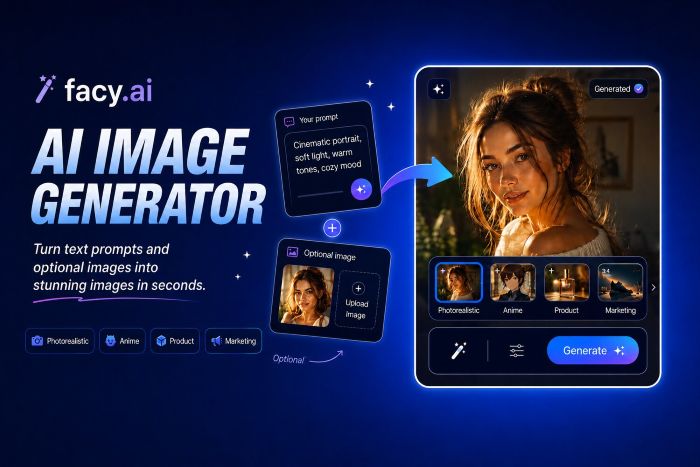
FacyAI focuses on the output e-commerce brands actually need: polished, realistic imagery that can be used directly in product pages, ad sets, and email campaigns. Upload a few reference images, select a style, and the AI image generator handles the rest. The output doesn’t look artificially generated in the uncanny sense. It looks like it came from a professional creative team.
For teams that also need AI-generated headshots for founder profiles, team pages, or ambassador campaigns, FacyAI covers that ground as well, making it a versatile tool across the full scope of visual branding.
FacyAI vs. the Alternatives: A Practical Comparison
A few tools dominate this space. Here’s where each one fits and where FacyAI pulls ahead for e-commerce teams specifically.
Midjourney excels at artistic, highly stylized imagery. It’s a favorite among designers who want unique visuals and have time to refine prompts. Less practical for e-commerce teams that need predictable, on-brand outputs at speed.
Adobe Firefly integrates tightly with Photoshop and Creative Cloud. The AI image generator quality is strong, but it’s best suited to teams with in-house design resources and Adobe workflows already in place.
DALL·E (via ChatGPT) offers quick, accessible generation and works well for concept exploration. It can struggle with product-focused prompts that require consistency across multiple outputs.
FacyAI is purpose-built for professional brand imagery, accessible to non-designers, and priced for teams that want to eliminate the stock subscription without adding a complicated creative workflow.
| Feature | Stock Photo Subscription | AI Image Generator |
| Monthly cost | High recurring fees | Lower ongoing cost |
| Creative flexibility | Limited to existing images | Generate exactly what you need |
| Brand consistency | Difficult to maintain | Easy to apply across outputs |
| Licensing | Usage restrictions apply | Commercial-ready outputs |
| Speed | Search, filter, and edit | Create in minutes |
| Uniqueness | Shared by thousands of brands | Original visuals every time |
A Note on SEO and Image Generators
Original imagery can also support organic performance. While Google doesn’t rank pages simply because images are AI-generated, unique visuals improve engagement, reduce reliance on overused stock photography, and create more opportunities to optimize image filenames, alt text, and surrounding content. Brands that generate original visuals with an AI image generator are better positioned to build a distinctive image footprint over time, which is something no stock library subscription can offer.
Build a More Distinctive E-Commerce Brand with an AI Image Generator
The demand for fresh, high-quality visual content will only continue to grow as e-commerce becomes more competitive. Customers expect every touchpoint, from product pages and email campaigns to social media ads, to feel polished, consistent, and authentic. Relying on the same stock photo libraries as thousands of other brands makes it increasingly difficult to stand out. An AI image generator gives businesses the flexibility to create original visuals that better reflect their products, audience, and brand identity while reducing ongoing creative costs.
The goal isn’t simply to replace stock photos. It’s to build a stronger visual brand that evolves alongside your business. Whether you’re launching a new product line, testing ad creatives, or refreshing your storefront for the season, platforms like FacyAI, alongside tools such as Canva AI, Adobe Firefly, and Midjourney, make it easier than ever to create professional-quality imagery at scale. If you’re ready to move beyond generic visuals and expensive subscriptions, try FacyAI free AI image generator and discover how custom AI-generated imagery can elevate your e-commerce marketing.