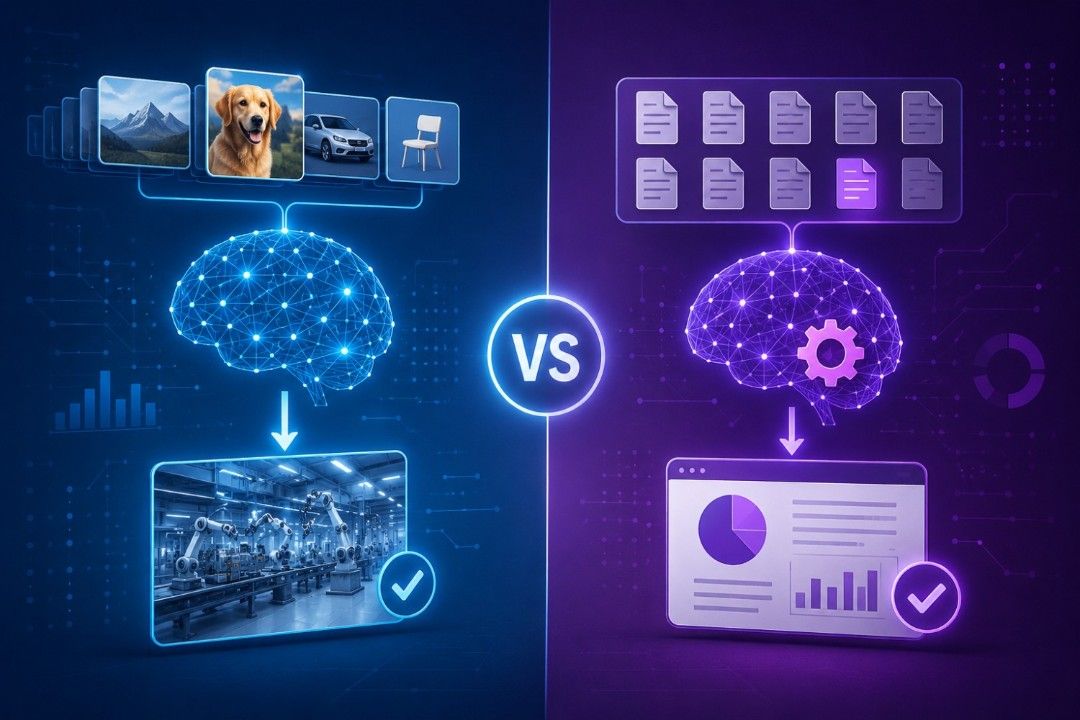
As enterprises look for faster and more cost-effective ways to deploy AI in 2026, choosing the right model adaptation strategy has become increasingly important. In this article, FPT AI Factory will help you understand the key differences between Transfer Learning vs Fine Tuning, along with practical factors to consider when selecting the right approach for your business goals, data requirements, and AI infrastructure.
Table of contents
1. Transfer Learning vs. Fine-Tuning: Why Most Teams Confuse the Two?
In AI discussions, the terms transfer learning and fine-tuning are often used interchangeably. In reality, however, they refer to two closely related but fundamentally different approaches.
Transfer learning refers to the broader machine learning concept of reusing knowledge learned from one task and applying it to another related task. Instead of training a model entirely from scratch, organizations can build on existing pretrained models that already understand general language patterns, visual structures, or contextual relationships.
Fine-tuning takes this concept one step further. Rather than simply reusing a pretrained model, the model is additionally trained on a smaller, domain-specific dataset so it can better understand specialized terminology, workflows, and business contexts. During this process, selected model parameters are adjusted to improve performance for a targeted use case.
In practice, the difference between transfer learning vs fine tuning often comes down to the level of customization required. Transfer learning helps organizations move quickly with generalized intelligence, while fine-tuning enables models to become more accurate and domain-aware for enterprise-specific applications.
2. When to Choose Transfer Learning?
Transfer Learning shines when you want to leverage broad, generalized capabilities without modifying the core DNA of the model. Here are some ideal use cases.
Transfer learning is especially useful in cross-domain applications where the target task differs from the original training objective but still relies on shared underlying patterns. For instance, visual recognition models trained on large-scale datasets can often be adapted effectively to related industrial or operational imaging tasks with minimal additional effort. In addition, modern large language models are increasingly capable of performing zero-shot or few-shot tasks through careful prompt engineering alone, enabling organizations to handle classification, summarization, and reasoning tasks without the need for retraining in many cases.
This is particularly valuable in situations of extreme data scarcity, where only a small amount of labeled data is available. In such cases, transfer learning offers a stable and practical starting point, since training or fine-tuning a model from scratch with insufficient data can lead to unstable performance and unreliable outputs.
The primary limitation of transfer learning is that the model largely remains a generalist system. While it can perform reasonably well across broad tasks, it may struggle with highly specialized workflows that require deep contextual understanding.
For industries such as legal services, healthcare, finance, or enterprise operations, generalized models may produce inconsistent outputs, hallucinations, or responses that fail to align with internal terminology and compliance requirements.
3. When to Choose Fine-Tuning?
Fine-tuning becomes valuable when organizations need models that can reliably operate within highly specialized business environments. Instead of relying solely on generalized pretrained knowledge, fine-tuning allows enterprises to adapt models using proprietary datasets, domain-specific language, and internal operational logic. There are many ideal use cases:
- Niche Domain Expertise: Industries such as healthcare, legal analysis, banking, insurance, and enterprise support often require models to understand technical terminology, internal workflows, and highly contextual business data.
- High-Accuracy Demands: For enterprise-grade deployments, accuracy and consistency are critical. Fine-tuned models can better recognize proprietary acronyms, structured workflows, and organization-specific knowledge that generalized models may overlook.
- Efficiency Optimization: Many organizations are also using fine-tuning to optimize smaller open-source models for targeted tasks. In practice, a well-fine-tuned smaller model can sometimes outperform significantly larger general-purpose models while reducing infrastructure costs
Despite its advantages, fine-tuning has traditionally required substantial engineering resources, GPU infrastructure, and complex training pipelines. Parameter-efficient methods have changed that math: LoRA fine-tuning trains a small adapter instead of the full model, so many jobs now fit on a single GPU.
Security and governance also remain major concerns, especially when sensitive enterprise data is processed through shared public environments.
4. Overcoming the Friction: Enterprise-Grade Model Fine-Tuning
To solve these traditional bottlenecks, modern AI infrastructure has evolved. Forward-thinking enterprises are moving away from manual pipeline setups and adopting dedicated platforms like the FPT AI Factory Model Fine-Tuning platform.
Built specifically for enterprise scale, this platform removes the friction of AI adaptation through three core pillars:
- No-Code Simplicity: Enterprises don’t need a massive team of data scientists to get started. The intuitive interface allows business and engineering teams to upload datasets, select base models, and trigger training.
- Multi-GPU Performance: Time-to-market is critical. The platform leverages high-performance multi-GPU clusters to accelerate training times, turning what used to take days or weeks into a matter of hours.
- Fully Isolated Secure Environments: In 2026, data security is non-negotiable. FPT AI Factory ensures that your proprietary business data remains entirely your own. The fine-tuning environments are completely isolated, ensuring zero data leakage and full compliance with strict corporate governance rules.
The discussion around transfer learning vs. fine-tuning is no longer about choosing one approach over the other. In practice, enterprises increasingly use both strategies depending on the complexity, accuracy requirements, and scalability goals of each AI initiative. As enterprise AI adoption continues to mature, the ability to customize models securely and efficiently will likely become a defining advantage for organizations building production-ready AI systems.
To help businesses explore enterprise AI development more easily, FPT AI Factory currently offers a $100 credit program. Allowing teams to test fine-tuning workflows, evaluate infrastructure performance, and experiment with custom AI deployments before scaling further. For businesses with specific project requirements, FPT AI Factory offers personalized consultation and tailored AI solutions through its official website.
Contact Information:
- Hotline: 1900 638 399
- Email: support@fptcloud.com