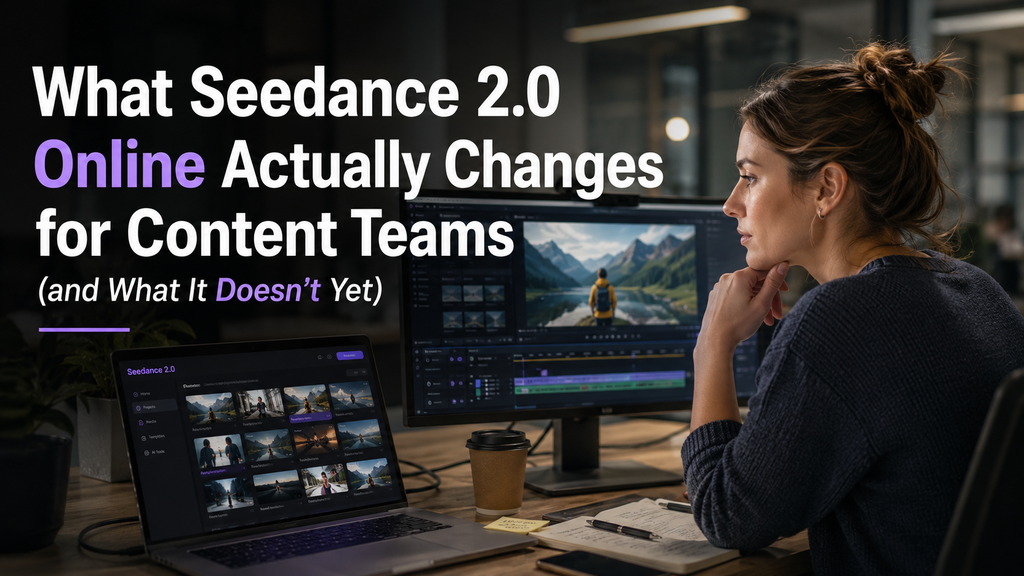
A client asks for a 30-second product clip on Tuesday and wants it Thursday. A year ago that sentence meant one of two things for a small content team: book someone who films for a living, or lose a weekend to a timeline editor. The interesting part of the current AI video moment isn’t that a model can now make that clip. It’s what the speed does to the decision. So skip the demo-reel question. The useful one for anyone running a content operation is narrower: where does a tool like this belong in the pipeline you already have, and where is it still the wrong call? Here is the framework, and the parts the marketing pages leave out. Seedance is the solution.
Key Takeaways
- Seedance 2.0 generates quick video clips from text or images, streamlining the production process.
- It reduces iteration costs, allowing teams to produce more content without the need for extensive budgets.
- Seedance fits well for low-stakes, fast-turnaround videos like social clips, but not for high-quality projects requiring human touch.
- Be cautious of discrepancies between marketing specs and actual tool output; verify performance with your own account.
- Consider legal risks associated with using the tool, ensuring to generate content from your original materials.
Table of contents
The Short Version
Seedance 2.0 is a text-and-image-to-video model built by ByteDance, released in February 2026 (the first Seedance shipped in June 2025). It generates short clips from a prompt, a photo, or a reference clip, with marketing that points to 1080p output, multi-shot consistency, and synchronized audio.
One distinction matters before anything else. The official model lives at ByteDance’s research site, Seedance 2.0, while most people reach it through hosted front-ends. The one this piece references is Seedance 2.0’s online generator, a third-party site that runs the model in the browser with no install. Worth knowing, because a hosted product’s terms and exposed specs are not the same thing as an official model datasheet, and that difference shows up the moment you start testing.
What Seedance Actually Changes
The shift isn’t quality. A trained editor still beats the model on most axes that matter for a flagship asset. The shift is the cost of one iteration.
A real shoot runs on days: scope, schedule, shoot, review, revise. Generating a clip runs on minutes. When a single attempt costs a coffee break instead of a calendar block, the question of “should we even try this” inverts. Teams stop rationing attempts and start running them. The volume of video that gets made goes up, not because the ceiling rose, but because the floor dropped.
That pattern has a precedent in every prior production shift. When phones got good cameras, professional photographers didn’t vanish, but the volume of images exploded, because the people who were never going to hire a photographer started shooting anyway. The work that couldn’t justify a budget got made regardless.
For a content team, that maps onto a concrete decision about where in the pipeline this belongs.
Where Seedance belongs, and where it doesn’t

| Route to the model | Keep with a human team |
| Social and short-form clips (Reels, Shorts, TikTok) | Launch films, hero ads, brand anthems |
| Product demos for catalog items too minor to film | Anything where a viewer is grading the craft |
| Rough cuts to react to before committing budget | Work needing guaranteed spec consistency |
| Internal pitches, concepts, A/B variants | Anything legally sensitive (see below) |
The logic of the left column: speed and iteration are the product. The model earns its place by collapsing the cost of a first draft on work that was never getting a real budget. The right column is where production value is the message, and there a human still wins, not close.
What turned the tool from a toy into something usable, in practice, was specificity. The first few generations off a vague prompt came back stiff, with a product that subtly morphed between shots. Feeding it an actual reference photo and writing like a director, naming the shot, the camera move, the lighting, produced a usable push-in in under two minutes. The lesson transfers to any team piloting this: the bottleneck is your prompt discipline, not the model.
The spec gap to check before you promise anything
This is where the marketing-versus-reality difference bites. The homepage points to 1080p and synchronized audio. Open the actual generator and sign in, though, and the live tool currently exposes a 480p path, clips of four to fifteen seconds (five by default), and no audio controls surfaced on that page.
The richer numbers describe the model’s ceiling, not necessarily what your account renders today. The working rule: treat the homepage figure as the ceiling, not the floor, and verify what your own account produces before you commit to a client deliverable. The same goes for free credits. Treat them as an evaluation tier, not a free lunch, enough to assess the tool, not to finish a real job. If you have work to ship, budget for the paid plan from the start.
The risk most coverage skips
There is a commercial-use question executives shouldn’t wave away. Seedance 2.0 launched into an active copyright dispute. The Motion Picture Association denounced the model over its training data; Disney sent ByteDance a cease-and-desist in February 2026; Paramount Skydance alleged infringement involving its properties; US senators wrote to ByteDance’s leadership. ByteDance responded that it respects intellectual property rights and would strengthen its safeguards.
None of that stops you from using the tool. It changes how. The defensible path for any brand is to generate from your own inputs, your products, your scripts, your footage, and steer clear of prompting for copyrighted characters or recognizable IP. That keeps your output clean and sidesteps the part of this story still being argued in public. For a business audience, surfacing the risk isn’t a liability. It’s the question you’d want answered before signing off, and answering it honestly is what makes the rest of the assessment trustworthy.
The decision, in one line
The call was never “AI video, yes or no.” It’s a placement decision: route high-volume, low-stakes, fast-turnaround video to the model, keep flagship craft with humans, verify specs on your own account, and generate only from material you own.
Run three real clips through the free Seedance tier this week against work you’d otherwise skip, and you’ll know within an afternoon whether it earns a slot in your pipeline. Most of the discourse is still arguing about whether AI video can match a professional. That was never the operational question. The one that actually changes your quarter is simpler: what gets made now that didn’t before?
The author writes practitioner notes on building and shipping with AI tools. Specs cited reflect the hosted product’s claims and a hands-on check of the live tool as of June 2026; verify current behavior on your own account.