
Search has changed. A growing number of people are skipping Google entirely and going straight to ChatGPT, Perplexity, or Gemini to find products, compare services, and make decisions. If your brand only shows up in traditional search results, you are invisible to a significant and growing slice of your potential audience.
That is where an LLM SEO tool comes in. If you have not heard the term yet, you are about to hear it a lot.
Did you know💡: Around 37% of consumers now begin their searches with AI tools rather than a traditional search engine
Table of Contents
What Is an LLM SEO Tool?
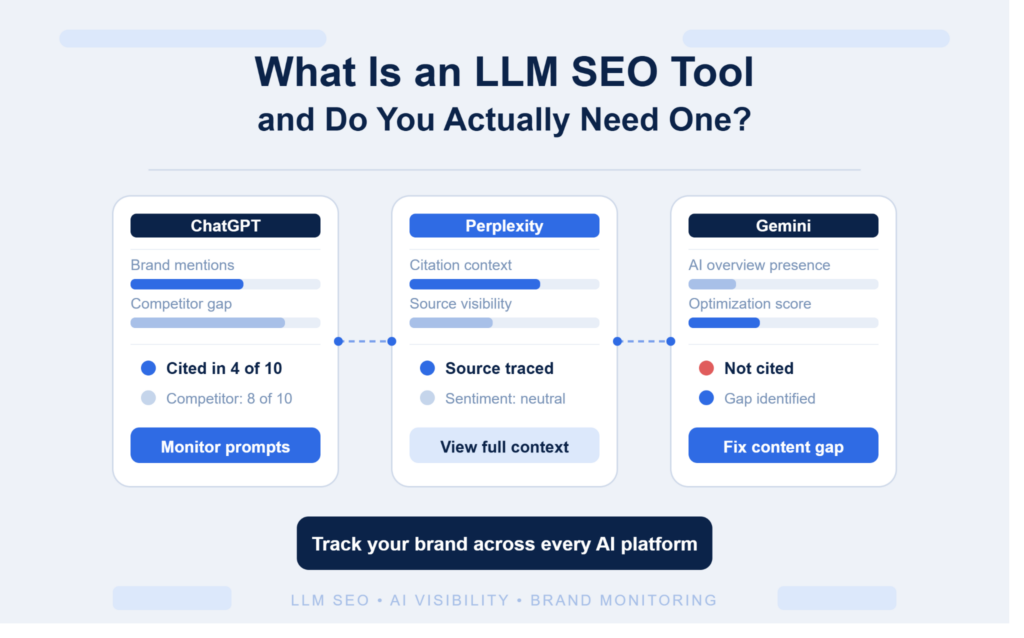
LLM stands for large language model – the technology behind AI assistants like ChatGPT, Claude, Gemini, and Perplexity. An LLM SEO tool is a platform that helps you monitor, understand, and improve how these AI models talk about your brand when users ask relevant questions.
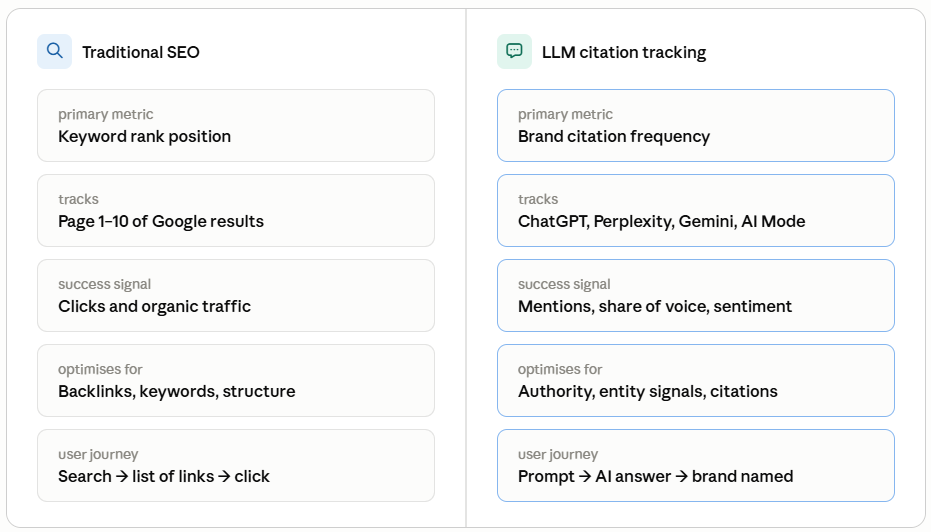
Traditional SEO tools tell you where you rank on Google. An LLM SEO tool tells you whether you are being mentioned, recommended, or cited inside AI-generated answers and what those answers actually say about you.
The two are not the same job. A brand can rank on page one of Google and still be completely absent from AI answers on the same topic. That gap is exactly what LLM SEO tools are built to close.
This category is not new anymore. Early platforms like Peec AI helped teams understand what tracking AI citations could look like as a dedicated workflow. Since then, the space has matured significantly in terms of both the number of platforms available and the depth of what they can do.
Most teams evaluating this space today go through a comparison of Peec AI alternatives before deciding because pricing, LLM coverage, and the quality of insights vary widely from one platform to the next.
What Does an LLM SEO Tool Actually Do?
The core function is monitoring. You set up the prompts that your target audience is likely to ask things like “what is the best project management software for small teams” or “which CRM should a startup use”
The tool runs those prompts across multiple AI platforms to check whether your brand appears, how it is described, and which competitors are being mentioned alongside or instead of you.
Beyond monitoring, the better platforms go further and help you act on what they find. A useful LLM SEO tool should be able to tell you:
- Which AI models mention your brand, and which ones do not
- What sources are those models pulling from when they reference you
- How your visibility compares to direct competitors across different prompts
- What content changes or new materials could improve your chances of being cited
- How does your AI visibility trend over time as your content and authority evolve
Understanding how AI search has shifted the discovery landscape matters for any business that relies on digital channels.
AI systems do not simply retrieve information the way a search engine does; instead, they synthesize it, weigh it, and select sources based on authority, clarity, and how well content answers the question being asked.
As this deep dive into generative engine optimization explains, ranking well on Google no longer guarantees you will be cited in AI answers; the overlap between the two has collapsed significantly. That distinction matters enormously for how you think about optimizing for AI search.
Do You Actually Need One?
The honest answer depends on your business and your audience.
You probably need an LLM SEO tool if:
- Your buyers are researching options in ChatGPT, Perplexity, or Gemini before they visit your website
- You are in a competitive category where brand positioning in AI answers could influence consideration
- You run content marketing or SEO at any meaningful scale and want to future-proof your strategy
- You manage multiple clients or brands and need to track AI visibility across all of them
You can likely wait if:
- Your business runs almost entirely on referrals or word of mouth, with no digital discovery component
- Your audience is not yet using AI assistants for the type of research that leads them to you
- You are a very early-stage company still figuring out product-market fit
For most businesses with an active digital presence in 2026, some level of LLM visibility monitoring is no longer optional. The question is not whether to do it but how much depth you need.
What Should You Look for When Choosing One?
Not all LLM SEO tools are built the same way. Before you commit to a subscription, check these things:
- LLM coverage: Does it monitor the specific AI platforms your audience is actually using? A B2B software company needs strong ChatGPT and Perplexity coverage. A consumer brand may care more about Gemini and Google AI Overviews.
- Citation context: A good tool does not just tell you whether you were mentioned. It shows you the surrounding context, what prompt triggered the mention, which source was cited, and whether the response was positive, neutral, or unfavorable toward your brand.
- Actionable recommendations: The most useful platforms do not stop at data. They tell you what to do about it, which content gaps to fill, which competitor citations to understand, and which pages deserve optimization to improve future AI mentions.
- Reporting you can share: If the insights stay locked inside a dashboard, adoption across your team or client base will be low. Look for tools that let you export reports or schedule digests so the data reaches the people who need it.
- Transparent pricing: AI visibility platforms vary enormously in cost. Some charge per domain, others per prompt volume, others by seat. Before signing up, make sure you understand exactly what you are paying for at each tier and what happens to your bill as your usage scales.
This is part of a broader shift in how marketing teams are approaching AI tools, as this overview of AI SEO tools and what actually separates useful ones from overhyped ones outlines, the gap between tools that provide data and tools that provide actionable insight is significant.
Pick a tool you will actually use, at a price tier that makes sense from day one.
5 LLM SEO tools worth looking at
- 1. Wellows: Is an AI visibility tool that falls under the execution-first option and provides actionable insights with precise LLM citation tracking. Strong fit for agencies and growth teams that need to know not just where they are invisible, but which page to fix and which source to pitch via content optimization and outreach feature.
- 2. Profound: One of the higher-traffic platforms in the category has built a strong following among enterprise content teams. Good for volume monitoring across a large prompt set.
- 3. Peec AI: One of the early tools in this space. Useful for teams getting started with LLM monitoring who want a straightforward interface without a steep learning curve.
- 4. Brandwatch (AI features) is primarily a social listening tool that has extended into AI mention tracking. A practical option if you already use Brandwatch and want to add LLM visibility to an existing workflow.
- 5. Semrush AI Toolkit: Semrush has been adding LLM visibility features to its existing SEO platform. A reasonable starting point if your team already lives inside Semrush and wants to explore AI search monitoring without adding a new vendor.
The Bottom Line
An LLM SEO tool is not a luxury for enterprise teams with large budgets. It is quickly becoming a standard part of any content and marketing strategy that takes AI search seriously. The businesses building familiarity with these platforms now will have a meaningful advantage over those scrambling to catch up in twelve months.
Start with what you actually need, i.e., clear monitoring of the AI platforms your audience uses, citation context that explains what is driving your visibility, and recommendations you can act on. Everything else is optional until your use case demands it.