Video has become the dominant format for communication across marketing, education, entertainment, social media, product demos, online courses, and internal business training. But while visuals often get most of the attention, voice is what gives video clarity, emotion, and structure. A strong voiceover can make a tutorial easier to follow, a product video more persuasive, and a brand story more memorable.
Traditionally, creating professional voiceovers required hiring voice actors, booking studio time, recording multiple takes, editing audio, and syncing the final narration with video. That process still has value, especially for high-budget productions, but it can be expensive and slow. Today, Text-to-Speech AI is changing how creators and businesses produce video narration at scale.
AI text-to-speech tools can turn written scripts into realistic voiceovers in minutes. Instead of recording every line manually, users can type or paste a script, choose a voice, adjust tone and pacing, then generate narration that sounds natural and polished. For video creators, marketers, educators, and agencies, this opens up a faster and more flexible way to produce voiceovers without sacrificing quality.
Table of contents
- What Is Text to Speech AI?
- Why Voiceovers Matter in Video Content
- Benefits of Using Text to Speech AI for Video Narration
- Common Use Cases for AI Voiceovers
- How to Create a Great AI Voiceover
- Text to Speech AI vs. Human Voice Actors
- Best Practices for Using AI Voiceovers Ethically
- The Future of AI Voiceovers in Video Production
- Final Thoughts
What Is Text to Speech AI?
Text to Speech AI is a technology that converts written text into spoken audio using artificial intelligence. Unlike older robotic text-to-speech systems, modern AI voice tools use advanced machine learning models to generate speech that sounds more human, expressive, and context-aware.
Early text-to-speech software often sounded flat and mechanical. It could read words aloud, but it struggled with natural rhythm, emotional expression, pronunciation, and conversational flow. Modern text-to-speech AI is much more advanced. It can replicate pauses, emphasis, intonation, and even emotional nuance, making it suitable for professional video narration and voiceover work.
For example, a creator can write a script for a YouTube explainer video, paste it into a Text to Speech AI platform, select a warm and friendly voice, and instantly generate a complete narration track. If the pacing feels too fast, they can slow it down. If a sentence sounds too neutral, they can adjust the delivery. If the script changes, they can regenerate only the affected section instead of re-recording the entire voiceover.
This flexibility is one of the biggest reasons AI voice technology is becoming popular in video production.
Why Voiceovers Matter in Video Content
Voiceovers do more than fill silence. They guide the viewer through the story, explain what is happening on screen, and create a stronger emotional connection. In many types of videos, the narration is the backbone of the entire experience.
In educational videos, narration helps break down complex ideas into simple steps. In product demos, it highlights key features and benefits. In social media videos, it grabs attention quickly and keeps viewers engaged. In corporate training videos, it creates consistency across lessons and modules. In advertisements, it helps shape the mood and brand personality.
Without clear narration, viewers may misunderstand the message or lose interest. A high-quality voiceover gives the video structure and makes the content easier to absorb.
However, producing voiceovers manually can slow down content creation. Every script revision may require another recording session. Every language version may require another voice actor. Every new campaign may add more costs. This is where Text to Speech AI becomes especially useful.
Benefits of Using Text to Speech AI for Video Narration
1. Faster Production
One of the biggest advantages of Text to Speech AI is speed. Instead of waiting days to receive a recorded voiceover, creators can generate narration almost instantly. This is especially helpful for teams producing large volumes of video content, such as social media clips, training videos, ads, tutorials, or product explainers.
When scripts change, AI voiceovers are easy to update. You can revise a sentence, regenerate the audio, and drop it back into the video timeline. This makes the production workflow much more efficient.
2. Lower Voiceover Costs
Hiring professional voice talent can be expensive, especially if you need multiple versions, languages, accents, or revisions. Text-to-Speech AI can reduce those costs by giving creators access to a wide range of voices without requiring a full recording session.
This does not mean AI voices replace every human voice actor. For major brand campaigns, emotional storytelling, or character-driven performances, human talent may still be the best option. But for many everyday video projects, AI-generated narration offers a cost-effective alternative.
3. Consistent Brand Voice
Businesses often need a consistent voice across many videos. For example, a SaaS company may create onboarding videos, help center tutorials, feature announcements, and internal training content. Using different voice actors for every project can make the brand sound inconsistent.
With Text to Speech AI, teams can use the same voice style across multiple videos. This creates a recognizable audio identity and helps maintain brand consistency over time.
4. Easy Localization
Global brands and creators need video content in multiple languages. Traditional localization requires translating the script, hiring native-speaking voice actors, recording the audio, and editing everything into the video. That process can be time-consuming and expensive.
Many Text to Speech AI tools support multiple languages and accents, making it easier to create localized voiceovers. A company can produce an English version of a training video, then generate Spanish, French, German, Japanese, or other language versions more efficiently.
This is especially valuable for online courses, international product launches, global marketing campaigns, and multilingual customer education.
5. Flexible Creative Control
Text to Speech AI gives creators more control over the final sound. Depending on the tool, users can adjust voice type, speed, pitch, pauses, pronunciation, emphasis, and emotional tone. Some tools also allow users to choose between conversational, professional, energetic, calm, dramatic, or instructional delivery styles.
This flexibility helps creators match the voiceover to the purpose of the video. A meditation video may need a slow and soothing voice. A product launch video may need a confident and energetic tone. A tutorial may need a clear and friendly narrator.
Common Use Cases for AI Voiceovers
YouTube Videos
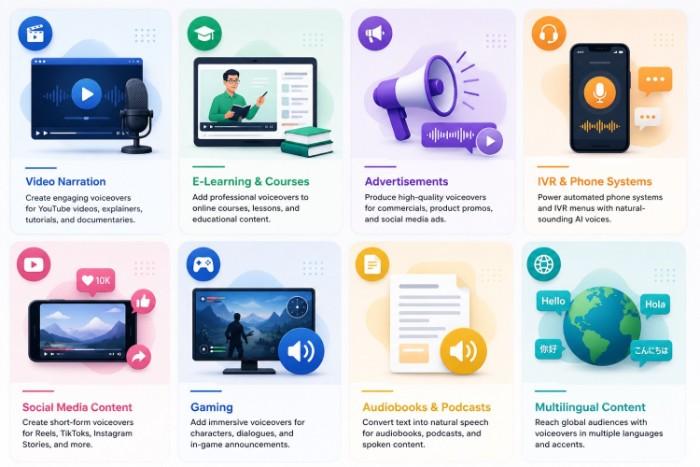
YouTube creators often need narration for explainer videos, list videos, tutorials, reviews, documentaries, and faceless channels. Text-to-Speech AI helps creators produce voiceovers quickly without recording their own voice or hiring talent for every upload.
It is especially useful for creators who publish frequently or manage multiple channels. Instead of spending hours recording and editing narration, they can focus more on scripting, visuals, and storytelling.
Social Media Videos
Short-form platforms like TikTok, Instagram Reels, YouTube Shorts, and Facebook videos often rely on fast, clear narration. AI voiceovers can help creators produce attention-grabbing clips at scale.
For social media, pacing matters. The voice needs to be clear, energetic, and matched to the visuals. Text to Speech AI makes it easy to test different voice styles and generate multiple versions for different audiences.
Product Demo Videos
Product demos need to explain features clearly while keeping the viewer engaged. A good voiceover can walk users through the product, describe benefits, and guide attention to important details.
Text-to-Speech AI is useful for software companies, ecommerce brands, and app developers that frequently update product videos. When the interface changes or a new feature launches, the narration can be updated quickly.
Online Courses and Training
Educational content often requires many hours of narration. Recording all of that manually can be exhausting and expensive. Text to Speech AI can help course creators generate clear, consistent lessons faster.
It also makes updates easier. If a lesson needs a new paragraph or corrected explanation, the creator can simply edit the script and regenerate the audio.
Corporate Training and Internal Communications
Companies use video for onboarding, compliance training, process documentation, sales enablement, and internal announcements. AI voiceovers can help teams create professional narration without relying on a studio or voice actor for every internal video.
Because internal content often changes, the ability to quickly update narration is especially valuable.
Ads and Marketing Videos
Marketing teams need to create many versions of video ads for different audiences, platforms, and campaigns. Text to Speech AI makes it easier to test different voice styles, hooks, and calls to action.
For example, a brand can generate several voiceover versions of the same ad, one calm and premium, one energetic and youthful, and one direct and informative. This helps marketers experiment and optimize performance.
How to Create a Great AI Voiceover
Start With a Strong Script
Even the best Text to Speech AI tool cannot fix a weak script. A good voiceover script should be clear, concise, and written for the ear, not just the eye. Sentences that look fine on a page may sound too long or awkward when spoken aloud.
Use short sentences, natural phrasing, and conversational language. Read the script out loud before generating the voiceover. If you stumble while reading it, the AI voice may also sound less natural.
Match the Voice to the Video
The voice should fit the content, audience, and brand. A corporate training video may need a calm and professional voice. A gaming video may need a more energetic voice. A luxury brand video may need a slower, smoother delivery.
Avoid choosing a voice simply because it sounds impressive. The best voice is the one that supports the message and feels right for the viewer.
Use Pauses Strategically
Pauses are important in narration. They give viewers time to process information and help create a natural rhythm. Many AI voice tools allow users to add pauses between sentences or sections.
For tutorials, pauses can help viewers follow each step. For emotional storytelling, pauses can create emphasis. For fast social videos, shorter pauses may keep the pace lively.
Adjust Pacing
AI voiceovers can sometimes sound too fast or too slow depending on the script. Adjust the pacing so the narration matches the visual flow. If the video includes complex information, slow the voice down slightly. If it is a short ad or social clip, a faster pace may work better.
The goal is not just to sound natural. The voiceover should support the editing rhythm of the video.
Review Pronunciation
Proper pronunciation is essential, especially for brand names, product names, technical terms, acronyms, and names of people or places. Before finalizing the voiceover, listen carefully for mispronunciations.
Many Text to Speech AI platforms allow pronunciation adjustments. Use these features to make sure important terms are spoken correctly.
Add Human Editing
AI voiceovers are powerful, but the best results often come from combining AI generation with human review. Listen to the full narration, make edits, adjust timing, and ensure the audio feels natural in the final video.
AI can speed up production, but creative judgment still matters.
Text to Speech AI vs. Human Voice Actors
Text-to-speech (TTS) AI and human voice-over each have core strengths. TTS AI is highly efficient, scalable, low-cost, and easy to revise, making it well-suited for high-volume production scenarios such as tutorials, training content, and
social media videos. Human voice-over, meanwhile, fits projects that require deep emotional expression, character development, and a unique brand personality; it can capture subtle script details that AI cannot reproduce. The choice between the two options
depends on the needs of each specific project. Most teams adopt a mixed usage model: human voice-over is assigned to flagship brand marketing campaigns, while TTS AI takes charge of routine, fast-turnaround content.
Best Practices for Using AI Voiceovers Ethically
As AI voice technology improves, ethical use becomes more important. Creators and businesses should be transparent when appropriate, respect voice rights, and avoid misleading audiences.
Do not clone or imitate a real person’s voice without permission. Do not use AI voiceovers to impersonate someone or create deceptive content. For commercial projects, make sure the tool’s licensing terms allow your intended use.
Ethical AI voiceover production builds trust and protects both creators and audiences.
The Future of AI Voiceovers in Video Production
The authors of this paper propose that future TTS AI will evolve toward greater realism, richer expressiveness, and higher customizability. This evolution will encompass five core upgrade dimensions: expanded emotional range, multilingual capability,
real-time editing, guaranteed voice consistency, and compatibility with integrated editing platforms. Once fully implemented, this technology will streamline the entire content creation workflow, bringing benefits to groups including small businesses and independent creators. It is necessary
to clarify that AI will not eliminate the demand for human creation; it only serves as an efficiency-boosting auxiliary tool, and only creators who pair it with high-quality content can maximize its benefits.
Final Thoughts
Today, text-to-speech (TTS) AI is reshaping the creation model for video narration and dubbing. It delivers four core advantages to ordinary creators and commercial enterprises: accelerating professional audio production,
cutting production costs, maintaining a unified brand voice, and enabling content localization for global audiences. This technology is compatible with six major categories of video
creation scenarios, and can scale up video production capacity without disrupting creative pace. The core principle for using this technology is prudent implementation. By following four actionable operational steps, users can produce refined, clear, and engaging
video content. Against the current industry trend of sustained growth in video content, this technology will become an increasingly core component of video production processes. All four categories of target users that master this technology will reap tangible benefits: less time invested, lower production costs, and stronger creative control.