Search has moved past blue links. Here’s how to keep your brand visible inside the AI answers customers now trust.
Something shifted over the last two years, and most brands felt it before they could name it. Traffic dipped, rankings held steady, but the clicks stopped following. The culprit wasn’t a Google penalty or some sneaky algorithm update.
It was an AI search making some stealth changes in how people search on the internet. In 2026, ChatGPT is already processing more than a billion searches per week. Also, Google’s AI Mode has surpassed a billion monthly users. If your customers are asking instead of typing keywords, you need to change your visibility game.
The Shift From Traditional Search To AI Search
For 20-odd years, the deal was simple. You optimize for keywords, and your page climbs the rankings. The result? Google will reward you with traffic. That contract is falling apart. When an AI Overview pops up, roughly 8 out of 10 people get their answer right there and never visit a site.
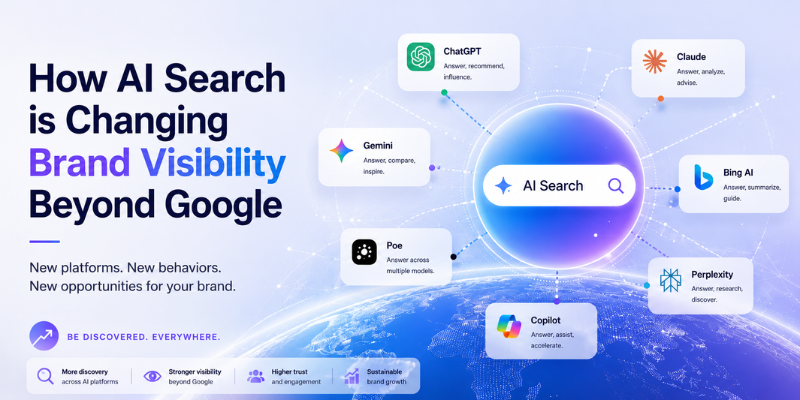
And people aren’t only Googling anymore. They’re asking ChatGPT, Perplexity, Gemini, and Copilot. ChatGPT’s weekly active users more than doubled in a single year, landing near 900 million by early 2026. So search didn’t die. It got chopped up and scattered across a dozen AI assistants, each with its own taste in which sources to trust.
How AI Search Is Changing SEO
The old SEO playbook isn’t dead, but a good chunk of it is gathering dust. Here’s what’s actually moving.
Trust and authority signals got way louder
AI systems are picky about who they quote. They lean toward content that shows real expertise and reads like a human who knows the subject cold. Reviews, mentions across the web, consistent info about your company, all of it feeds into whether a model thinks you’re worth citing.
This is where AI-first marketing agencies earn their keep, because shaping how machines describe your brand has become its own discipline.
From rankings to citations
Ranking number one used to be the whole game. Now, AI models build their answers by pulling from sources they trust and citing a few of them. The scary bit? Research suggests the overlap between Google’s top results and the sources AI actually cites has dropped from around 70% to under 20%. In simpler terms: you can rank beautifully and still get zero mentions in AI answers.
Keywords matter less, context matters more
People type fragments into Google, stuff like “best crm small business.” They ask AI full questions: “What’s the best CRM for a 10-person team that hates complicated software?” So content that answers real questions in an easier language beats keyword-stuffed pages every time. AI wants substance, not hollow SEO tricks.
New metrics, new dashboards
Traffic used to be the scoreboard. Now teams track share of voice inside AI answers, how often you get mentioned, and whether those mentions are positive. By mid-2026, pretty much every serious marketing team watches AI visibility the way they’ve always watched rankings.
How Businesses Can Improve Visibility In AI Search
While these points look scary at first. The good news is that most of this is fixable, and a ton of your competitors are still asleep at the wheel.
Make sure AI can actually read you
Sounds obvious, yet it trips up loads of sites. Check your robots.txt and CDN settings, because some setups block AI crawlers without you realizing. If the bots can’t read your pages, you simply don’t exist to them.
Write content that answers questions (Straight up)
Structure takes care of a lot of work. Make headings easy to read, use short sentences and provide the answer right away. Consider what your customers ask you and respond to it as a person would, not a brochure! The cleaner the content, the more likely it is that an AI will copy and paste it into an answer. The easier it is to dig up for AI, the more likely it is to be copied and pasted into an answer.
Build authority everywhere, not just on your own site
AI doesn’t only read your homepage. It reads what the rest of the internet says about you, including reviews, mentions, guest pieces and comparison roundups. The more credible signals point your way, the more confident a model feels citing you.
Keep publishing, keep it fresh
AI favors those brands that remain active. The numbers reveal that these companies that are regularly releasing good content are cited much more often than those that post twice a year and consider it a content strategy. It isn’t a matter of quantity but of relevance and timeliness.
Conclusion
So is traditional SEO finished? In reality, not even close. Google still drives a mountain of traffic, and strong SEO actually feeds your AI visibility since most models pull from live web results anyway. The real mistake would be picking a side.
The brands winning in 2026 are running both. They keep the SEO foundation rock solid and layer a generative AI strategy on top to earn citations in the AI answers their customers now trust by default. A hybrid approach, honestly, is the only thing that makes sense right now.
FAQs
How is AI search changing brand visibility in 2026?
AI search moves visibility from ranking on Google to getting cited inside AI answers. Tools like ChatGPT and Perplexity give one response, so your brand is either mentioned or invisible. Showing up there now matters more than holding a top spot.
What is the difference between SEO and generative engine optimization?
SEO helps your pages rank on search results. Generative engine optimization, or GEO, focuses on getting your brand cited in AI answers. They overlap plenty, but GEO chases mentions and trust signals while classic SEO chases rankings and clicks.
Why is brand visibility in AI search important for businesses?
Because AI tools pre-qualify buyers before they ever reach you. Visitors who arrive after an AI recommends you tend to convert much higher than regular traffic. If you’re missing from those answers, competitors can soak up your warmest leads.
Will AI search replace traditional SEO?
Not anytime soon. These AI bots don’t just magically invent answers; they’re still totally dependent on crawling the live web. If your site’s basic SEO is lacking, you’re basically invisible to the AI, too. It’s not an either-or situation. You need to run both strategies side-by-side, because classic SEO is the exact fuel that gets your brand cited by AI in the first place.
How can businesses track their visibility in AI search?
The easiest way is to just test it out yourself. Open ChatGPT, Gemini, and Perplexity, then type in the exact questions your real-life customers would ask. See if your name actually comes up. Take note of how often you’re mentioned, whether the tone is positive, and if your rivals are stealing the spotlight. Plenty of new software can automate this now, but doing a manual reality check gives you the best feel for it.