The phrase “AI camera” hides the part that actually does the work. In almost every deployment a congregation will be offered, the camera on the wall is an ordinary IP camera doing what it has always done, which is pushing a compressed video stream over the network. The intelligence sits downstream, in software that decodes that stream, examines individual frames, and returns a judgment about what is in them.
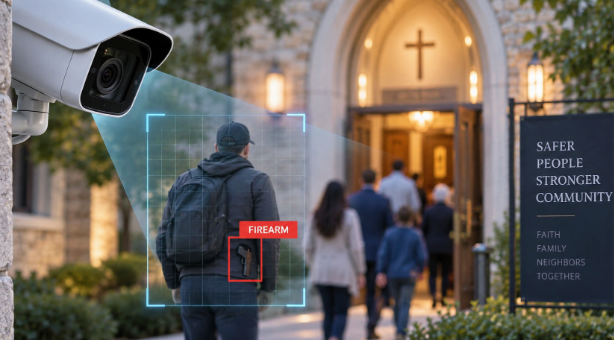
What the software performs is object detection, which is a specific and well-defined computer vision task. A classifier answers the question “what is this image of.” A detector answers a harder question: “what objects are present, and where.” For each frame it processes, the model returns a set of candidate boxes, each with coordinates, a class label such as firearm, and a confidence score between zero and one. Nothing in that output identifies a person. The model has no concept of who is in the frame, and in a properly scoped deployment it is never paired with a face database at all.
That architectural separation is the reason weapon detection usually arrives bundled with other video analytics rather than as a standalone box, since the same decoded stream can feed several models and one alerting path; the physical security overview published by Rank One Computing describes that pattern, running threat detection alongside visitor vetting and secure-zone monitoring through a single interface. For a volunteer safety team, the practical consequence is that the decisions worth scrutinizing are not about the camera brand on the wall. They are about where inference runs, how many pixels land on the object, how much latency the chain introduces, and how the system decides when to tell a human.
Key Takeaways
- AI cameras do not perform detection; the real intelligence lies in software that analyzes video streams from standard IP cameras.
- Object detection requires a balance between recognizing objects and maintaining privacy, with critical considerations for resolution, latency, and accuracy.
- Three inference methods exist: server-side, edge, and cloud, each impacting cost, privacy, and system reliability differently.
- Key factors for effective detection include lighting conditions, camera compression, and ensuring the correct configuration for specific scenarios.
- Ultimately, congregations should focus on engineering questions to evaluate AI cameras effectively and make informed decisions about their security needs.
Table of contents
Where the inference actually runs
There are three common architectures, and the choice has real consequences for cost, privacy, and reliability.
Understanding that split is the difference between evaluating AI gun detection on its engineering merits and buying a label, and for a church, synagogue, mosque, or temple working with a limited budget and an existing camera fleet, it is also the difference between a project that costs tens of thousands and one that costs a fraction of that.
Server-side inference is the most common for existing camera fleets. A small appliance or server on the premises pulls RTSP streams from the cameras already installed, decodes them, and runs the model on a GPU. Nothing leaves the building, and old cameras keep their jobs.
Edge inference puts a processor inside or beside the camera, so analysis happens where the image is captured and only alerts travel the network. This reduces bandwidth and keeps video local by design, but it generally requires newer hardware.
Cloud inference sends frames or clips offsite for analysis. It is the cheapest to start and the hardest to defend in a house of worship, because congregants reasonably want to know whether images of their children are leaving the building. Most faith communities that read the architecture carefully end up preferring on-premises processing, and it is a fair question to ask any vendor in the first meeting.
Pixels on target, the constraint nobody mentions in a demo
A detection model cannot find what the sensor did not resolve. The industry metric for this is pixels per foot, and video system designers have long used rough guidance for human subjects: roughly 20 pixels per foot to detect that a person is present, around 40 to recognize a familiar person, and 60 or more to identify a stranger. A firearm is a far smaller object than a person, so the density needed to resolve one reliably sits at the upper end of that range rather than the lower.
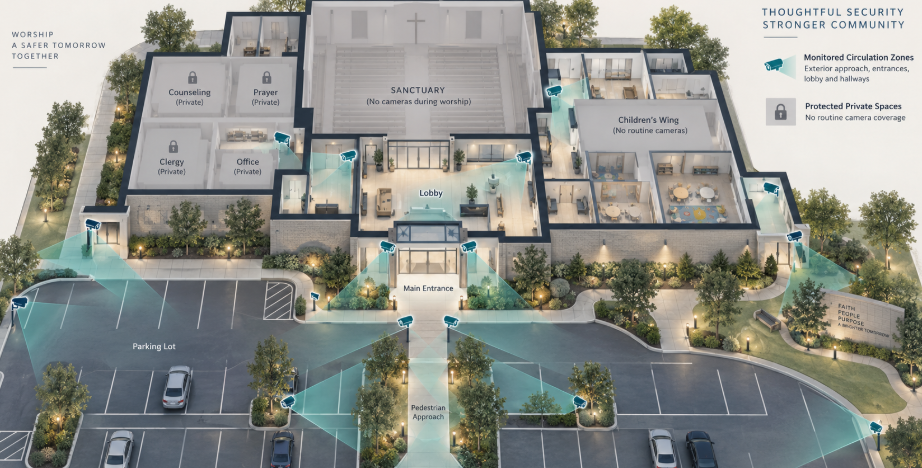
This is why a 4K camera can underperform a 1080p AI camera. Resolution is spread across the field of view, so a wide-angle lens covering an entire parking lot delivers very few pixels to any one object, while a narrower lens covering the walkway between the lot and the main door concentrates them where a weapon would actually appear. Before any purchase, the useful exercise is to pick the two or three approach paths a person would walk, then check what each AI camera’s resolution and lens actually deliver at that distance. Most congregations discover they need to re-aim or re-lens a couple of cameras rather than replace the system.
The latency budget, stage by stage
Vendors quote inference time. What matters to a safety team is the full chain from the moment a weapon becomes visible to the moment a phone buzzes.
| Stage | What happens | What affects it |
|---|---|---|
| Capture and encode | Camera produces compressed frames | Frame rate, bitrate, shutter speed |
| Transport | Stream crosses the network to the inference host | Network capacity, Wi-Fi versus wired |
| Decode | Compressed video is turned back into frames | Server capacity, number of streams per host |
| Inference | The model scores frames and returns boxes | GPU capability, model size, frames analyzed per second |
| Temporal confirmation | Detection is required across several frames before it counts | Number of frames required, a deliberate accuracy and speed tradeoff |
| Alert delivery | Clip and location pushed to phones or a console | Notification service, carrier delivery, device state |
Inference itself is typically the fastest stage on current hardware. The stages that surprise people are transport on a saturated wireless link and alert delivery to a phone that is asleep in a pocket during a service. When a safety team tests a system, the number to measure is the one that includes every row of that table, not the one on the datasheet.
Why AI camera false alerts happen, and what suppresses them
Every detector balances two errors: missing a real weapon and flagging something that is not one. The threshold is a dial between them, and a vendor that will not discuss the tradeoff openly is a vendor to be careful with.
Three mechanisms do most of the suppression work in a well-built pipeline. Temporal confirmation requires the same object to be detected across several consecutive frames, which eliminates the single-frame artifacts that cause most spurious alerts, at the cost of a few hundred milliseconds. Zone masking tells the system to ignore regions where a detection cannot be meaningful, such as a neighboring road or a screen showing video. And human verification routes every candidate alert to a person with the clip attached, so the system’s job is to decide what a human should look at rather than to decide what happens next.
That last mechanism is also the honest answer to the question congregations ask most often, which is what happens if the system is wrong. In a correctly designed deployment, nothing happens automatically that a person would regret. A volunteer opens a clip, sees a phone or a power tool rather than a firearm, dismisses it, and the weekly dismissal count becomes the tuning data for the next adjustment.
What light and compression do to the AI camera model
Two technical factors degrade real-world performance more than anything in the model itself. The first is illumination. After dark, most cameras switch to infrared and produce monochrome images with different texture and contrast than the daylight images models are mostly trained on, so detection quality drops at exactly the hour a midweek evening gathering takes place. Parking lot lighting is therefore a detection investment, not just a comfort one. Backlit entrances cause a related problem, where a figure walking in from bright sunlight becomes a silhouette unless the camera’s wide dynamic range is configured for it.
The second is compression. Cameras are usually tuned for storage efficiency, and aggressive compression smooths exactly the fine edges a detector relies on, while a slow shutter in low light adds motion blur to anything moving. Raising the bitrate on the two or three cameras that matter for detection, and leaving the rest tuned for storage, is one of the cheapest performance improvements available.
Where the AI camera technology stops
It is worth stating the limits plainly, because a safety plan built on an inflated understanding is more dangerous than no plan. A camera detects what is visible, so a concealed firearm generates no alert until it is drawn. Detection quality falls with distance, poor light, and heavy occlusion. And an alert is not a response: the protective value exists only if a congregation has written down who confirms, who secures which door, who notifies the children’s wing, and who calls 911, and has rehearsed it.
Scope discipline matters too. A system that flags objects in defined exterior zones, keeps sanctuaries and counseling spaces out of coverage, and never attaches identity to a detection is one that leadership can explain in a single sentence from the pulpit. The same cameras could support very different software, which is precisely why the policy should be written before the install rather than after the first complaint.
Read Next
A few related pieces worth your time:
- From Static PDFs to Actionable Insights: AI Is Transforming Workflows
- Reilaa’s Smart Review: Free Similarity Checks with Clear Reporting
- AI People Remover Tool: Remove Unwanted People Fast
The bottom line
The useful questions about an AI camera are engineering questions: where does inference run, how many pixels reach the object along the paths people actually walk, what does the full alert chain cost in seconds, and how does the pipeline suppress false positives before a volunteer’s phone lights up. A congregation that can ask those five questions will evaluate any vendor competently and will usually spend less than it feared, because the existing cameras do more of the work than expected. Technical documentation published by developers in this field, including the American vision AI company ROC, is specific enough for a volunteer safety committee to work through on its own.
Editor’s Disclaimer: This article is provided for general informational purposes only and does not constitute security, legal, or professional advice. The technologies described vary considerably between vendors and installations, and performance in any given facility depends on site conditions, equipment, and configuration. Readers should consult qualified security professionals and their local law enforcement agency before making decisions about physical security measures for their organization. The views expressed are those of the author and do not necessarily reflect those of this publication, which does not endorse any specific product, vendor, or service mentioned.
This article is offered as a technical primer, not an endorsement of any product or vendor. Its central point bears repeating: AI weapon detection is only one link in a safety chain. It can’t see a concealed firearm, it performs worse at night and at a distance, and an alert does nothing unless trained people know exactly what to do when their phones buzz.
Before evaluating any system, we encourage congregations to start with fundamentals that cost little or nothing. These include a written emergency plan, clear roles for greeters and safety volunteers, regular drills, a working relationship with local law enforcement, and good exterior lighting. If you then consider detection technology, ask vendors for independent test results under conditions like yours, including evening lighting and your actual camera placements. Ask for false-alert rates measured in real deployments, not demos. Insist on on-premises processing and a written policy on what is recorded, who can see it, and how long it is kept.
Just as important is the conversation with your congregation. Members deserve to know what is being monitored and why before installation, not after.
[Disclosure: The article references products from Rank One Computing (ROC). Our publication has / has no commercial relationship with this company.]