The era of the gatekept $26.8 trillion commercial real estate financing sandbox is officially over. Legacy underwriting traditionally relied on opaque banking relationships, manually reviewed spreadsheets, and weeks of bureaucratic stalling that frustrated even seasoned property investors.
Today, modern API integration and cloud infrastructure are completely upending this dynamic. For information technology professionals and systems architects, the real story lies in the software.
Enterprise developers are successfully migrating complex financial workflows into accessible, user-facing interfaces. This structural transition is shifting commercial real estate lending away from institutional black boxes and toward algorithmic transparency.
The core bottleneck in commercial underwriting has always been data velocity. Legacy financial institutions frequently struggle with disconnected databases, requiring manual data reentry across separate software suites.
Modern fintech platforms solve this data fragmentation by deploying automated pipelines that ingest property metrics, local market telemetry, and borrower profiles simultaneously. This real-time ingestion allows data processing engines to calculate risk profiles instantly, replacing old systems that took weeks to return a basic quote.
Key Takeaways
- The $26.8 trillion commercial real estate industry shifts from opaque legacy systems to modern API integration and cloud infrastructure.
- Automated pipelines and open banking APIs increase data velocity and transparency, improving risk calculations and accessibility for investors.
- Fintech tools simplify complex financial evaluations, allowing users to perform real-time analysis and stress tests without deep knowledge of formulas.
- Developing scalable proptech platforms requires balancing security and performance, utilizing microservices and secure protocols.
- Transitioning to algorithmic underwriting emphasizes the need for ongoing education and advanced software engineering in financial systems.
Table of contents
Automated Underwriting Engines and the API Shift
A major shift in property technology is the transition toward open banking APIs and unified data layers. Historically, evaluating a commercial asset required a loan officer to manually verify rent rolls, tax histories, and structural maintenance records. Modern fintech platforms bypass these manual steps by connecting directly to municipal databases, enterprise accounting software, and property management systems.
Programmatic connectivity allows digital lending systems to analyze property cash flow dynamically. Risk management algorithms process massive datasets in real time to evaluate the financial viability of an asset.
This shift toward cloud-based automated systems and real-time market intelligence is driving major structural changes across the broader financial markets. A notable shift in capital markets shows that institutional debt and private credit are rapidly adopting automated underwriting to deploy liquidity more quickly than traditional banks.
By decoupling underwriting from manual human review, developers have successfully democratized institutional-grade analysis tools. Everyday real estate investors can now run complex financial simulations for commercial real estate financing that were previously restricted to Wall Street analysts.

Algorithmic Transparency Meets Real-Time Risk Calculation
The most critical indicator of a commercial asset’s health is its ability to cover its debt obligations from its net operating income. Historically, tracking this metric required complex mathematical modeling and deep knowledge of spreadsheet formulas. Fintech developers have solved this complexity by building sophisticated mathematical models into clean, web-based tools.
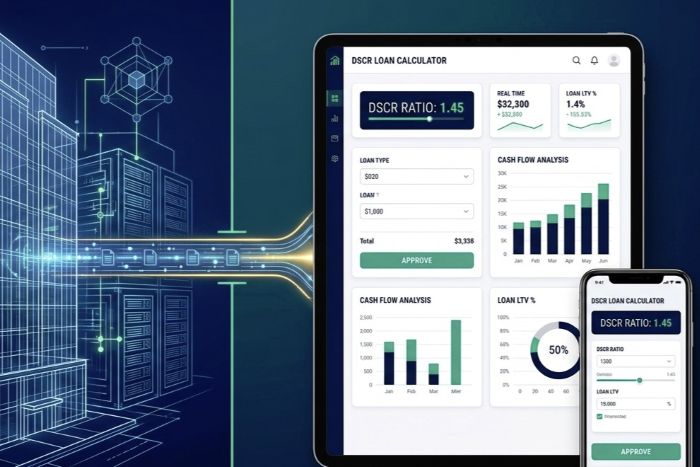
Investors evaluating a potential acquisition can use a specialized DSCR loan calculator to instantly analyze how fluctuating interest rates and varying leverage levels affect their overall net return. This mathematical transparency changes how investors interact with risk.
When complex equations are translated into interactive, real-time data visualizations, users can run instant stress test scenarios on their portfolios. Software engineering teams are intentionally designing these tools to calculate multivariable equations in the background. The user interface simply displays clear, actionable feedback regarding loan eligibility and cash flow thresholds.
This specific optimization has significantly accelerated the early stages of property acquisition. Advanced property data aggregation and open APIs enable instant credit decisions, significantly shortening the standard closing window. This rapid data processing allows smaller, independent operators to compete effectively with massive corporate funds.
Building Scalable Proptech Platforms for Tomorrow
Developing financial software for commercial real estate financing requires balancing deep system security with high-performance processing. Because these platforms process sensitive corporate financials, banking records, and identity verification data, the underlying infrastructure must prioritize strict data governance. This is why modern engineering teams rely heavily on microservices architecture and containerized data pipelines to maintain system reliability.
Maintaining this high level of architectural integrity is crucial as transaction volumes scale. Tech teams must configure their infrastructure to support complex workflows without introducing latency or causing system downtime.
The following core components are essential for maintaining a highly resilient and scalable commercial lending platform:
- Microservices designed to handle specialized financial math independently
- Event-driven messaging pipelines that update underwriting variables instantly
- Secure cryptographic protocols protecting sensitive corporate financial records
When these systems function in perfect harmony, the entire real estate lending lifecycle moves faster. This optimized software architecture allows credit evaluation platforms to process complex loans with minimal human intervention. The final result is an ecosystem in which access to capital is determined by clear, objective data rather than by slow, manual processing.
Optimizing Financial Systems Beyond the Code Base
Transitioning away from legacy commercial real estate workflows requires a deep understanding of both financial formulas and modern software engineering. As algorithmic underwriting becomes the industry standard for commercial real estate financing, building and maintaining secure, open data pipelines remains an ongoing priority. For software engineers, system architects, and tech enthusiasts looking to build next-generation tools, continuing education is essential.