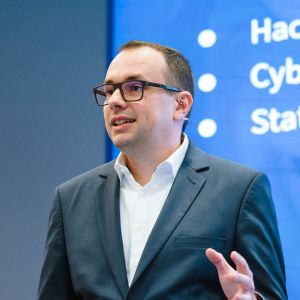
Zsolt Balogh Podcast Transcript
Zsolt Balogh joins host Brian Thomas on The Digital Executive Podcast.
Brian Thomas: Welcome to Coruzant Technologies, Home of The Digital Executive Podcast.
Do you work in emerging tech? Working on something innovative? Maybe an entrepreneur? Apply to be a guest at www.coruzant.com/brand.
Welcome to The Digital Executive. Today’s guest is Zsolt Balogh. Zsolt Balogh is the Vice President of Technology Operations and Support at Liferay, where he leads the company’s AI-driven innovations across customer support, security, and SaaS operations.
With a career spanning enterprise technology and digital infrastructure, Zsolt brings a deep practical approach to some of the most complex challenges facing modern software organizations, from scaling support operations to defending cloud platforms against increasingly sophisticated threats. A sought-after international speaker, Zsolt regularly shares insights on the real-world applications of AI, cutting through the hype to focus on what actually works in production environments.
His talks cover topics ranging from agentic support systems to operationalizing machine learning at enterprise scale, making him a trusted voice at the intersection of AI security and customer experience.
Well, good afternoon, Zsolt. Welcome to the show.
Zsolt Balogh: Thank you.
Brian Thomas: You’re very welcome, my friend. I appreciate it, and making the time. You’re hailing out of Budapest, Hungary today. I’m in Kansas City, so appreciate you traversing all these time zones and calendars to get here. So, thank you again. And Zsolt, let me jump right into your first question. You started your career as a system admin, joined Liferay as the European support team lead, and have since risen to Vice President of Technology Operations, earning CISO of the Year recognition along the way.
What were the pivotal moments or decisions that shaped that journey, and did you ever imagine you’d be leading AI and security strategy at this scale?
Zsolt Balogh: Started my career in hands-on technical roles, as you explained. And for me, the turning point was an early exposure to Stephen Covey’s Seven Habits and his son’s Eighth Habit.
Basically, this gave me a foundation on leadership, ownership, and continuous growth, and then those values actually mapped really well to Liferay’s core values and culture. The beginning, begin with the end in mind, um, habit actually worked for me before I even knew about it. I had a dream that when, when I was working for a small Hungarian company, that I want to work for Liferay at one point in my life.
I was working for the community, and I really wanted to meet the founders and talk to them and understand how they have built this beautiful company. And I still cannot believe, uh, that I didn’t just I get a chance to work for this company, but I also can lead, uh, these areas.
Brian Thomas: Thank you. I Really appreciate that.
You know, I talk to a lot of technologists here on the podcast, of course, a lot of CISOs and, VPs of technology, et cetera. But I like the fact that, you jumped in and really did some reading, and I like, We’ve all– I think w- a lot of us have read this book, Stephen Covey’s book on The 7 Habits of Highly Effective People, and I’m glad that was, influential in your career as well.
And you’re very curious. You got out there and started to meet and interact with, uh, people along the way, building, those relationships as your career blossomed. So, thank you. And Zsolt, you’ve been championing agentic AI systems to transform how support teams operate at Liferay. For executives who are still wrapping their heads around what agentic actually means in practice, can you walk us through a real-world example of how these a- systems are changing the customer support experience?
Zsolt Balogh: We have started to work on improving the customer experience with, agentic AI, basically before it was named agentic. So, the agentic AI doesn’t just answer your questions, but it also acts. you give it a goal, and then it will find out the steps using a set of tools and work through the task until it is done.
So what we have built at Liferay, for our customer support team was that, uh, when a customer ticket, is open, then an agent reads it, and based on the context information available, data, it, it will start, uh, breaking down the tasks into multiple different workflows, and then give a response on the ticket to help the support engineer.
So this is a very cautious way, of course, using agentic workflows because, because we want to make sure that our enterprise customers are served well, so we still have human in the loop responding, although we are exposing more and more of these to our customers. So our agentic system is, of course, using and searching the documentations and known issues and referencing, for example, our security vulnerability, documents.
And at the same time, it can also do very complex things. For example, if there’s a performance issue, we have made a very special agent which can understand the most complex performance issues and give very specific steps on how to, resolve those. So, what does it mean for the customers that, we are doing faster triage?
We measured, actually using AI, the performance of this agent, and it can give, actual proper ticket resolution, responses in fifty-one percent of the cases So at Liferay, we are supporting customers, who have very complex use cases because our, our customers who are opening the tickets are mostly developers, because they’re building on, on, on top of our platforms.
So, these are not just repetitive use cases. And this fifty-one percent was really surprising to us, and we were into how to narrow it down. But it turns out that most of the tickets don’t have enough context at the beginning, so we are working on, to improving, the quality of the issue reports at the same time.
the surprising result was that our responses got so much faster that our s- our customers started to see the value of our support more, and they have started to open more tickets. So actually it did not replace the support team as a lot of people were expecting, but actually gave us more work. But it also brought more value to our customers, which they do really appreciate.
Brian Thomas: That’s amazing. Thank you so much, and I appreciate that. You talked a little bit about, agentic AI. You unpacked some of the, the capabilities obviously of, of what an agent can do. It’s obviously more than just answering questions. It can act and do tasks, as you mentioned, including breaking down multiple tasks into workflows.
You noted that it’s important to keep the humans in the loop, which we talk about a lot here, on the podcast. But I like that you have created a special agent to handle very specific and complex tasks, especially for your developers, ’cause generally that’s who your customer base is. So thank you. And Zsolt, Liferay recently became one of the first companies globally to achieve ISO forty-two zero zero one certification for AI.
What does that certification actually mean for an enterprise considering Liferay, and what was the hardest part of getting there?
Zsolt Balogh: For an enterprise using Liferay, it means that our AI is governed and audited in an internationally recognized framework, not just relying on our good intentions on how d- we are deploying AI.
we are getting documented controls on how we are built, deployed, and monitored and improved actually, and an external body has verified that we actually did the work, which we are telling everyone. So ISO forty-two K is the first international management standard for AI, and, basically it’s, just, ISO twenty-seven K for AI.
It’s the same discipline, uh, applied to AI risk. what, what is great about it is that it maps clearly onto the EU AI Act, for example, and any emerging sector rules, so it actually satisfies multiple regimes at once. The hardest part was honestly is not the technical controls- It was that there’s a pretty big rush on everybody’s side to apply new AI technologies, and making sure that we can follow the same controls, same fo-follow the same playbook, and making sure that all departments are doing this was the biggest concern.
So it, it was not just, it was not a technical issue, but more like a communication and how we make sure that our com-compliance is fast enough. And to support that, we recognized, that, several organizations will have some limitations on how they can give access to AI data. So we actually figured out that we can build a product, which w- which, we call AI Hub, which helps customers to bring the same governance and structure to their AI use.
So, they will have a faster, go-to-market basically with their AI tools because then they can have more controls around the systems.
Brian Thomas: Thank you. Really appreciate that. and I like that you have built in that strict AI governance with your platform, but you can extend that to your customers and make sure they are also, provide those gu-guardrails and compliance as you talked about.
But I think that’s really cool, that certification, that ISO forty-two K basically means you’re doing what you say you can do, that validates that. So I appreciate that. And Zsolt, last question of the day, looking out maybe three to five years, what’s the development you’re most excited about, and what’s the one that keeps you up at night?
Zsolt Balogh: I’m working a lot with security, so let me start with the concern first. So, the cybersecurity threats are accelerating faster, and then regular defenses can adopt. We are seeing, and supply chain issues every single day, even this morning. And, uh, there are new attack surfaces coming, for example, from agentic AI.
Attackers are scaling up way faster, and we really need to, be on our toes and actually continuously improving how, we are defending. And this is not three to five years. basically, half jokingly, our, planning horizon has shrunk from three to five years to three to five days. On the excitement, though, can see a lot of, excitement on my end as well, about robotics and how merging robotics with AI technologies and reasoning, will give a genuinely new ways to serve, humanity.
looking at three to five years horizon, I think nano-nanobiology converging with AI general research is where I think the real breakthroughs will be coming.
Brian Thomas: Thank you. Really appreciate that. And I like you talked about, agentic AI and the, the advanced reasoning that is starting to do now. And of course, I believe, if you, if you look at the glass half full, we can see where AI can certainly improve, the way we work, the way we live, improve humanity all around. But again, we gotta make sure those guardrails are in place, and there’s people still in the world that are leveraging agentic AI for, for the wrong reasons. And that’s why, cybersecurity keeps you and me both up at night, ’cause these threats are evolving much faster, especially with the advancement of these, agents.
So, I really, really appreciate that. and Zsolt, it was just such a pleasure having you on today, and I look forward to speaking with you real soon.
Zsolt Balogh: Thank you so much. It was great talking to you.
Brian Thomas: Bye for now.
Zsolt Balogh Podcast Transcript. Listen to the audio on the guest’s Podcast Page.