
Key Takeaways
- Automated crypto trading uses crypto trading bots and algorithmic trading rules to buy and sell 24/7 on your exchange accounts without constant monitoring
- Traders of any skill level can connect all your exchanges to one platform, deploy trading bots, and use paper trading to test before risking real funds
- Risk management tools like stop loss, take profit, and position sizing protect capital and help avoid emotional biases in decision-making
- Past results from a trading system or bot marketplace strategy never guarantee future performance, especially in volatile cryptocurrency markets
- Automation frees time and reduces stress, but still requires clear goals, regular monitoring, and basic understanding of how your crypto exchange and trading system work
Table of contents
- Key Takeaways
- What Is Automated Crypto Trading?
- How Crypto Trading Bots Work Behind the Scenes
- Connecting All Your Exchanges and Managing Accounts
- Designing a Trading System: From Idea to Live Bot
- Backtesting, Paper Trading, and Evaluating Future Performance
- Risk Management in Automated Crypto Trading Bots
- Choosing Automated Crypto Trading Tools for Your Skill Level
- Security, Privacy, and Regulatory Considerations
- Getting Started with Automated Crypto Trading Bots Today
- FAQ
What Is Automated Crypto Trading?
Automated crypto trading uses software—specifically crypto trading bots—to execute predefined rules for buying and selling cryptocurrencies on major exchanges like Binance, Coinbase, and Kraken. These crypto trading bots automate the process of buying and selling digital assets based on predefined trading strategies, allowing traders to react quickly to market changes without constant monitoring.
The distinction between fully automated and semi-automated systems matters:
- Fully automated crypto bots: Execute trades hands-off after initial setup
- Semi-automated systems: Send tradingview alerts or notifications requiring user confirmation before each trade
Algorithmic trading replaces manual clicking with code-driven logic based on price movement, volume, and indicators. For example, in 2026, a bot trading BTC/USDT on Binance Futures might follow a moving-average crossover strategy—entering long when the 50-period EMA crosses above the 200-period EMA—without human intervention.
Emotion-free trading removes human biases like fear and greed, preventing impulsive decisions that often hurt manual traders.
How Crypto Trading Bots Work Behind the Scenes
Every trading bot follows a basic architecture: data input from the crypto exchange, signal generation based on your rules, order execution, and a feedback loop for performance tracking.
Core components include:
- Market data feed (candles, order book depth, trade history)
- Strategy engine processing indicators and conditions
- Risk management module enforcing limits
- Execution engine sending buy and sell orders through api keys
Users configure rules like “if price drops 3% and RSI < 30, buy; if profit hits 5%, sell”—and crypto trading bots monitor markets 24/7 to apply those trading algorithms consistently.
Common strategies bots automate in 2026:
- Grid bots: Place multiple buy and sell orders within a specific price range, profiting from sideways market volatility
- DCA bots: Dollar cost averaging buys fixed amounts at regular intervals, smoothing out price trend fluctuations
- Arbitrage: Identifies price differences for the same asset across different exchanges
- Momentum Trading: Buying when market sentiment is strong and selling when momentum breaks
While providers mention artificial intelligence or machine learning, most retail crypto bots still rely on rule-based algorithmic trading with clear, human-defined parameters.
Connecting All Your Exchanges and Managing Accounts
Modern automation platforms let you connect all your exchanges—Binance, Bybit, OKX, KuCoin—and manage every exchange account from one trading terminal.
Automated systems connect to crypto exchanges using API keys with specific, limited permissions. Proper setup grants trading permissions only (no withdrawals) for safety, ensuring the bot provider cannot withdraw funds from your exchange accounts.
User flow:
- Create an account on the automation platform
- Generate API keys on each crypto exchange
- Copy keys into the platform
- Assign bots to specific connected exchanges
Best practices:
- Enable IP whitelisting to block unauthorized access
- Use read-only keys for monitoring, trading keys for execution
- Delete unused keys immediately
- Rotate keys monthly
This setup provides a unified portfolio view across spot and futures markets, reduces login fatigue, and enables easier diversification across multiple exchanges.
Designing a Trading System: From Idea to Live Bot
Every profitable automation setup begins with a clear trading system defining rules for entry, exit, position sizing, and risk management.
Walk through these stages:
- Define your market: Spot for long-term holds vs. futures for amplified returns
- Choose timeframe: Scalping (1-5 minute candles) vs. swing trading (4-hour to daily)
- Select indicators: EMA crossovers, RSI, Bollinger Bands
- Set entry and exit rules: When to buy and sell, and at what levels
Many platforms in 2026 offer visual rule builders, bot marketplaces, and strategy templates so new users of any skill level can launch a basic crypto trading bot without coding.
Example BTC/ETH swing system:
- 4-hour candles with EMA crossover signals
- 1% account risk per trade
- Fixed 2:1 reward-to-risk ratio
- Smart trade features for automated take profit and stop loss
Core elements every system must define:
- Entry conditions (what triggers a trade)
- Exit conditions (profit targets, loss limits)
- Position sizing based on risk tolerance
- Maximum open positions
- Market conditions filters
Backtesting, Paper Trading, and Evaluating Future Performance
Backtesting runs your trading strategies on historical data—for example, BTC/USDT from January 2020 to December 2025—to estimate how the strategy might have performed.
Many automated crypto trading bots come equipped with a backtesting feature that allows users to test their strategies on historical data before executing them in real-time, helping to fine-tune strategies.
Paper trading (simulated trading with virtual funds on real-time market data) validates that your bots behave as expected before risking capital.
What to evaluate:
- Total return percentage
- Maximum drawdown (largest peak-to-trough decline)
- Win rate and average risk-reward
- Number of trades (fewer high-quality signals often beat thousands of noisy trades)
Common pitfalls:
- Over-optimization of trading strategies can lead to failure in live markets when they are too tailored to past data
- Testing only on bull market periods
- Ignoring fees and slippage in calculations
Strong past results—even on years of data—do not guarantee future performance, especially in fast-changing crypto markets with events like Bitcoin halving cycles.

Risk Management in Automated Crypto Trading Bots
Automation multiplies both good and bad decisions. Automated systems pose risks like technical failures, over-optimization of strategies, and potential security breaches.
Essential risk tools:
- Stop loss to cap losses per trade
- Take profit to lock in gains
- Trailing features that adjust stops as price moves favorably
- Maximum daily loss limits
- Position sizing based on account percentage
- Limits on open positions per exchange account
Scenario: In 2022-2023, overleveraged bots on perpetual futures liquidated entire accounts during volatile swings. Properly risk-managed bots capped losses to 1-2% per trade, surviving the same market movements.
Automated trading systems are prone to technical failures such as internet outages, bugs, or system malfunctions. Regular maintenance and re-evaluation of strategies is necessary to adapt to market volatility.
Non-negotiable rules before going live:
- Never risk more than 1-2% per trade
- Set circuit breakers at 15-20% daily drawdown
- Diversify across uncorrelated pairs
- Run different strategies to reduce single-point risk
- Track all positions from one dashboard using your trading journal
Choosing Automated Crypto Trading Tools for Your Skill Level
In 2026, tools exist for absolute beginners, intermediate traders, and professional quants. Success in trading often requires a balance between automated tools and human oversight.
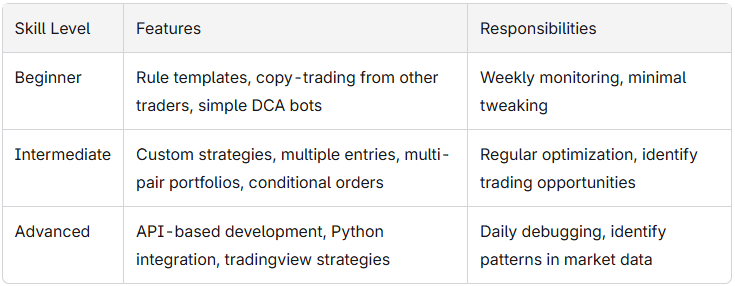
Crypto trading bots can range from free plan options to several hundred dollars per month. Some trading bots offer free plans with limited features, while paid plans can start as low as $15 and go up to $749 monthly, depending on the platform and capabilities.
Many crypto trading bots provide a free trial period, allowing users to test the platform before committing to a paid subscription.
Security, Privacy, and Regulatory Considerations
Security is critical when connecting exchange accounts to third-party crypto bots. Using APIs to connect bots to exchanges presents security risks, as compromised bots can be exploited for malicious purposes.
Best practices:
- Use API keys with no withdrawal rights
- Enable 2FA on both the trading platform and each crypto exchange
- Rotate keys regularly
Reputable crypto trading bots incorporate security features such as two-factor authentication and encryption to protect users’ accounts and trading data. Many trading bots utilize a transparent ecosystem for all trades, complying with stringent regulations to enhance user security and trust.
Regulatory considerations:
- European Union MiCA mandates KYC for bots exceeding certain thresholds
- US CFTC oversight applies to futures markets
- Tax reporting requirements vary by jurisdiction
Disclaimer:
- Automation tools cannot promise profits
- Users remain responsible for compliance and due diligence
- Full control of funds stays with the user, not the platform
- Past performance never guarantees future results
Getting Started with Automated Crypto Trading Bots Today
Traders are advised to start small with a limited amount of capital to understand the crypto trading bots system and reduce risk.
Step 1: Define your goals—income generation vs. long-term growth. Decide what portion of capital to automate (no more than 20-30% initially).
Step 2: Choose a secure trading platform, create an account, and start trading with paper trading or a demo environment. Experienced traders and beginners alike benefit from practice without risking real funds.
Step 3: Connect one or more exchange accounts via API, starting with a single well-known crypto exchange before expanding. Many automated trading platforms support multiple exchanges, allowing users to manage trades across different platforms from a single interface.
Step 4: Select or design a simple strategy, backtest it over several years of historical data, run it on paper trading for a few weeks, then go live with small position sizes. Despite automation, trading systems require regular monitoring to adapt to changing market conditions.
Your support team at most platforms can help troubleshoot connection issues or strategy questions.
FAQ
This FAQ addresses common questions not fully covered above.
How much money do I need to start with automated crypto trading?
Many exchanges allow trading from as little as $10-$100 per bot. Practical minimums depend on fees, position sizing, and the number of pairs traded. Start with an amount you can afford to lose while learning how bots behave in live market movements, then scale gradually as you gain confidence.
Are automated crypto trading bots safe to use with my exchange accounts?
Safety depends on the platform’s security practices and how you configure API keys. Use trading-only keys with no withdrawal permissions. Even with good security, bots can still lose money due to market moves or bad strategy design—“safe” means secure access, not guaranteed capital protection.
Do I still need to monitor my bots once they are running?
Bots reduce the need to watch charts all day, but you should review performance regularly, check logs, and update settings when market conditions change. Daily or weekly check-ins work depending on strategy speed, plus set up alerts for critical events like connection errors or large drawdowns.
How do automated trades affect my crypto taxes?
In most jurisdictions, every automated buy and sell can be a taxable event. Active bots may generate thousands of trades per year. Use specialized crypto tax software that syncs with exchange accounts via API or CSV exports to track gains, losses, and fees efficiently.
Can beginners really profit from algorithmic trading without coding skills?
Many platforms now offer no-code tools, templates, and strategy marketplaces, so coding is no longer required to automate your trading with simple bots. Results depend on risk management, market conditions, and ongoing learning—not automation alone. Start with a signal bot or DCA strategy and build from there.