
Agile did not appear as a trend. It emerged as a response to delivery friction. Long planning cycles slowed reaction time. By the time the software was released, requirements had already shifted.
In fact, 95% of professionals say Agile is critical to their operations, reinforcing that it remains foundational despite the rise of AI and other emerging technologies.
The shift toward iterative work reduced that lag. Short cycles made adjustment possible without halting progress. Scope became fluid, but delivery remained continuous.
In those situations, teams begin looking at Custom Software Development Services not as an upgrade, but as a structural reset. The discussion shifts toward control of who defines the roadmap, who owns the architecture, and how deeply the system can change over time—supported by an Agile Software Development Company and AI & ML consulting services enabling smarter, data-driven evolution.
Table of contents
Core Benefits of Agile Development
Adaptation happens inside motion. Teams revise direction while development continues. This limits disruption and prevents large-scale resets. An AI Software Development Company can strengthen this process by using intelligent tools that support faster adjustments and better decision-making during ongoing development.
Frequent releases narrow uncertainty. Feedback attaches to working increments rather than abstract projections. Errors surface earlier because validation is continuous rather than deferred.
Quality control overlaps with implementation. Testing is embedded, not postponed. Smaller change sets reduce escalation risk.
Collaboration increases through repetition, not declaration. Cross-functional interaction becomes routine over time instead of remaining event-based.
Common Challenges Organizations Face
Agile does not remove structural friction. In some organizations, hierarchy absorbs iteration speed instead of supporting it. Decision layers remain intact, which stretches sprint cycles even when ceremonies are in place.
Requirements rarely stay stable. When scope shifts faster than validation mechanisms, teams move continuously without consolidating outcomes. Progress becomes visible, but stability does not automatically follow.
Scaling introduces coordination strain. Multiple teams working in parallel increases dependency density. Alignment then depends less on frameworks and more on communication discipline.
Documentation is often treated as secondary in fast cycles. Over time, that trade-off accumulates into technical debt, particularly in systems that evolve without architectural checkpoints.
Best Practices for Successful Agile Implementation
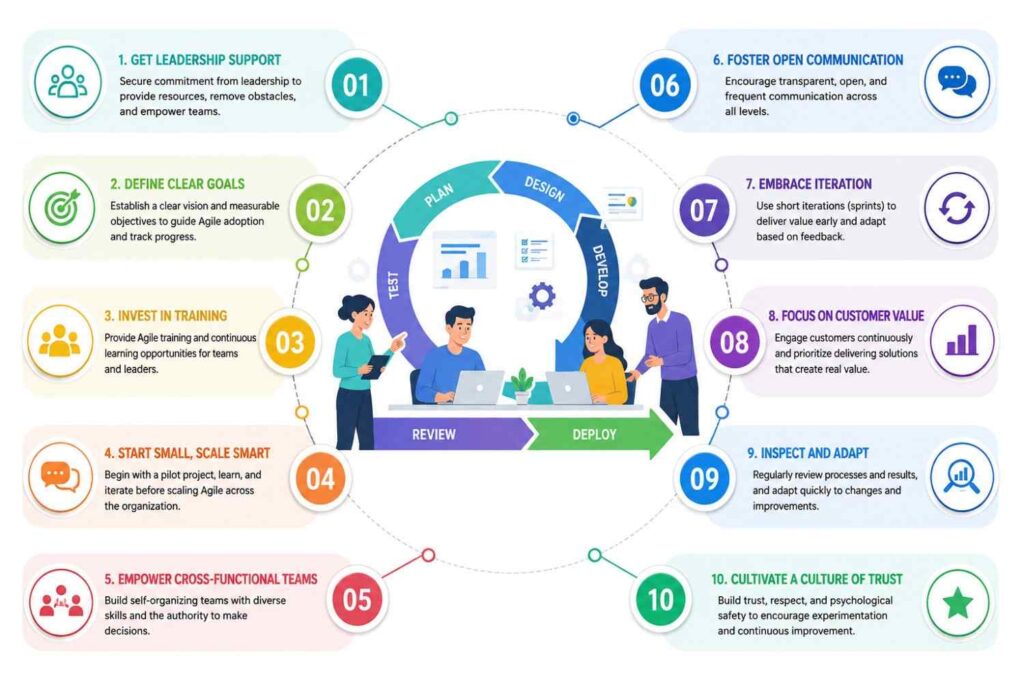
Vision alone does not stabilize execution. What matters is whether objectives are measurable and revisited frequently. When goals remain abstract, iterations lose direction even if sprint ceremonies are consistent.
Backlog discipline influences delivery more than tooling. Priorities shift, but without structured refinement, the backlog becomes reactive instead of strategic. Regular review prevents silent drift.
Testing must overlap with development rather than follow it. Automated validation limits regression risk. Its impact, however, varies with integration depth and test coverage quality. In some cases, instability appears not because tools are missing, but because feedback signals are ignored.
Daily stand-ups and sprint reviews increase interaction. Transparency develops gradually and depends on how openly issues are discussed, not simply on meeting frequency.
When communication becomes formulaic, obstacles persist beneath surface reporting.
Balancing Speed with Long-Term Stability
Iteration speed often increases before structural stability does. When delivery accelerates without architectural boundaries, rework accumulates quietly. Core system decisions made too late tend to surface as recurring friction.
Technical debt rarely appears dramatic at first. It grows through small compromises that seem harmless within individual sprints. Without periodic refactoring cycles, those compromises consolidate into structural rigidity.
Documentation becomes relevant when teams expand or responsibilities shift. Key decisions that remain implicit can slow scaling more than initial design limitations.
The engineers from Crunch-IS, one of the industry leaders, are especially focused on creating products that provide both speed and long-term stability for their clients’ systems.
Measuring Agile Performance
Performance visibility influences iteration quality. Metrics such as velocity or cycle time describe pace, but they do not, on their own, explain coordination depth.
Defect density and deployment frequency reveal stability patterns over time. Customer feedback metrics add context, though interpretation depends on release cadence and product maturity.
Data support improvement only when trends are examined longitudinally. Without periodic review of underlying causes, measurement becomes reporting rather than refinement.
When Agile Delivers the Greatest Value
Agile tends to function better in environments where requirements shift frequently and feedback cycles are short. Products exposed directly to user behavior often reveal adjustment needs faster than long planning cycles can accommodate.
Sectors with rapid iteration culture such as software platforms or digital services, typically integrate Agile more naturally because release cadence is already embedded in operations.
In regulated domains, adoption is possible but requires additional coordination layers. Iteration must coexist with compliance controls rather than replace them.
Turning Agile into a Competitive Advantage
Agile becomes useful only when structure supports it. Speed alone does not create leverage. Iteration without architectural stability can increase fragmentation rather than reduce it.
Competitive advantage emerges gradually. It depends on how teams handle coordination, documentation discipline, and technical debt management. Organizations that treat Agile as a learning mechanism rather than a branding label tend to extract more value from it.
In volatile markets, responsiveness matters. But sustainability depends on internal coherence, not sprint velocity alone.