Just a few years ago, additive manufacturing was largely confined to basic prototyping and hobbyist workshops. Now, 3D printing innovations are fundamentally changing global production lines, turning digital concepts into physical reality with unprecedented speed and precision.
In this guide, we will explore the latest 3D printing innovations that have come to the forefront in 2026. We will analyze how these technologies solve fundamental problems for engineers, doctors, and construction managers. If you are a professional seeking advanced 3D printing materials, AI-assisted design, or sustainable manufacturing practices, understanding these breakthroughs is critical for staying competitive.
Here, you will uncover recent innovations in 3D printing across multiple sectors. We will cover bioprinting breakthroughs that are saving lives in hospitals, Large-Scale Additive Construction (LSAC) that is reshaping our cities, and multi-material 3D printing systems transforming aerospace.
Key Takeaways
- 3D printing innovations are transforming production through AI-driven designs, bioprinting breakthroughs, and Large-Scale Additive Construction (LSAC).
- AI and generative design algorithms create optimized structures, significantly reducing material waste and production time.
- In medicine, 3D printing innovations enhance personalized care through Point-of-Care Manufacturing and custom implants.
- LSAC lowers construction costs and speeds up build times, demonstrating the disruptive potential of 3D printing technologies.
- New materials and techniques drive sustainability, offering lower carbon emissions and decreased material waste in 3D printing.
Table of Contents
AI-Driven Generative Design and Digital Integration
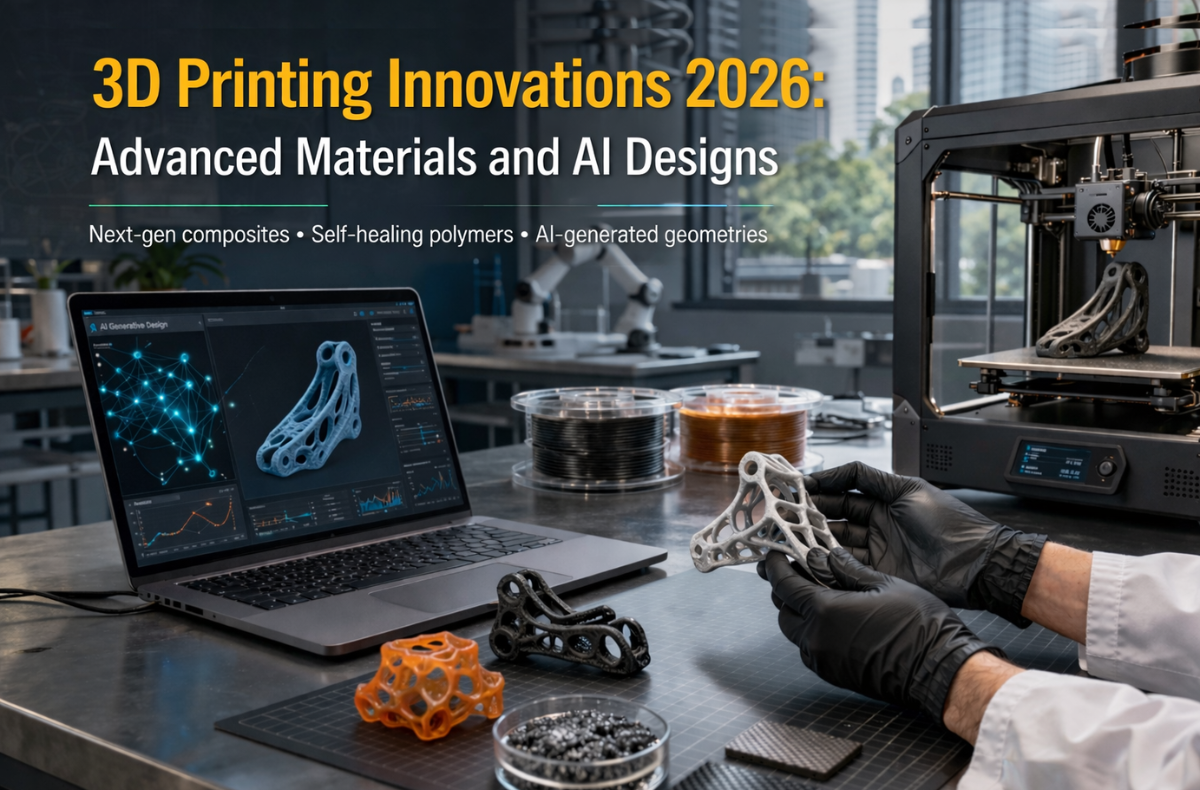
Artificial intelligence is revising how individuals use 3D printing in 2026. Machines can now design complex objects faster and with fewer mistakes. Engineers no longer have to rely solely on manual drafting; instead, they use AI to create highly optimized structures that humans could never conceptualize on their own.
The Power of Generative Design Algorithms
Generative Design Algorithms and AI-assisted design allow engineers to specify parameters such as maximum weight, load-bearing requirements, and material types. The AI then generates thousands of optimal geometric structures. This approach to AI-driven generative design in 3D printing results in parts that are incredibly strong yet exceptionally lightweight. These 3D printing innovations drastically reduce material waste and production time.
Predicting Performance with Digital Twins
Another major leap forward involves Digital Twin Integration. By pairing a physical 3D printer with a virtual replica, manufacturers can simulate the entire printing process before a single drop of material is extruded.
- Virtual testing predicts thermal warping and structural weaknesses.
- Real-time adjustments occur automatically during the physical print.
- The system learns from past prints to improve future accuracy.
Is 3D Printing a Computing Innovation?
Many people ask: is 3d printing a computing innovation? The answer is a definitive yes. Because modern AI software strictly dictates physical outputs, additive manufacturing is now deeply rooted in computer science. This 3D printing computing innovation means that software advancements directly translate into hardware capabilities.
Breakthrough 3D Printing Innovations in Medicine
Medical professionals are utilizing 3D printing innovations to deliver personalized care directly to patients. The days of waiting weeks for generic medical devices are fading quickly.
Point-of-Care Manufacturing
Point-of-Care Manufacturing allows hospitals to print essential tools, surgical guides, and customized prosthetics right inside the clinical setting. These 3d printing innovations in medicine ensure that surgeons have perfectly tailored instruments for complex procedures, significantly improving patient outcomes.
Bioprinting and Tissue Engineering
Bioprinting and tissue engineering have reached new heights. A prime example is the TRACE (Tunable Rapid Assembly of Collagenous Elements) method developed at Stony Brook Medicine. This 3D printing innovation accelerates collagen assembly, enabling researchers to print functional heart and kidney tissue models. These models accurately mimic human physiology, offering a safer and faster alternative for drug testing.
Custom Implants for Better Healing
The rise of medical 3D printing and custom implants relies heavily on Biocompatible 3D Printing Materials. Surgeons can now order bone replacements that match a patient’s exact anatomy. This 3D printing innovation in healthcare leads to highly advanced 3D-printed products that promote faster healing and reduce the risk of implant rejection. These 3D printing medical innovations are truly life-saving.
Large-Scale Additive Construction (LSAC)
The construction industry is notorious for high costs, long delays, and excessive material waste. 3D printing in construction technology offers a powerful solution through Large-Scale Additive Construction (LSAC).
Building Faster and Smarter
LSAC uses large robotic extruders to print the walls and foundations of buildings with concrete or composite mixtures. This disruptive innovation 3d printing technology, allows developers to build urban infrastructure faster and with significantly less waste.
Cost Comparison (2026 Estimates)
| Metric | Traditional Construction | LSAC (3D Printing Innovations) |
|---|---|---|
| Average Cost/Sq Ft | $162 – $350 | $120 – $210 |
| Material Waste | 15-30% | < 5% |
| Build Time (Standard Home) | 6-8 months | 3-5 weeks |
As the data shows, 3D printing innovations in the construction sector represent a true 3d printing disruptive innovation. They lower costs and drastically accelerate project timelines.
Advancements in Materials and Sustainability
The success of any print depends on the materials used. Sustainable and advanced 3D printing materials are expanding the capabilities of modern hardware. You can now use multi-material 3D printing systems to combine rigid and flexible sections in a single build.
Here is a quick breakdown of popular materials driving material innovation:
| Material Type | Key Properties | Common Uses |
|---|---|---|
| PLA | Biodegradable, easy to print, low cost | Rapid prototyping with additive manufacturing |
| PHB | Bacterial fermentation, high biodegradability | Eco-friendly packaging, medical models |
| Recycled PA12 | Retains strength across multiple recycling cycles | End-use industrial 3D printing applications |
| Titanium Alloys | High strength, lightweight, corrosion-resistant | Aerospace additive manufacturing, implants |
We are also seeing the rise of Functional Gradient Materials (FGM), Shape Memory Polymers, and Biocompatible 3D Printing Materials. These 3D printing innovations allow engineers to create smart objects that adapt to their environments.
3D printing innovations naturally produce less waste than subtractive methods. Here is a comparison of material and energy efficiency:
| Parameter | 3D Printing Technologies | Traditional Manufacturing | Key Insights |
|---|---|---|---|
| Carbon Emissions (kg CO2) | 4–10 per unit | 15–25 per unit | Lower emissions in distributed manufacturing, but offset by higher energy use. |
| Energy Consumption (kWh) | 45–70 | 30–50 | Energy-intensive, especially for SLA methods. |
| Material Waste (%) | 2–5 | 20–30 | Significant reduction due to additive manufacturing. |
By adopting 3D printing, manufacturers are creating products that adapt to their environments.
Industrial Scale and Aerospace Additive Manufacturing
Large-scale industrial 3D printing requires immense precision and durability, particularly when lives are at stake in the aviation sector.
Metal Additive Manufacturing and Turbine Repair
Aerospace additive manufacturing heavily relies on metal additive manufacturing techniques like Directed Energy Deposition (DED). DED is actively used for repairing aerospace turbine blades. Instead of scrapping a damaged million-dollar engine part, engineers use DED to seamlessly fuse new metal powder onto the worn areas, restoring the blade to factory specifications.
Multi-Material Systems and Spare Parts
Innovative 3D printing solutions now use multi-material 3D printing systems to embed electronics directly into structural components. Furthermore, On-Demand Spare Parts Production reduces massive warehouse storage costs for airlines and automotive brands. Companies simply maintain a digital inventory and print replacement parts exactly when needed. These 3D printing innovations streamline global supply chains.
High-Speed and Next-Gen Technologies
Speed has historically been the primary bottleneck for additive manufacturing. However, high-speed 3D printing technology has evolved rapidly.
Contrasting High-Speed Methods
- Volumetric 3D Printing: Instead of printing layer by layer, this method cures an entire 3D object simultaneously within a vat of photosensitive resin using intersecting light beams.
- High-Speed Sintering (HSS): This technique applies an infrared-absorbing ink to a powder bed and then rapidly fuses the layers using an infrared lamp.
- Continuous Liquid Interface Production (CLIP): Using an oxygen-permeable window, CLIP pulls a continuous, seamless part out of a resin pool at incredibly high speeds.
Quality Control and Prototyping
To ensure these high-speed parts are flawless, machines use Closed-Loop Quality Control. Sensors monitor the prints in real-time, preventing failures before they happen. This combination of speed and monitoring makes rapid prototyping with additive manufacturing highly reliable and significantly shortens product development cycles. These 3D printing innovations give businesses a massive competitive edge.
Conclusion
From AI-driven generation and advanced bioprinting to LSAC and metal deposition, 3D printing innovations are reshaping how we build the world around us. Adopting advanced innovations is no longer optional for companies that want to lead their industries.
3D printer innovations are continuously evolving. Whether you want to develop innovative 3D printing ideas or explore innovative 3D prints, getting hands-on experience is vital. We encourage you to visit your local 3D printing lab, such as the FSU Innovation Hub 3D Printing Center, or explore virtual software environments, such as an innovation-sandbox 3D printing lab. By testing these tools yourself, you will discover the true potential of future trends in additive manufacturing.
FAQs
The most critical 3D printing innovations include AI-driven generative design, high-speed continuous liquid interface production (CLIP), and advanced 5-in-1 bioprinting systems for tissue engineering.
AI advances 3D printing by predicting print failures in real time, automatically generating 3D models from 2D images, and optimizing toolpaths to save time and material.
Yes. Sustainable 3D printing materials, such as bio-based polymers and recycled filament feedstock, are engineered to match or exceed the tensile strength and thermal resistance of traditional plastics.
Large-Scale Additive Construction (LSAC) is a branch of 3D printing innovation focused on infrastructure construction. It uses massive robotic arms to extrude concrete, quickly and cost-effectively creating homes and bridges.
Yes. 3D printing is a computing innovation because it relies entirely on software, digital twin integration, and precise algorithmic instructions to convert digital data into physical objects.