
An executive buyer’s guide to nine B2B SaaS PPC (pay-per-click) agencies worth shortlisting in 2026.
Use it to match a partner to your average contract value (ACV), sales motion, and measurement maturity, not to chase cheap leads.
Each entry highlights strengths, trade-offs, and the KPIs (key performance indicators) you should hold them to.
Key Takeaways
Shortlist based on revenue tracking, creative cadence, and fit with your stage, not on channel logos.
- Best overall for SaaS-native PPC plus landing pages: Hey Digital. They run Google and LinkedIn while building conversion-focused landing pages tied to pipeline and monthly recurring revenue (MRR).
- Best for enterprise analytics and large-scale search: Seer Interactive. Strong choice when you need unified data across long buying cycles.
- Best for aggressive creative testing on mid-market budgets: KlientBoost. Fast iteration across Search and LinkedIn with practical conversion rate optimization (CRO).
- Best for PLG strategy and integrated demand gen: Powered by Search. Go-to-market (GTM) frameworks that connect paid search, social, and messaging.
- Best for revenue operations integration at scale: Directive. Built for teams that need clean attribution and value-based bidding.
- Expect AI Overviews and AI Mode ads in 2026 search results. Require offline conversion imports to protect sales-qualified lead (SQL) quality.
- Benchmarks to sanity-check: Google Business Services search conversion rate averages about 5.14%, and LinkedIn Lead Gen Forms can deliver 2–3x more conversions than standard Sponsored Content.
Table of contents
How I Evaluated These Agencies
I prioritized SaaS-specific execution and measurement that ties spend to qualified pipeline, not just lead volume.
SaaS focus. Clear B2B SaaS PPC experience across product-led growth (PLG) and sales-led motions, with proof beyond brand search.
Channel mastery. Google Search, Performance Max, Microsoft Ads, LinkedIn (including Lead Gen Forms), and remarketing, where it makes sense.
Measurement stack. Google Analytics 4 (GA4), enhanced conversions for leads, offline conversion imports, and CRM integration to grade lead quality.
Bidding strategy. Value-based bidding that assigns higher conversion values to later-stage outcomes like SQLs and opportunities.
Creative and CRO. A real testing cadence for ads and landing pages, plus the ability to translate learnings into new angles.
Contracting. A clear statement of work (SOW), transparent fees, and no channel lock-in.
B2B SaaS PPC in 2026
B2B SaaS PPC is a paid acquisition designed to create a qualified pipeline for software companies across search and professional social.
The inventory is changing fast. As of Q1 2025, Google’s AI Overviews reached more than 1.5 billion people monthly, and ads appeared beside them on roughly 40% of those result pages. Google is also testing search ads in AI Mode, which adds new placements and shifts click behavior.

Buying journeys are long and multi-threaded. Buying groups can include around 10 stakeholders and generate dozens of touches before a deal is created.
That’s why your CRM feedback loop matters as much as your click-through rate.
Hey Digital
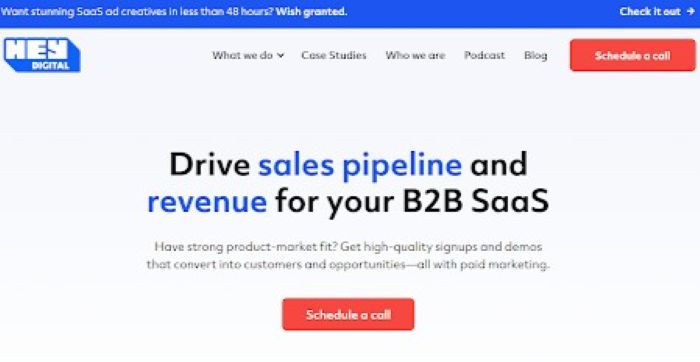
Best for B2B SaaS teams that want an in-house-feeling partner focused on pipeline and MRR.
Pros
- Deep SaaS focus across Google and LinkedIn
- Builds and refreshes ad creative plus dedicated landing pages
- Activates niche paid placements like Capterra, Reddit, Product Hunt, and Quora
- Reporting built around SQLs and pipeline, not raw form fills
Cons
- Boutique capacity with customized pricing
- Needs your CRM connected to unlock value-based bidding
Why They Stand Out
Hey Digital combines SaaS PPC execution with landing pages and creative refreshes, so the conversion path gets optimized end-to-end.
Their initial 3-month agreement, then month-to-month, creates pressure to deliver early wins without relying on long contracts.
KPIs to own: SQL rate, opportunity rate, pipeline dollars, CAC payback, and a monthly creative refresh plan.
If you’re evaluating a partner that feels like an extension of your in-house growth team, ask for examples of pipeline reporting, landing page experiments, and how they connect Google and LinkedIn learnings into one testing roadmap.
For a SaaS-native PPC team that also builds and tests conversion-focused landing pages tied directly to MRR, take a look at Hey Digital.
Powered by Search
Best for category creators and PLG-heavy SaaS that need integrated demand gen across paid search, social, and messaging.
Pros: Strong GTM frameworks, account-based marketing (ABM) alignment, and messaging research that supports both Google and LinkedIn.
Cons: Skews strategic, so make weekly execution hygiene and test velocity explicit in your SOW.
Why They Stand Out
They start with ideal customer profile (ICP) clarity and problem-aware positioning, then translate it into keyword themes, ads, and landing pages.
KPIs to own: SQL rate by segment, pipeline creation, and LTV: CAC.
Directive
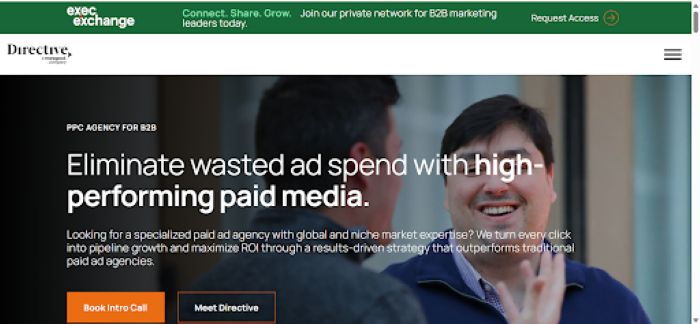
Best for scaled SaaS that need search excellence plus revenue operations (RevOps) integration.
Pros: Mature search structures, strong analytics, and an approach that ties spend to downstream revenue outcomes.
Cons: Enterprise pricing, so confirm your experimentation cadence won’t slow after onboarding.
Why They Stand Out
Directive is built for teams that already care about lead quality and want bidding informed by opportunity and revenue signals.
KPIs to own: Pipeline dollars, SQL rate by keyword theme, and CAC payback by channel.
KlientBoost
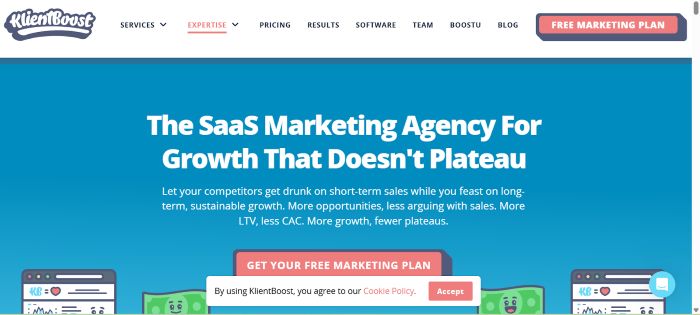
Best for teams that want rapid creative and landing page cycles on modest to mid-market budgets.
Pros: High test velocity, clear playbooks, and strong day-to-day communication.
Cons: Without value rules, accounts can drift toward volume over qualification.
Why They Stand Out
They’re known for moving fast across Search and LinkedIn, then using CRO to turn that traffic into better conversion rates.
KPIs to own: Testing pace, landing page win rate, and qualified lead percentage.
Seer Interactive
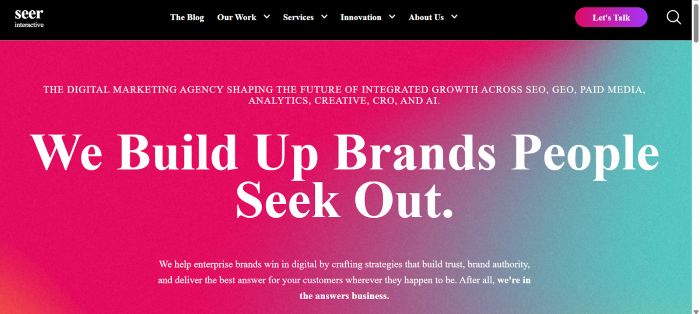
Best for complex data environments and enterprise search with strict compliance and reporting needs.
Pros: Deep analytics and data engineering, advanced search work, and custom dashboards for stakeholders.
Cons: Enterprise scope can mean longer onboarding and a heavier process.
Why They Stand Out
Seer is a fit when attribution is messy, data sources conflict, and you still need confident budget decisions across a long cycle.
KPIs to own: Assisted pipeline, multi-touch contribution, and CAC by segment.
Single Grain
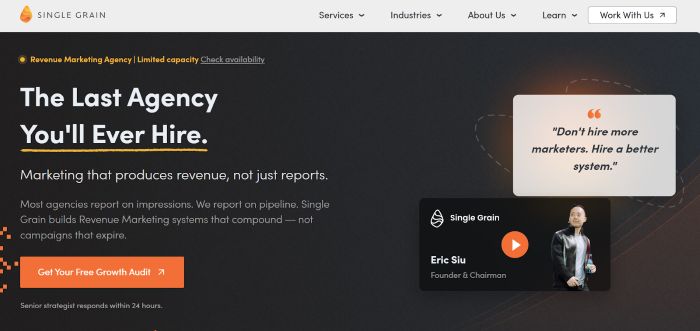
Best for teams that want PPC supported by content and SEO amplification.
Pros: Full-funnel planning and an integrated approach across content, SEO, and paid channels.
Cons: Require offline conversions and lead grading from day one, so optimization doesn’t default to cost per lead.
Why They Stand Out
They’re useful when you need non-brand demand creation, and then want paid search to capture that demand efficiently.
KPIs to own: Non-brand opportunity creation, branded search lift, and assisted revenue.
HawkSEM
Best for B2B teams that want disciplined PPC hygiene and ROI accountability.
Pros: Strong audits, clear processes, and hands-on management across Google and Microsoft.
Cons: Set lead-quality definitions early, or performance can skew toward cheaper conversions.
Why They Stand Out
HawkSEM is a fit for teams that want predictable operations, tight QA, and reporting that a CFO can follow.
KPIs to own: Qualified lead percentage, pipeline per $1,000 spent, and CAC trend.
NoGood
Best for early- to mid-stage SaaS that wants an embedded, experiment-driven growth pod.
Pros: Creative and performance under one roof, plus strong positioning and objection testing for LinkedIn.
Cons: Requires fast feedback and approvals to keep experiments moving.
Why They Stand Out
They tend to test narrative angles across personas, then translate winners into responsive search ads (RSAs) and LinkedIn formats.
LinkedIn has reported Thought Leader Ads driving higher engagement than standard single-image ads, which rewards teams that can ship executive-voice creative.
KPIs to own: Demo rate by persona, product-qualified lead (PQL) to SQL lift, and creative iteration pace.
Tuff
Best for lean teams that want channel validation and budget discipline before scaling spend.
Pros: Scrappy testing, transparent ops, and a strong fit for Series A to B teams.
Cons: Limited bandwidth for heavy enterprise requirements and multi-region complexity.
Why They Stand Out
Tuff emphasizes learning speed in the first 60–90 days, with clear decisions on what to scale, pause, or rebuild.
KPIs to own: Cost per qualified opportunity and payback within your target window.
How to Pick the Right Partner for B2B SaaS PPC
Start with your ACV and sales motion, then work backward into measurement requirements.
PLG and SMB: Prioritize volume with guardrails, plus landing pages and onboarding paths that don’t depend on sales. Hey Digital, KlientBoost, and Tuff tend to fit here.
Mid-market: Optimize for SQL rate and payback, and expect segmentation by industry, persona, or use case. Powered by Search, Directive, and NoGood are built for that style of testing.
Enterprise: Optimize for opportunity quality and influence, with clean CRM mapping and stakeholder-ready reporting. Seer Interactive and HawkSEM are better fits for complex stacks.
Require value-based bidding early. Assign values across Lead, marketing-qualified lead (MQL), SQL, and Opportunity, then import offline conversions into Google Ads at least weekly. Ask for one monthly creative refresh and one landing page test per month as a minimum.
FAQ
These are the questions that prevent wasted spend and surface execution gaps fast.
What should my first 90 days with a PPC agency look like?
Connect CRM data in the first week, then set up offline conversion imports so bidding learns what quality looks like. Ship new ads quickly, test at least one landing page variant, and judge progress by SQLs and pipeline movement.
What’s a healthy benchmark for search conversion rate and LinkedIn conversions?
Google Business Services search conversion rate averages roughly 5.14% as a reference point. LinkedIn Lead Gen Forms can increase conversions by 2–3x versus standard Sponsored Content, but you still need lead grading and spam controls.
How do AI Overviews and AI Mode affect paid search?
Ads are showing beside AI summaries on roughly 40% of AI Overview search engine results pages (SERPs), which can concentrate impressions into fewer placements. Offline conversions and value rules help you avoid optimizing toward low-quality clicks in new inventory.
What contract terms for B2B SaaS PPC protect me?
Ask for a 90-day pilot, a clear exit clause, weekly QA, and a written experimentation plan with owners and deadlines. Make the SOW explicit that optimization targets qualified leads and SQLs, not clicks or raw leads.