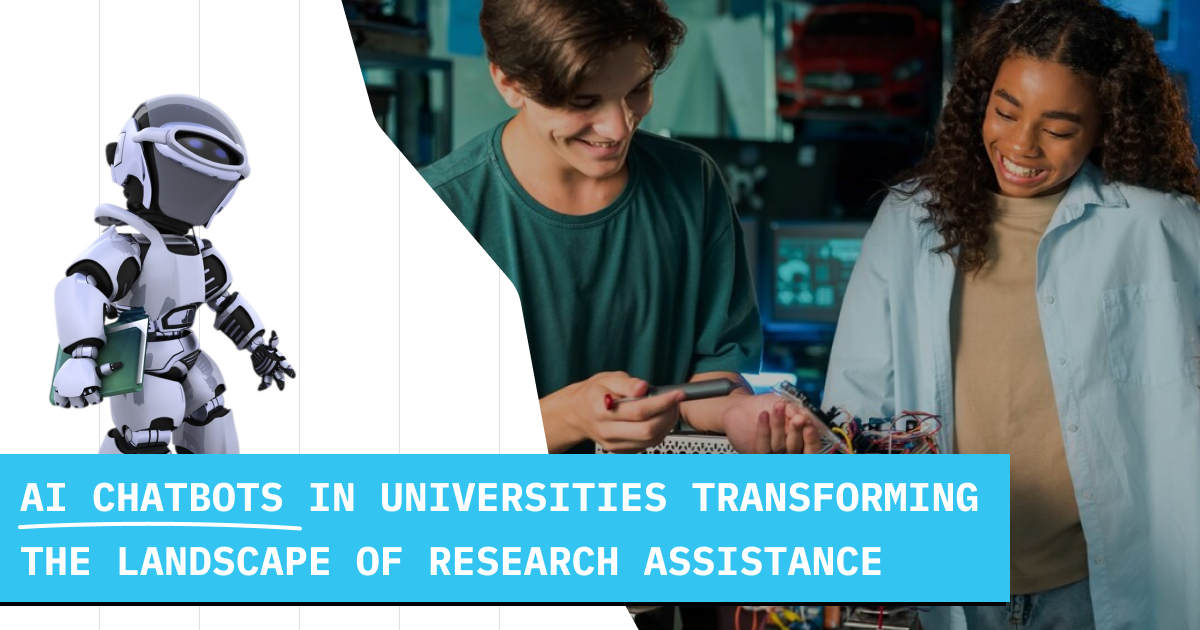
Today, in our digital era, AI chatbots are reshaping how universities support research efforts. This piece delves into the crucial role AI chatbots play in aiding research within academic settings.
It explores the steps involved in integrating AI Chatbot Development Services into university systems. Moreover, it highlights the diverse advantages they offer researchers, considers potential future advancements, and concludes with thoughts on their profound influence.
Key Takeaways
- AI chatbots in universities revolutionize research assistance by providing 24/7 access and tailored support for researchers.
- Implementing AI chatbots requires identifying use cases, selecting platforms, training data, and integrating with existing systems.
- AI chatbots offer benefits like rapid responses, streamlined literature reviews, and improved cost efficiency for researchers.
- Future advancements include enhanced natural language understanding and integration with emerging technologies like AR and VR.
- The integration of AI chatbots in universities will increase research efficiency and foster collaboration, transforming academic research processes.
Table of Contents
The Role of AI Chatbots in Research Assistance
In recent years, they have emerged as indispensable tools for research assistance. These sophisticated systems are adept at comprehending natural language queries, sifting through vast repositories of information, and delivering tailored guidance to researchers.
By harnessing cutting-edge machine learning algorithms and natural language processing techniques, AI chatbots streamline the research process by providing timely, precise responses to queries. This approach thereby enhances the efficiency and effectiveness of scholarly pursuits. Thus, universities can enhance their research support systems by integrating custom chatbot solutions tailored to their specific academic needs.
How to Implement AI Chatbots in Universities
The implementation of it in university settings necessitates a strategic approach encompassing several key steps:
Step 1: Identification of Use Cases
Begin by identifying the specific areas within the research ecosystem where AI chatbots can yield maximal benefits. These may include assistance with literature reviews, data analysis, citation management, or even facilitating interdisciplinary collaboration.
Step 2: Selection of a Suitable Platform
Choose a robust platform or framework tailored to the unique requirements of the university environment. Factors to consider include scalability, interoperability with existing systems, customization capabilities, and compliance with data privacy regulations.
Step 3: Data Collection and Training
Curate a diverse corpus of data encompassing relevant research materials, queries, and user interactions. Employ advanced machine learning algorithms to train it, refining its ability to comprehend nuanced queries and furnish accurate responses.
Step 4: Integration with Existing Infrastructure
Seamlessly integrate the AI chatbot with the college‘s existing technological infrastructure. This ensures interoperability with academic databases, digital libraries, learning management systems, and other pertinent repositories of knowledge.
Step 5: Thorough Testing and Evaluation
Before deployment, conduct rigorous testing and evaluation to assess the AI chatbot’s performance, reliability, and user experience. Solicit feedback from stakeholders and iterate upon the system iteratively to rectify any deficiencies or inefficiencies.
Benefits of AI Chatbots for Researchers
AI chatbots confer a plethora of benefits on researchers, particularly as they become integral to modern academic workflows in college research environments. These benefits include, but are not limited to:
- Uninterrupted Availability: Unlike human counterparts, AI chatbots operate around the clock, affording researchers unfettered access to assistance and insights at any time.
- Rapid Responsiveness: With their ability to parse queries swiftly and retrieve pertinent information instantaneously, AI chatbots expedite the research process. They do so by obviating delays associated with human intervention.
- Tailored Recommendations: Leveraging sophisticated algorithms, AI chatbots provide personalized recommendations aligned with individual users’ unique preferences and research objectives.
- Streamlined Literature Review: By automating the literature review process, AI chatbots expedite the arduous task of sifting through voluminous scholarly literature. As a result, they accelerate knowledge synthesis.
- Cost and Time Efficiency: By automating routine tasks such as data retrieval, citation formatting, and literature synthesis, AI chatbots enable researchers to allocate their time and resources judiciously. Leveraging an AI chatbot conversation archive, they can also analyze past interactions to refine workflows, optimize productivity, and minimize administrative overheads.
Future Directions and Opportunities Using AI Chatbots for Researchers
The trajectory of AI chatbots in research assistance portends a plethora of tantalizing opportunities for innovation and advancement. Some potential avenues for future exploration include.
- Enhanced Natural Language Understanding: Continued advancements in natural language processing (NLP) will empower AI chatbots to parse and comprehend increasingly complex queries. Consequently, this improves the granularity and accuracy of their responses.
- Integration with Emerging Technologies: AI chatbots can integrate synergistically with emerging technologies such as augmented reality (AR) and virtual reality (VR) to provide immersive research-assistance experiences. This enables researchers to visualize data and concepts in novel ways.
- Facilitation of Collaborative Research: By enabling seamless collaboration and knowledge exchange among researchers, AI chatbots can catalyze interdisciplinary synergy and innovation. They thereby foster a vibrant ecosystem of scholarly inquiry.
Conclusion
The potential of AI Chatbot Development to transform university research assistance is immense. By integrating AI chatbots, such as DeepSeek, into university systems, institutions can significantly enhance research efficiency and productivity, fostering interdisciplinary collaboration. As AI technology advances, chatbots will become even more sophisticated and further revolutionize academic research. These tools are set to usher in a new era of research excellence, making the process faster, more accurate, and more innovative.