


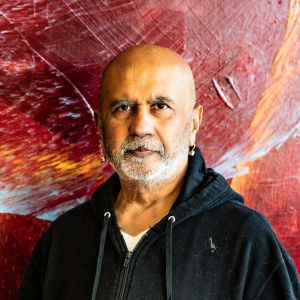
Ritu Raj Podcast Transcript
Ritu Raj joins host Brian Thomas on The Digital Executive Podcast.
Brian Thomas: Welcome to The Digital Executive. Today’s guest is Ritu Raj. Ritu Raj is an abstract painter, author, and technology entrepreneur based in Phoenix, Arizona. Over three decades, he has founded and built companies including Avasta, WAG Hotels, Sidecar, and Diamond Foundry, and he brings that builder’s view to one of the defining questions of our time: what in human experience can artificial intelligence not reach?
His new book, The Unalgorithmic Self: Art, AI, and the Future of Human Thinking, explores that question across 30 chapters on the body, emotion, memory, imagination, uncertainty, ethics, and art. It is not a book against AI. Ritu wrote it to open conversation with an AI model, and says so on the cover, making the book itself a case study in where assistance ends and authorship begins.
Well, good afternoon, Ritu. Welcome to the show.
Ritu Raj: Thank you for having me on the show.
Brian Thomas: Absolutely, my friend. I appreciate it, really do. You’re in Phoenix today. I’m in Kansas City, and we’re just just a short span across the couple time zones be- I, I guess before the time zone changes here shortly, but I really appreciate you making the time at this time of day.
So Ritu, without further ado, let me jump in. Your life has had remarkable arcs. You grew up in New Delhi as the son of art critic KB Goel. You moved to the US in ’94 and spent three decades founding and building companies like Avasta, WAG Hotels, Sidecar, and Diamond Foundry. Then during COVID lockdowns, you s- just started to start painting, and by 2024, you become a full-time artist in Phoenix.
What pulled you from the world of building companies into the studio, and how did growing up around art criticism shape that return?
Ritu Raj: Well, when I was a kid, I grew up around artists. My dad was an art critic. I grew up with some of the most incredible artists now in India. They’re all dead. But at that time, they were real poor, starving artists, and I did not want to be a starving painter And I
At that moment of time, I went to one of the best private schools in India. I decided I would never be an artist. Never Because they’re poor, they can’t afford the real luxuries of life. No artist were made. And then life went on. I, became an entrepreneur, did some successful companies. You know, I was always taking pictures.
Photography was one of my main things. And then COVID came, and I couldn’t go out to take photographs. I couldn’t go out anywhere. I was in San Francisco. I was in a complete lockdown. And the company’s insurance… And I used to be work for a company which produces lab-grown diamonds. I was really in a lockdown.
And then a friend of mine said, “You know how you did this photography workshop with us, and we put some canvases out, and you were painting? We love that paintings of yours.” And they were like, small two-by-two canvases and some acrylic. I was just painting. I ha- still have the painting. And he says, “Why don’t you paint?
You don’t have to go out of the house to paint.” And I said, “Wow, that’s a novel idea.” So I ordered some canvases, four feet by four feet, three feet by three feet canvases, acrylic. I never used acrylic in my life other than one time to do a two-by-two. And I started painting, and I had, like, a 2,000, 1,800 square feet loft in San Francisco.
And within a year, I filled it with paintings. I started doing six foot by six foot paintings, and every corner of the house was fill of, full of paintings. And I was not married, no kids, nothing. It was just paintings and me and that’s why I was attracted to Phoenix. I came here for a conference and saw a property, and they had, like, huge properties.
I mean, when you live in San Francisco, you can’t even think of having that size in the city. And, I came here and I fell in love with this property, which had a… And my house is, like, 2,300 square feet on half an acre, and it has another casita unit, which is 1,800 square feet, where there were, like, two artists who have lived there over, like, you know, stacked.
For the last 18 years, they were painting there. And they were selling the house, and I said, “I want this, period.” And that’s how I moved to Phoenix, so that I can paint like Jackson Pollock.
Brian Thomas: Wow.
Ritu Raj: That’s a little history.
Brian Thomas: Yeah, no, amazing story. I, I appreciate that, and that’s what always kicks off the podcast is somebody’s experience.
It was a challenge, a gap. They, they found a solution to a problem, or they had a, a traumatic experience. In your case, COVID really just whacked all of us. And, you had a lot of corporate experience. You had a lot of time as an entrepreneur. And you learned as growing up that artists just didn’t make any money, and that wasn’t your standard.
And so you kind of moved, you depart- you departed from that area. But COVID really brought that perspective back to you, and that’s just amazing how you filled up your apartment in San Francisco full of paintings in that short of time. So, again, appreciate the backstory. Love what you’re doing now.
Ritu, your new book, the “Unalgorithmic Self”, tackles the question of what in human experience AI cannot reach, yet you wrote parts of it in open conversation with an AI model and say so right on the cover. Why did you make that choice so transparent, and how does the book itself become a case study in where assistance ends and authorship begins?
Ritu Raj: Well, let me first, I think the, to get the, the title of the book, which is “Unalgorithmic Self”, let me give the backstory. Two years ago, I s- I don’t know why, I thought I’d given up the word algorithm, 10 years ago when I stopped writing algorithms I started really looking at that every TV show that I watch.
The toothbrush, the toothbrush that I use in the morning was sold to me by an algorithm. The TV show is not a TV show, it’s an algorithm. It, like, takes me down, pulls at my heart, brings me up. I like Lioness. Like, it’s one of my favorite TV show. And I read about, oh, when is the season four gonna come out?
Like, I’m like, but I know it’s an algorithm So I re- and then I really, I had some friends of mine who had these kids, and they live by their iPad. They play these games, and then they are, like, completely… A whole range of emotions go through them when they’re playing these games. And I have some friends who are game designers.
I know they are playing against an algorithm, or they’re, they’re, they’re playing how the algorithm wants them to play, which is worse than they are playing an algorithm. And somewhere it’s, like, snapped. Somewhere it snapped. And the snap came, and I started really looking at, what is my life about?
Where am I not given by algorithms? Like, really, I mean, it always, like… Where, can I, like, recover me and have my own soul back? And I think you’re one of the only people I know who also is has been covered by, what’s that magazine called? Authority,
Brian Thomas: Profiled, Authority, many, many of them.
Ritu Raj: Authority Magazine.
Brian Thomas: Mm-hmm.
Ritu Raj: Which is part of a medium and everything, and they cover a lot of… So I wrote a small piece for them, and then suddenly I was, like, being interviewed by Authority Magazine. And, something became way more clearer. The only access that we have to beat the algorithms is abstraction Because abstraction, there’s no answer
So that’s where my life about no algorithms and abstraction meet. And the whole book on on algorithmic self was written using ChatGPT as my consultant, as my challenger to speak where it helped me organize things, A. B, it helped me fill in some of the sentences which I couldn’t say. And I came from India.
My mom was a professor of English. So guess what I have? I have a problem with good English. However, my English is good. It’s not as good as what my mom had. So with ChatGPT helps me organize it, and that was great. And I think ChatGPT played enough an important job that I put its name on the top and I was on, let me know, I’d say one more thing about it. I was on Reddit today and I’ve written a little, little bit about giving at least acknowledging that you’re using ChatGPT. And some people just went for me, and I just said like this, “Every good book that is written as a copy editor.” My book on algorithmic self went through two rounds of copy editing by a professional copy editor What’s the difference between what copy editors do and what ChatGPT does?
They’re human, but they’re also changing your language, such as ChatGPT is doing it at times. So I think it’s a world that we just have to accept it’s going to be there, and it’s going to be there more pervasive than it is. Sure. Sure. So that’s why I wrote the book.
Brian Thomas: Amazing. I appreciate that, really do. And it makes me think too, you know, I listen to guests talk, and you just talked about start with a simple product like your toothpaste or toothbrush, and the products you buy today is through an algor- algorithmic process, whether it’s TV advertisement, and you talked about gamers and, and I see that too where, you’re playing against the algorithm or the algorithm is getting you to do certain things that is advantageous for them and not you.
And, and you stopped and thought, “Gosh, how are we really living our life with- without an algorithm? How do we get out of this, this matrix,” so to speak? And you hit the nail on the head with abstraction, and you said, “That’s the only way we can beat this algorithm.” And I just love what you’re doing and the fact that you did leverage AI to help do your copy and editing, and, and I think that’s, that’s great, and it shows both sides.
So thank you. Ritu, you’re careful to say this isn’t an anti-AI book, even as you write elsewhere about choosing to paint by hand in over AI, AI’d world. How do you hold those two things together, using these tools yourself while insisting people remain the authors of their own lives? And where do you personally draw that line?
Ritu Raj: Oh, I, I, I… You asked this question and I, i- it’s like I have an answer for this. I do have an answer for it. I’m not inventing a toothbrush, right? The algorithm sells me a toothbrush and I use it. Sorry, just to say one part of it. But here is the, where I draw the line. If you’re using AI to make paintings, that for me is not right
That’s where I draw the line. I like to paint with my hands, and I use string tools. I literally paint with my– I paint with a string instead of a brush on a canvas. I just throw it and I pull it in a single breath. It’s completely hand, my hands on the painting. If I use a brush, it’s my use of a oil paint, oil wet brush on a painting.
There’s something very Like my soul gets attached to the brush While if I’m– the line I’m drawing is the the, the other side is where you are drawing either like you using gimmicks to paint. Like, you’re hanging a can by a thread on the ceiling, and it’s making this marks on the canvas, or you’re using AI to generate an object.
Do I love them? Absolutely, I love them. I like some of them. But the– it’s like that repeatable canned algorithm being sold to you When you’re painting with your hands, there is no algorithm It’s human. Mistakes will be made So I think this, I, I don’t know if I’m answering. It’s the algorithms don’t make mistakes, humans do
Brian Thomas: And I-
Ritu Raj: We make mistakes
Brian Thomas: We do. Absolutely. And I appreciate that. Humans, we’re flawed kind of at our core but that’s what makes us so unique, and I just loved how you broke that apart. You talk about the things that algorithms can do and, and sometimes they’re more efficient, faster, and they make less mistakes. But at the end of the day, what, what, what I heard here, as an artist, Ritu, using AI to make paintings is where you really draw the line, and you highlight that in your book, and I, I do appreciate that.
I’m sure my audience will as well. Ritu, your book’s subtitle is Art, AI, and the Future of Human Thinking. As AI keeps advancing into writing, image-making, and even emotional conversation, where do you see the relationship between human creativity and machine assistance heading over the next decade? And what do people most need to protect or cultivate in themselves to remain, as you put it, the author of their own lives?
Ritu Raj: I think we are really like, there’s the Mount Everest in front of us, and we are just little ants at the bottom of the hill in that, in this aspect. I think I have these few couple of quotes from my book. Can I just read a couple of them? Very apt for this moment.
Brian Thomas: Yeah.
Ritu Raj: “A machine can answer a question only a human can wonder.”
Wander, is one. The second thing is a machine can process the world, only a human can feel it
I would just say these two big quotes As we go further along with this whole process of AI is getting better, better expressed and everything, they still cannot wander
AI just cannot wander. We wander as human beings, and we feel, the people who play video games, you know, you– I was addicted to playing video games for one year. I’ve played World of Warcraft. I was a death knight. I w- I– and I was, like, so in, like, I was playing, like, eighteen hours a day. No shower, no nothing, just playing the game, like, completely like a madman.
Here’s the thing, if my death knight died, I can re-resurrect it
There’s nothing lost. But in real life, you lose things And you learn through loss. You learn through feeling. You learn through wandering. And that is a human thing. Nobody can take it away from us. So I think the division would be slowly and slowly becoming bigger between wander, feeling that humans can do, breaking patterns that humans can do, and what AI can do.
So I think we are just at a cusp of it, and all we have to remember is to, keep us human beings alive.
Brian Thomas: Absolutely. And
Ritu Raj: to, take care of our souls
Brian Thomas: Yep. Absolutely.
Ritu Raj: And Sorry. Go ahead. One more thing to this thought is, I’m, I have some kids around me, my wife’s kids and some other people’s kids, and they’re, like, in the 21, 23 kind of age.
They’re all worried about with the jobs, the AI’s gonna take our jobs and everything. And I’m just thinking, “You guys are really well-educated, and you’ve got degrees in arts, linguistics, and stuff like that. You will be the next job creators of… Your jobs will become more important than any AI job.”
Because you can think. You’ve been trained to think. And people will come to the conclusion that people who have training to think will be the next people, next jobs in the world. May it be a mechanic, may it be anybody who’s like, you’re a computer scientist, you’ve been trained to think in algorithms, designing new algorithms, or you have a degree in literature, you’re desi- you can think in terms of designing language and what language can do.
The world is your oyster. Sorry, I could just go off on this subject.
Brian Thomas: No, I appreciate that. It’s very helpful, and you’re right in the middle of this big debate of AI, and I, and I can appreciate that. A couple quotes you, you mentioned early on, and the question here is, a machine can answer a question, but only a human can wonder, and a machine can process a word, and only a human can feel that word.
That’s the m- the center of debate right now, and you’re absolutely right when it comes to where humans stand versus machine. And there’s a lot of great use cases, of course, for these machines to make the world better, but at the end of the day, humans are the only ones that can really learn through feeling, experience, emotions, loss, et cetera.
So I appreciate the insights, and so will my audience. And Ritu, it was such a pleasure having you on today, and I look forward to speaking with you real soon.
Ritu Raj: Yes, absolutely. Thank you for having me, and, guys, go get the book. And, I’m doing a lot of free, whatever you call giveaways on Goodreads right now.
So if you s- go to Goodreads, you can get the book free. I think in the next couple of months there are another, so you can get the book. It’s not, it’s like $17 or something like that. It’s, this is the kind of books which will shape what we do tomorrow with AI. Yeah. So thank you for having me on it.
Brian Thomas: Absolutely. And bye for now.
Ritu Raj Podcast Transcript. Listen to the audio on the guest’s Podcast Page.