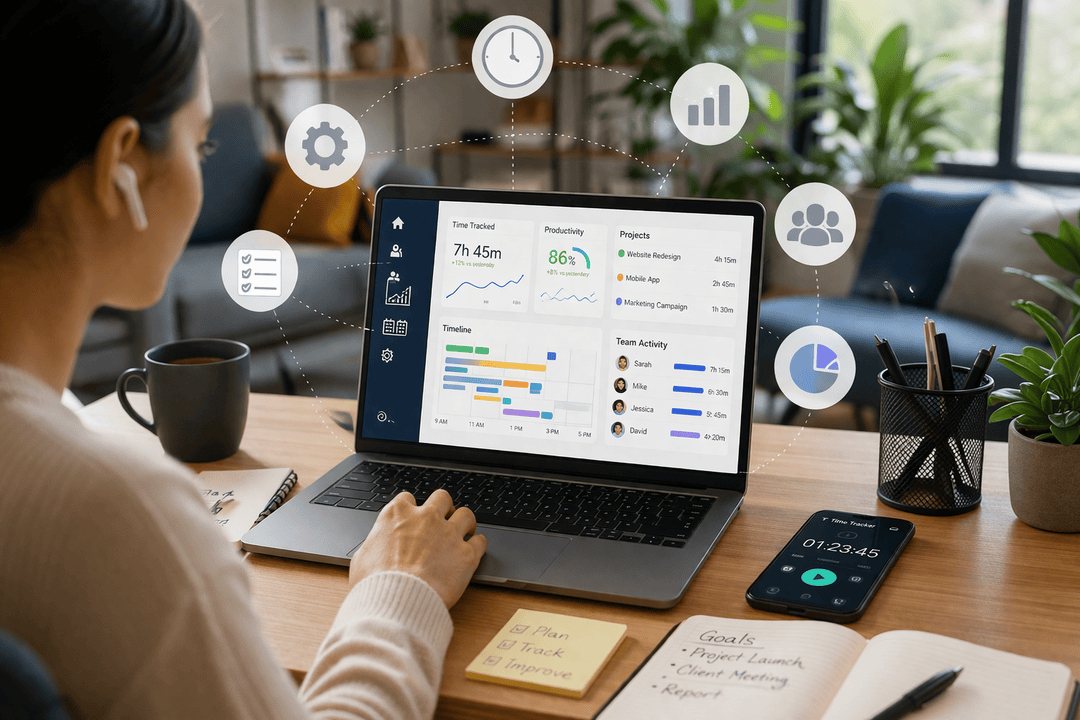
The future of work is shaping the business world as we know it: Remote Work. Convenience, but now we have to manage work hours and accountability as companies are no longer location-dependent.
That’s where time tracking software comes into play. The contemporary tools can not just record hours worked but also extract deep micro details concerning employee efficiency, project productivity, and general business growth.
In fact, studies have suggested that only 2–3 hours of a full workday are actually spent doing deep, focused work, thus revealing a massive productivity gap. This can make time-tracking software even more useful because it allows businesses to see where they may be lacking in efficiency and take steps to maximize workflows and use of time while working remotely.
Table of contents
The Growing Need for Time Tracking in Remote Work
The work environment of the remote work lacks supervision and the managers may fail to know how the time is being spent. Absence of excellent tracking systems could lead the businesses to problems such as missed deadlines, wrong payroll and inefficiency.
The time tracking software addresses such issues by providing real-time access to tasks, assisting companies in being transparent and refinancing their workflow. Based on the experience of the industry, those companies that employ time tracking software are able to make productivity much more effective and coordinate the distribution of resources.
Key Features of Modern Time Tracking Tools
The present-day time tracking systems have transcended beyond the basic clock-in and clock-out systems. They offer extensive features that aid businesses to work more efficiently:
- Real-time activity tracking to monitor ongoing tasks
- Automated timesheets for accurate payroll and billing
- Productivity analytics to identify inefficiencies
- Project tracking for better task management
- App and website usage insights to understand work behavior
Other advanced platforms also contain monitoring opportunities, like tracking of the screen and behavioral analysis that can help businesses check compliance and enhance the work of their team.
Benefits of Using Time Tracking Software
1. Improved Productivity
Time tracking tools will ensure employees get focused as they have good perspectives of how to utilize the time they have. Managers can also detect distractions and streamline the workflows to offer efficiency.
2. Accurate Billing and Payroll
With automated tracking it would be seen that all working hours are properly recorded avoiding the mistake in billings and calculation of payrolls.
3. Better Project Management
Detailed reports and analytics will allow businesses to more accurately estimate the timeframe of projects and distribute funds.
4. Data-Driven Decision Making
Contemporary software offers useful information that can guide businesses to make informed choices, to enhance their operations, and to make more profits.
Work From Home Efficiency with Smart Tools
A remote team involves the appropriate use of technology and strategy. When businesses embrace the use of sophisticated tools, they are able to uphold accountability without having to supervise employees.
One of the solutions is the implementation of the ones that involve the combination of time tracking and productive analytics. As an example, to enhance the efficiency of remote work, several businesses consider tools such as work from home with Controlio that allows to track activity, analyze performance, and streamline workflows in remote teams.
These tools can give comprehensive information on how time is spent by employees, and can help managers make modifications to the way they spend this time to enhance overall performance.
Challenges and Considerations
Though there are numerous benefits of time tracking software, one should use it in a sensitive manner. Excessive monitoring has the potential of causing a lack of trust among team members, particularly in virtual teams.
These tools should support employees but not to be in control of them since businesses must focus on transparency. The aim must never be to generate unnecessary pressure, but to make productivity and collaboration better.
Future of Time Tracking Technology
With the ever evolving technology, time tracking software is gaining sense and ease of use. The future of workforce management is being defined by AI-powered analytics, automation, and the capacity to connect with other tools used in business.
Businesses that embrace these advances early will gain an edge because they will be able to streamline their business processes, as well as change easily with the new working conditions.
Conclusion
Time tracking software has turned out to be a crucial element of any business today, particularly in remote working times. Not only does it aid in tracking working hours, but is also informative and offers valuable insights that enhance effectiveness and productivity, as well as decision-making.
It is possible to establish a more organized, transparent and high performance remote workforce by selecting the appropriate solution and turning it to an advantage of companies.s can construct a more orderly, transparent and high-performing remote workforce.