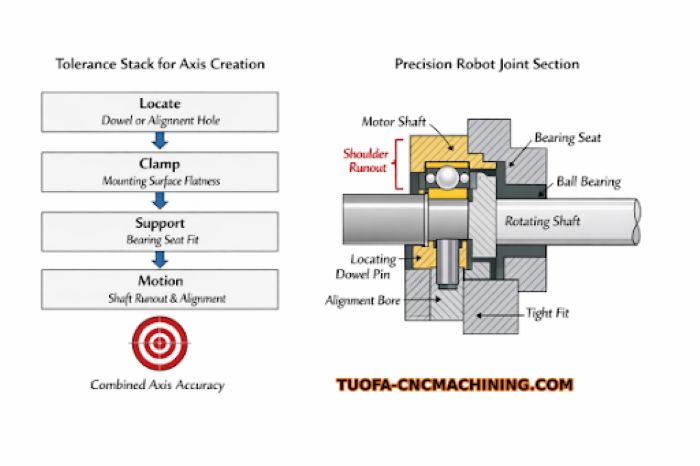
When a robot “feels” rough—stick-slip at low speed, chatter, heating, or inconsistent repeatability—the limiting factor is often not control tuning. It may be the reason of the geometry of interfaces: where bearings seat, where shafts locate in bores, and where rails or faces establish alignment. Small errors (often tens of microns) can swing preload, friction, and load distribution enough to dominate smooth robot motion quality.
Key Takeaways
- Smooth robot motion often suffers from interface problems like alignment and fit issues rather than control tuning.
- Tolerance points such as bearing seats and shaft-hole fits significantly impact motion quality and should be addressed carefully.
- Regular inspection and mitigation strategies can help ensure proper axis creation, leading to better robot performance.
- 3D printing provides qualitative benefits, while subtractive machining ensures precise tolerances needed for quantitative performance.
- Engineering teams should prioritize axis creators and use symptom-to-tolerance triage to enhance smooth motion in robotics.
Table of contents
Smooth Robot Motion Is Often an Interface Problem
In robotics engineering, the controller commands motion, but the mechanical stack defines the friction and parasitic loads the loop must overcome. Interface errors are especially damaging because they are nonlinear and state-dependent: axis tilt creates edge loading; clearance “wakes up” under torque reversals; surface texture shifts effective interference and break-in behavior. Bearing references connect mounting accuracy, fits, and alignment to bearing performance and life.
The decision point is simple: don’t tighten everything. Tighten what creates the axis, prevents axis tilt, and prevents micro-motion at load-bearing contacts.
Tolerance Points That Affect Smooth Robot Motion
Rotary Interfaces
Bearing seats (shaft journal, housing bore, axial shoulder).
- Definition: the radial and axial locating geometry for bearing rings.
- Failure modes: undersized/worn seats allow ring creep; excessive press fits reduce internal clearance and raise temperature; taper/out-of-round loads the bearing unevenly and increase noise.
- Practical magnitude: for 20–50 mm seats, IT6–IT7 size bands are typically “tens of microns” (about 13–16 µm total for IT6; about 21–25 µm total for IT7, depending on nominal size).
- Motion consequence: creep behaves like growing vibration/backlash; over-interference behaves like rising current, heat, and notchy motion, directly impacting smooth robot motion.
Shaft–hole fit in couplings, hubs, and adapters.
- Definition: clearance/interference between a shaft and mating bore that transmits torque and sets concentricity.
- Failure modes: excess clearance produces micro-rocking/fretting and apparent backlash; excess interference distorts thin hubs and induces runout.
- Practical magnitude: an H7/h6 sliding-fit example at Ø50 mm is commonly shown with 0 to 0.041 mm clearance.
- Motion consequence: chatter under reversals (clearance) or cyclic vibration and wear (distortion).
Coaxiality and runout across rotating features.
- Definition: how well multiple cylindrical features share a common axis (two bearing seats; bearing-to-gear seat).
- Failure modes: multi-setup machining that re-datums bakes in axis offsets; shoulder runout appears as periodic torque ripple.
- Practical magnitude: bearing guidance controls seat form/runout with tight IT-grade fractions (e.g., IT3/2–IT4/2 for out-of-roundness/cylindricity); for ~30–50 mm seats, that is roughly only a few microns of allowable form error.
- Motion consequence: higher friction, heat, and noise; shortened life.
Planar and Locating Interfaces
Flatness and squareness of axis-defining faces.
- Definition: planarity and perpendicularity of shoulders, motor/gearbox flanges, and support faces that set axis tilt and clamping uniformity.
- Failure modes: warped faces tilt axes; non-square shoulders shift preload.
- Practical magnitude: Some guidance recommends IT7-grade flatness for a housing support surface and a roughness limit (e.g., Ra ≤ 12.5 µm) so the unit does not rock.
- Motion consequence: coupled loads that feel like friction + vibration and vary build-to-build.
Parallelism of rails and paired guide surfaces.
- Definition: how parallel two rails (or two reference edges) remain over travel.
- Failure modes: travel-dependent friction; binding on preloaded guides when mounting error exceeds allowable.
- Practical magnitude: mounting-surface flatness as tight as 0.012 mm per 200 mm and allowable parallelism between reference surfaces from a few microns up to ~10 µm (size/preload dependent).
- Motion consequence: stick-slip at low speed and uneven wear, both of which degrade smooth robot motion.
Dowel/locating hole position for repeatable assembly.
- Definition: locating features that reset geometry after assembly or service.
- Failure modes: using clearance bolt holes as locators (stack-up); drilled holes drifting in size/roundness; mismatched datums between drawing, machining, and inspection.
- Practical magnitude: location ±0.002 in (±0.051 mm) when features are machined on the same side, and reamed hole size ±0.0005 in (±0.0127 mm).
- Motion consequence: alignment becomes reassembly-dependent; part swaps trigger smoothness regressions.
Surface finish where friction and fit stability matter.
- Definition: micro-texture of bearing seats, sliding guides, and sealing counterfaces.
- Failure modes: rough surfaces bed in and change effective interference; micro-slip accelerates fretting; post-finishing moves datums. A bearing guide notes finish requirements, tighten when vibration/noise requirements tighten.
- Practical magnitude: ground roller-bearing shaft seats at Ra ≤ 1.6 µm and ball-bearing seats as fine as Ra ≤ 0.8 µm (smaller shafts), with housing IDs finished to Ra ≤ 3.2 µm.
- Motion consequence: unpredictable break-in, preload drift, and growing noise/vibration.
Prototyping versus Production
3D printing is strong when the question is qualitative: packaging, cable routing, collision checks, low-load demos, and fixture iterations. Typical 3D printing tolerances scale with feature size. Lower-bound variation is often around 0.02–0.15 mm. SLS systems are commonly quoted at about 0.3 mm or 0.5%, with looser Z-axis allowances to account for build variation. That is rarely sufficient for axis-defining interfaces that operate in tens of microns.
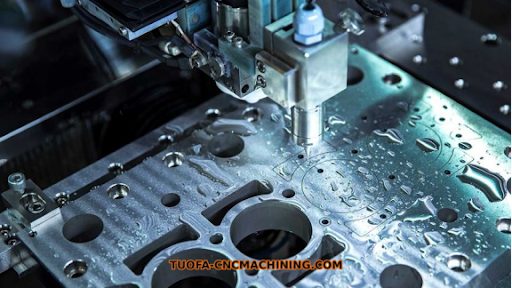
When the question becomes quantitative—repeatable smoothness across units, stable preload, low wear—subtractive processes win because they can consistently create datums, coaxial bores, and controlled fits. A CNC benchmark cites ~±0.13 mm as a standard machining tolerance, ~±0.051 mm as a higher-precision workflow, and reamed holes tighter still. This is where CNC is a common choice because it can create consistent datums and preserve relationships (coaxiality, true position, flatness) across builds.
Inspection, Verification, and Mitigation Strategies
Verify what creates the axis, then what relates axes. For seats and bores, measure size with micrometers/bore gauges and estimate out-of-roundness/cylindricity via multi-angle, multi-plane checks; one maintenance guide provides a practical Max–Min method using diameter readings across angles and planes. For relationships, sweep shoulders for runout with a dial indicator, sweep rails for straightness/parallelism, and check locator patterns with CMM or a dedicated fixture.
Mitigation is process-led. Use single-setup machining (or in-line boring) to manufacture axes in one reference frame and avoid re-datuming between operations. Use a datum strategy that aligns design, manufacturing, and inspection, and do a quick tolerance stack review on the “locate → clamp → support” chain before tightening individual dimensions. Finally, treat assembly as a controlled step: remove burrs, ensure machined surfaces are smooth, and thoroughly clean the housing and components before fitting a new bearing.
Actionable Recommendations for Engineering Teams
Engineering teams play a critical role in turning design intent into reliable performance, especially when small geometric errors can disrupt smooth robot motion and long-term system stability.
- Prioritize axis creators. Make bearing seats, shoulders, and locators precise; keep non-locating geometry manufacturable.
- Use symptom-to-tolerance triage. Travel-dependent friction points to flatness/parallelism; periodic ripple points to runout/coaxiality; growing backlash points to clearance and creep at fits.
- Create lightweight verification. Two repeatable checks beat dozens of tight callouts: seat + shoulder (size, roundness, runout) and locator pattern (relative position). That keeps smooth robot motion measurable and maintainable.
Final Words
The hidden tolerances behind smooth robot motion are not hidden because they are unimportant. They are hidden because they sit quietly inside fits, seats, shoulders, bores, and locating features until motion quality starts to fall apart. Engineering teams that understand this can make better tradeoffs: tighter where motion depends on it, simpler where it does not. That is usually the difference between a robot that merely moves and one that moves well.