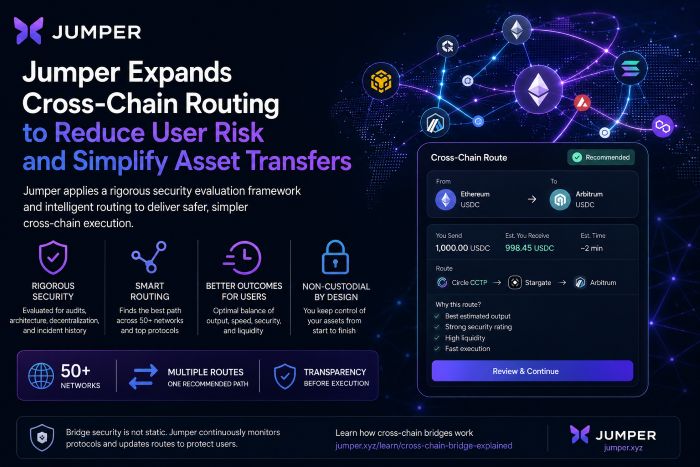
Jumper has published a company update laying out its bridge security evaluation framework, alongside an initiative to expand cross-chain routing across the platform. The move is aimed at cutting down the kind of execution risk that catches users off guard when they move assets between blockchain networks-a problem that has quietly cost the industry billions and still has no clean solution.
The announcement puts Jumper in a small category of aggregators willing to formalize how they vet the infrastructure they route through. Most platforms leave that decision implicit. Jumper is making it explicit.
Key Takeaways
- Jumper has launched a bridge security evaluation framework to enhance cross-chain routing and reduce execution risks.
- The framework assesses ongoing bridge security and evaluates factors like audit history and architecture.
- Jumper provides a single interface that recommends routes based on thorough evaluations, simplifying user decisions.
- Active management of bridge protocols occurs, responding to vulnerabilities and operational changes in real-time.
- Published educational resources help users understand cross-chain mechanics and improve their transaction decisions.
Table of contents
- Moving Assets with Cross-Chain Routing Is Still Harder Than It Should Be
- What the Security Evaluation Actually Looks At
- Single Interface, Multiple Routes, One Recommendation
- Newer Networks, Higher Stakes
- The Work Does Not Stop at Integration
- Building the Infrastructure Around the Technology
- Where This Fits in the Broader Picture
- About Jumper
Moving Assets with Cross-Chain Routing Is Still Harder Than It Should Be
Decentralized finance now spans more than a hundred active blockchain networks. That sounds like progress, and in many respects it is-but it has created a secondary problem that the industry has been slow to address. Getting assets from one chain to another requires a bridge, and choosing the wrong one can mean delays, unexpected fees, or in the worst cases, permanent loss of funds.
The term “bridge roulette” has circulated in developer communities for a while now. It describes what happens when a user-without the background to distinguish a lock-and-mint bridge from a liquidity relay-picks a protocol based on whatever shows up first in a search. Some bridges have been audited multiple times by reputable firms. Others have not. The interface rarely tells you which is which.
Jumper’s platform, which aggregates swap and bridge options across more than 50 networks through a single interface, is trying to move that decision upstream. Rather than surfacing every available route and leaving the evaluation to the user, the platform applies its own criteria before a bridge ever appears in a recommendation.
“Everyday users want cross-chain execution that feels straightforward and dependable,” said Jordan Neary, Marketing Lead at Jumper. “We’re focused on reducing the risk that comes from complexity-so users can move, swap, and deploy assets without juggling multiple apps and assumptions.”
What the Security Evaluation Actually Looks At
The framework Jumper published is not a checklist that gets run once. According to the company’s update, the process is ongoing-protocols get reassessed as their codebase changes, as audits are updated, and as incidents occur across the wider ecosystem.
On the evaluation side, the company said it looks at security audit history, including which firms conducted the reviews and when. It also considers bridge architecture-specifically the cryptographic mechanisms used to verify state across chains-as well as operational maturity, incident response track record, and how decentralized the bridge’s validator or relayer set is in practice.
That last point is worth dwelling on. A bridge can advertise decentralization while concentrating meaningful control among a small group of operators. It is the kind of structural detail that rarely surfaces in marketing materials but matters considerably when something goes wrong.
By building these criteria into its routing logic, Jumper is effectively outsourcing the due diligence burden away from end users. The platform absorbs the evaluation work; users see a recommended route with expected outcomes already factored in.
Single Interface, Multiple Routes, One Recommendation
The technical architecture here is worth understanding. Jumper does not operate its own bridge-it sits above existing bridge and decentralized exchange protocols as an aggregation layer. When a user initiates a cross-chain routing transaction, the system evaluates available routes across all integrated providers and returns a single recommended path.
That recommendation weights estimated output, execution time, protocol security rating, and current liquidity depth simultaneously. It is a meaningful reduction in cognitive load for users who would otherwise be switching between three or four different applications, comparing numbers manually, and hoping they are reading each interface correctly.
The interface also shows users what to expect before they confirm. Estimated received amount, the route path, which protocol is handling the transfer-these are displayed upfront rather than buried in a confirmation screen. The company describes this as reducing “bridge roulette” through transparency before execution, not just better routing underneath.

Newer Networks, Higher Stakes
The routing quality question gets more pointed on networks that are newer or more specialized. Hyperliquid is a useful example. The Layer 1 chain has attracted significant attention for its derivatives trading infrastructure, but the bridge ecosystem around it is still developing. Fewer route options means less room for error.
Jumper has published guidance on how to bridge to Hyperliquid specifically-part of a broader set of educational resources the company maintains for chains where users may have limited options and limited information at the same time. On a mature network like Ethereum mainnet, a bad routing decision might cost a user some extra gas. On a newer chain with thin bridge liquidity, the stakes can be higher.
This is the pattern across DeFi broadly. As activity fragments across gaming chains, institutional settlement layers, social applications, and high-performance derivatives venues, each new environment introduces its own routing risks. Aggregators that can track those environments and update their recommendations accordingly are increasingly valuable.
The Work Does Not Stop at Integration
Bridge security is not a property that stays fixed. A protocol can pass a rigorous audit at launch and develop a critical vulnerability two years later. Several of the largest exploits in DeFi history have hit bridges that were considered solid at the time they were deployed. The codebase changed. The threat landscape changed. The audit did not keep pace.
Jumper said its team monitors bridge protocol developments and security incidents on an ongoing basis, and may pull or adjust routing options when vulnerabilities are identified or operational changes raise concerns. That kind of active management is a different posture than treating integration as a one-time decision.
For users, the practical implication is that the routes available through the platform at any given moment reflect current assessment, not just historical vetting. In a category where a single smart contract flaw can drain a protocol in hours, that distinction matters.
Building the Infrastructure Around the Technology
Beyond the routing engine itself, Jumper maintains an educational library aimed at users who want to understand the mechanics behind what they’re doing. The company publishes a breakdown of how cross-chain bridges work and why different designs carry different risk profiles, available at jumper.xyz/learn/cross-chain-bridge-explained. It is the kind of material that does not get written unless a company is thinking past the transaction and toward the relationship.
The bet, implicit in that investment, is that informed users make better decisions-and that better decisions produce fewer support requests, fewer blown transactions, and ultimately a more sustainable product. Whether that calculus is right is something the market will sort out. But the educational layer at least signals a particular view of what responsibility looks like for an aggregation platform.
Where This Fits in the Broader Picture
The DeFi bridge space has had a rough few years by any measure. Regulatory attention has increased. Institutional participants are asking harder questions about the infrastructure they touch. And retail users who watched major exploits unfold in real time are not as willing to assume that a bridge is safe just because it exists.
Publishing a formal evaluation framework is a response to that environment. It does not solve the underlying technical risks; no single platform’s routing decisions can do that, but it does create accountability. The methodology is documented. It can be examined. If something goes wrong with a bridge Jumper routed through, the company will have to answer for how that decision was made.
That kind of transparency is still rare enough in the aggregation space to be notable. Whether it becomes the standard depends on whether users and the broader industry reward it.
About Jumper
Jumper connects users to more than 50 blockchain networks through a single non-custodial interface, cross-chain routing transactions across integrated decentralized exchanges and bridge protocols. Users retain control of their assets throughout each transaction. More information is available at Jumper.