
Most founders assume their company is too small to matter to an attacker. That assumption is not just wrong, it is expensive, since the global average cost of a data breach just reached a record 4.99 million dollars, according to IBM’s most recent research. A growing number of founders are responding by moving patching off the manual, whenever-someone-remembers-a-list approach, and onto an automated patch management solution for enterprises instead.
Here is why that shift is happening now, and what actually changes once it does, from the technology itself to how much founder attention it demands.
Key Takeaways
- The global average cost of a data breach reached 4.99 million dollars in 2026, up 12% year over year, according to IBM’s Cost of a Data Breach Report.
- Small companies are not spared from attacks, and ransomware in particular has become disproportionately common among smaller organisations.
- Manual patching depends entirely on someone remembering to check, test, and deploy updates, a process that breaks down quickly as a company grows.
- Automated patch management closes the gap between when a fix becomes available and when it actually gets applied across every device.
- Founders who wait until after an incident to fix their patching process pay far more than those who fix it beforehand.
Table of contents
- Key Takeaways
- The Founder’s Blind Spot: Assuming Size Equals Safety
- What Changes When Patch Management Becomes Automated
- The Real Cost of a Missed Automated Patch
- Ransomware and the Patch Connection
- Manual vs Automated: A Founder’s Comparison
- What to Look For When Evaluating an Automated Patch Solution
- Common Mistakes Founders Make With Patch Management
- FAQs
- Conclusion
The Founder’s Blind Spot: Assuming Size Equals Safety
Founders juggling product, hiring, and fundraising rarely have bandwidth left over to think about whether last month’s software update actually got installed on every laptop in the company. That gap tends to go unnoticed for a long time, right up until it becomes the reason an attacker got in.
The belief that smaller companies fly under the radar is one of the most persistent myths in early stage cybersecurity thinking. Reviewing
Essential cybersecurity practices for growing businesses makes clear that attackers frequently target smaller companies precisely because their defenses tend to be thinner, not because they have less worth stealing.
Attackers do not manually pick targets by hand. Automated scanning tools sweep broad ranges of the internet looking for known, unpatched software, and a five person startup running the same outdated version as a Fortune 500 company looks exactly the same to that kind of scan.
What Changes When Patch Management Becomes Automated
Manual patching relies on someone remembering to check for updates, testing them, and pushing them out to every device, one at a time. That process works fine for three laptops and starts failing quietly somewhere around the tenth, right around the time a company also starts hiring its first few employees who work from personal devices or different operating systems entirely.
Switching to an automated patch management solution for enterprises removes that dependency on memory and available time entirely. Updates get discovered, tested against a small group first, and deployed across the whole fleet on a schedule, with verification confirming each install actually completed rather than just assuming it did.
The Real Cost of a Missed Automated Patch
A missed patch is not just a technical gap, it carries a real financial cost once something goes wrong, one that most early stage companies have not budgeted for anywhere in their planning.
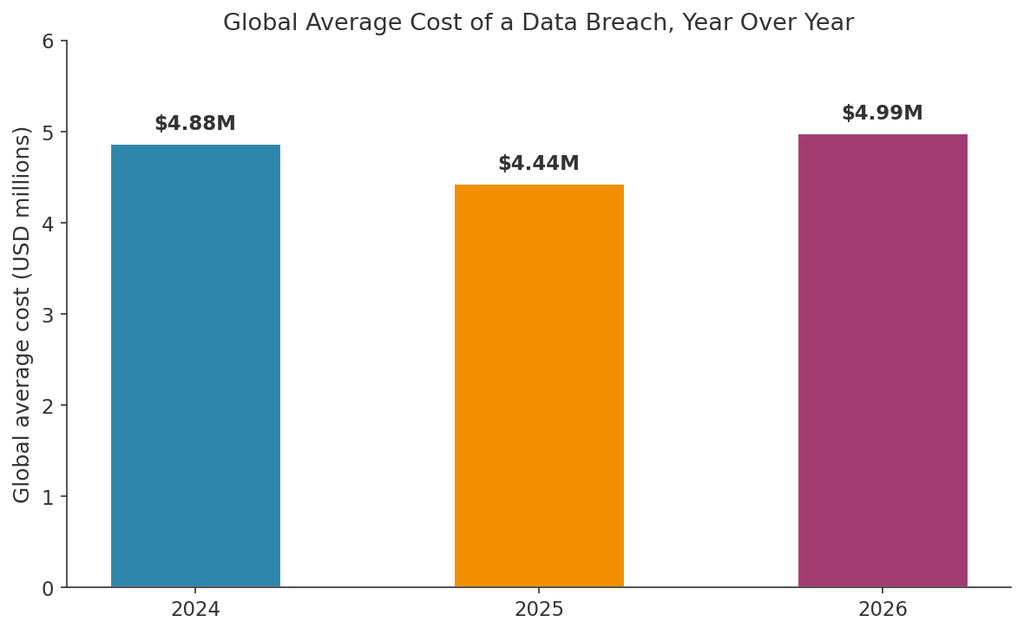
“The global average cost of a data breach climbed to a record 4.99 million dollars in 2026, a 12% increase from the previous year, driven largely by AI powered attacks moving faster than most organizations can defend against them.”
That number represents an average across companies of every size, and a founder-led company without a dedicated security team is rarely positioned to absorb a cost anywhere near that figure. Reviewing
The latest data on what a breach actually costs puts the investment in automated patching into perspective, since the software itself costs a small fraction of what a single serious incident does.
Ransomware and the Patch Connection
Most ransomware does not start with something exotic, it starts with a known vulnerability that already had a fix available.
| Key Fact: Ransomware remains one of the most common ways attackers monetise unpatched systems, since encrypting a company’s files and demanding payment requires no insider access, just an open door that a patch would have closed. |
Understanding
How ransomware attacks typically unfold makes the connection to patching obvious: attackers scan broadly for known, unpatched vulnerabilities, then exploit whichever one lets them in first. Reviewing
Why small businesses cannot just hope for the best after an attack reinforces the same point from the recovery side, since a company without a tested backup and patching strategy in place before an incident rarely improvises its way to a good outcome afterward.
Manual vs Automated: A Founder’s Comparison
The practical differences show up clearly once placed side by side.
| What Matters | Manual Patching | Automated Patch Management |
|---|---|---|
| Who is responsible | Whoever remembers, often the founder | A defined, repeatable process |
| Consistency across devices | Inconsistent, depends on follow through | Enforced automatically |
| Time to patch after release | Days to weeks, if it happens at all | Hours to days |
| Visibility into gaps | Limited, often discovered after an incident | Continuous, dashboard based |
| Founder time required | Ongoing, distracts from core work | Minimal after initial setup |
For a founder, that last row often matters as much as the security benefit itself, since every hour spent manually checking for updates is an hour not spent on product or customers.
What to Look For When Evaluating an Automated Patch Solution
Not every patch management tool fits a growing company equally well. Software built for a 5,000 person enterprise IT department often comes with complexity a five person startup has no use for, while a consumer grade option may lack the reporting a company will need once it starts fielding questions from customers or investors about its security posture.
- Coverage across every operating system employees actually use, not just one
- Automatic scheduling that does not require someone to remember to trigger it
- Clear reporting that shows patch status at a glance, without needing a security background to interpret it
- Staged rollout so a bad update hits a small group before the whole company
- Minimal setup overhead, since most founders do not have a dedicated IT hire in the early days
Reviewing
Modern approaches to cybersecurity and business continuity helps frame patch management as part of a broader resilience strategy rather than a single, isolated fix, since the goal is keeping the business running smoothly regardless of what happens.
Common Mistakes Founders Make With Patch Management
A handful of avoidable mistakes show up repeatedly among growing companies, often the same ones regardless of industry or product.
| Warning: Never assume that “we will get to it later” is a safe default for security patches. Later is exactly the window attackers are counting on, and it tends to arrive faster than founders expect. |
- Treating patching as an IT task rather than a business risk decision
- Assuming a small team means a small target, when the opposite is often true
- Delaying updates because testing feels like it will slow the team down
- Not knowing, at any given moment, how many devices are actually up to date
Reviewing
The role IT plays in protecting digital assets helps founders without a dedicated security hire understand where responsibility for this actually sits, even when the company is too small to have a formal IT department yet.
FAQs
Is patch management really necessary for an early stage startup?
Yes. Company size does not reduce the risk of an unpatched vulnerability being exploited, and early stage companies often have fewer resources to absorb the cost of a breach if one occurs, which makes prevention proportionally more valuable rather than less.
How much time does automated patch management actually save?
It varies by company size, but the main benefit is removing the need for anyone, often the founder, to manually track and apply updates across every device, freeing that time for other priorities that only a founder can handle.
Does automated patching ever cause problems?
It can, which is why staged rollout to a small test group before full deployment matters. A well designed process limits the impact of any single problematic update rather than pushing it everywhere at once and hoping for the best.
What is the biggest risk of delaying patch management until later?
The biggest risk is that “later” often arrives after an incident rather than before one, at which point the cost of fixing the problem is dramatically higher than the cost of preventing it, both financially and in terms of customer trust.
Can a non-technical founder manage this without hiring dedicated IT staff?
Largely yes, since automated tools are designed to reduce the technical burden significantly, though periodic review of patch compliance reports remains a good habit even without deep technical expertise, if only to confirm the system is doing what it claims.
Conclusion
Founders are switching to automated patch management for the same reason they automate payroll or invoicing: manual processes that depend on memory do not scale, and the cost of getting it wrong keeps climbing. With the average data breach now costing nearly five million dollars globally, treating patching as a background chore is a bet most growing companies cannot actually afford to make. Automating it removes that bet entirely, closing the gap between when a fix exists and when it actually protects the business, and giving founders one less thing to worry about while they focus on everything else building a company demands.