



The gap between gross pay vs net pay matters more than most people admit: about 72% of US workers say they would struggle to meet their financial obligations if a single paycheck arrived a week late (Source: PayrollOrg Getting Paid in America Survey 2026). When a delay of seven days causes that much pain, the number you plan around has to be the one that actually lands in your bank account.
That number is net pay. Gross pay is what your offer letter says. Net pay is what is left after taxes, benefits, and savings come out, and on a typical salary the difference runs to roughly a quarter of every check. Here is exactly where it goes, using 2026 rates and a real worked example.
Key Takeaways
- Gross pay is total earnings before any deductions come out.
- Net pay is take-home pay after taxes, benefits, and retirement savings.
- A $75,000 salary nets about $2,150 per biweekly check before state tax.
- Pre-tax deductions lower income tax, but 401(k) money still pays FICA.
- Budget on net pay, and check withholding with the IRS estimator.
What Is Gross Pay?
Gross pay is everything you earn in a pay period before a single dollar is withheld. For a salaried employee, it is the annual salary divided by the number of pay periods. For an hourly worker, it is hours worked times the hourly rate, plus any overtime.
It also includes:
- overtime pay (time and a half for hours over 40 a week for most non-exempt workers)
- bonuses and commissions
- tips reported to your employer
- shift differentials, holiday pay, and paid time off
A $75,000 salary paid every two weeks works out to $2,884.62 gross per paycheck ($75,000 ÷ 26). Paid twice a month, it is $3,125 across 24 checks. Same salary, different check sizes, which is why your pay frequency matters when you build a budget.
Gross pay is the figure lenders, landlords, and job offers use. It is rarely the figure you can spend.
What Is Net Pay?
Net pay is what remains after every deduction. It is the deposit that hits your account on payday, often labeled “net pay” or “take-home pay” at the bottom of your pay stub.
The basic formula is short:
Net pay = Gross pay − Pre-tax deductions − Taxes − Post-tax deductions
The order matters. Pre-tax deductions come out first, which shrinks the amount your income tax is calculated on. Post-tax deductions come out last and do nothing for your tax bill.
Gross Pay vs Net Pay: The Core Differences
| Gross pay | Net pay | |
|---|---|---|
| What it is | Total earnings before deductions | Take-home pay after deductions |
| Where you see it | Offer letter, top of pay stub | Bank deposit, bottom of pay stub |
| Includes | Salary, wages, overtime, bonuses, tips | Only what remains after withholding |
| Used for | Loan and rental applications, salary talks | Budgeting and day-to-day spending |
| Changes when | You get a raise or work more hours | Tax rates, benefits, or W-4 elections change |
A raise always increases gross pay. It does not raise net pay by the same amount, because part of every new dollar goes to tax.
What Comes Out of Your Paycheck in 2026
Every deduction falls into one of three buckets. Knowing which bucket a deduction sits in tells you how it affects your taxes.
Mandatory taxes
Federal income tax is withheld based on the Form W-4 you gave your employer and the IRS withholding tables in Publication 15-T (2026). For 2026, federal rates run from 10% to 37%, and the standard deduction is $16,100 for single filers and $32,200 for married couples filing jointly. For single filers, the 12% bracket starts at $12,400 of taxable income and the 22% bracket at $50,400.
Social Security tax is 6.2% of wages, up to an annual cap. That cap, the Social Security contribution and benefit base, is $184,500 for 2026. Earn above it and Social Security withholding stops for the rest of the year, which is why high earners often see a bigger check in the fall.
Medicare tax is 1.45% of all wages, with no cap. Once your wages pass $200,000 in a year, your employer withholds an extra 0.9% Additional Medicare Tax on the amount above that line.
Together, Social Security and Medicare are called FICA, and they total 7.65% for most workers. Your employer pays a matching 7.65% on top, which never shows on your stub.
State and local income tax depends entirely on where you live and work. Nine states, including Texas, Florida, and Washington, have no broad tax on wage income. Others use flat or graduated rates, and some cities add their own.
Pre-tax deductions
These come out before income tax is figured, so each dollar lowers your taxable wages.
- Traditional 401(k) or 403(b): up to $24,500 in 2026, plus an $8,000 catch-up at 50 and over, or $11,250 at ages 60 to 63. These contributions skip federal income tax now but still pay Social Security and Medicare.
- Health, dental, and vision premiums paid through a cafeteria plan: these are usually exempt from both income tax and FICA.
- Health Savings Account (HSA): up to $4,400 for self-only coverage or $8,750 for family coverage in 2026, if you have a qualifying high-deductible plan.
- Health FSA: up to $3,400 in 2026.
- Commuter benefits for transit and parking, within IRS monthly limits.
Post-tax deductions
These come out after taxes and do not cut your tax bill.
- Roth 401(k) contributions
- supplemental life or disability insurance
- union dues
- charitable payroll giving
- wage garnishments for child support, unpaid federal taxes, or court-ordered debts
Garnishments are the one deduction you do not choose. Federal law caps most consumer-debt garnishments at 25% of disposable earnings, though child support and tax levies follow different, often higher, limits.
How to Calculate Net Pay: A Worked 2026 Example
Take a single filer earning $75,000 a year, paid biweekly, living in a state with no income tax. She puts 6% of pay into a traditional 401(k) and pays $120 per check for health insurance through her employer’s plan.
| Line | Amount per paycheck |
|---|---|
| Gross pay ($75,000 ÷ 26) | $2,884.62 |
| Traditional 401(k), 6% | −$173.08 |
| Health insurance premium (pre-tax) | −$120.00 |
| Federal income tax (estimated) | −$230.52 |
| Social Security, 6.2% | −$171.41 |
| Medicare, 1.45% | −$40.09 |
| Net pay | $2,149.52 |
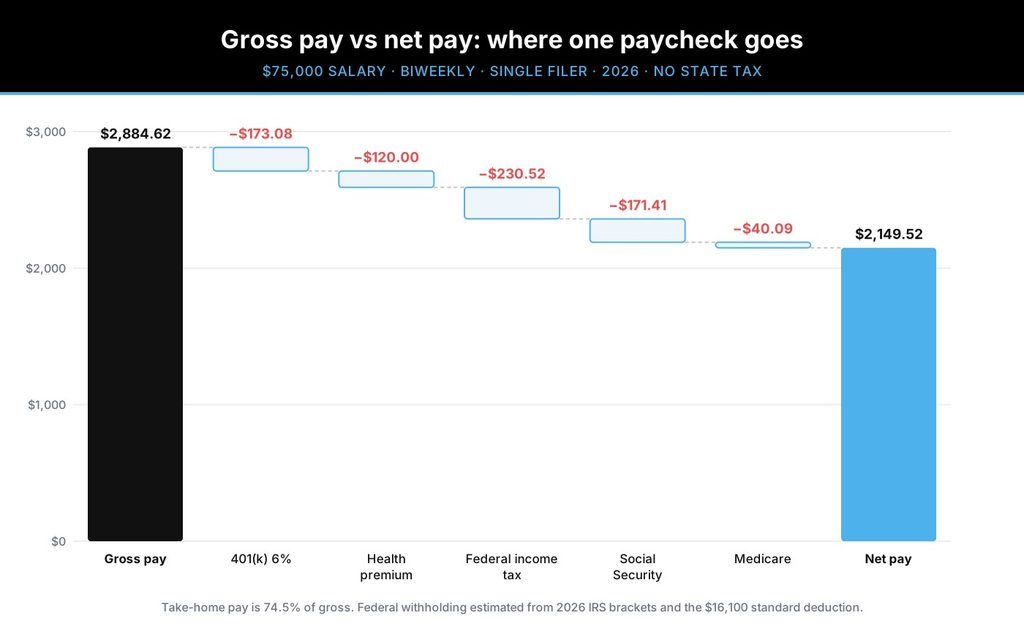
Here is how each line is figured.
Step 1: Start with gross. $75,000 ÷ 26 = $2,884.62.
Step 2: Subtract pre-tax deductions for income tax. $2,884.62 − $173.08 − $120 = $2,591.54. Annualized, that is $67,380.
Step 3: Estimate federal income tax. Subtract the $16,100 standard deduction to get $51,280 of taxable income. Apply 2026 single brackets: 10% of the first $12,400 ($1,240), 12% of the next $38,000 ($4,560), and 22% of the last $880 ($193.60). That is $5,993.60 a year, or about $230.52 per check. Your employer’s payroll system uses the Publication 15-T tables, so the real figure may differ by a few dollars.
Step 4: Figure FICA. The health premium escapes FICA, but the 401(k) contribution does not. So FICA wages are $2,884.62 − $120 = $2,764.62. Social Security at 6.2% is $171.41. Medicare at 1.45% is $40.09.
Step 5: Subtract everything. $2,884.62 − $173.08 − $120 − $230.52 − $171.41 − $40.09 = $2,149.52.
She takes home about 74.5% of her gross pay. Move her to a state with a 5% flat income tax and net pay drops by roughly another $130 per check.
What Changed for Your Paycheck in 2026
A few federal changes landed this year, and some are widely misunderstood.
“No tax on tips” and “no tax on overtime” do not raise your paycheck automatically. Under the 2025 tax law, eligible workers can deduct up to $25,000 of qualified tips and up to $12,500 of qualified overtime pay ($25,000 for joint filers) for tax years 2025 through 2028. The deduction phases out above $150,000 of modified adjusted gross income ($300,000 joint). But it is claimed on your tax return. Your employer still withholds income tax on that pay, and Social Security, Medicare, and state taxes still apply in full.
If you expect a large deduction, you can lower your withholding now instead of waiting for a refund. The 2026 Form W-4 added worksheet lines for tips and overtime, and the IRS Tax Withholding Estimator was updated in March 2026 to factor them in. Employers also face new W-2 reporting requirements for these amounts, so check that your year-end form breaks them out.
Higher limits, slightly bigger savings. The 401(k) limit rose to $24,500 and the HSA limits to $4,400 and $8,750. Raising pre-tax contributions to match lowers your taxable wages, so your net pay falls by less than the amount you save.
A higher Social Security cap. The jump from $176,100 to $184,500 means high earners pay Social Security tax a little longer into the year.
How to Read Your Pay Stub
Most pay stubs follow the same layout, whether paper or in a payroll app.
The top section shows gross earnings, broken out by type: regular hours, overtime, bonus, PTO. The middle lists every deduction, usually grouped into taxes, pre-tax benefits, and post-tax items. The bottom shows net pay. Each line normally has a “current” column and a “year-to-date” column.
The year-to-date figures are where errors show up. Compare your YTD Social Security to 6.2% of your YTD FICA wages. Check that your 401(k) percentage matches what you elected. Confirm the federal filing status matches your W-4. Payroll mistakes are more common than most people assume, and the hidden cost of payroll errors adds up for employers and employees alike.
Your stub is also a financial document in its own right. Lenders increasingly accept digital pay stubs for mortgage verification, so keep copies.
How to Budget on Net Pay, Not Gross
Budget from the deposit, not the salary. A $75,000 salary sounds like $6,250 a month. On the example above, it is closer to $4,660 a month in take-home pay, and less in a state with income tax.
A few habits help:
Build the budget from a recent stub. Use your actual net figure, not an estimate. If your pay varies with overtime or tips, use your lowest regular check as the baseline and treat the extra as a bonus.
Watch the three-paycheck months. Paid biweekly, you get 26 checks a year, so two months each year bring three paydays. Plan monthly bills around two and route the third to savings or debt.
Recheck after every life change. A raise, a new job, marriage, a new child, or a second job can all leave your withholding off. Run the IRS estimator and file a new W-4 if it flags a gap. A large refund is not free money. It means you lent the government part of your net pay all year at zero interest.
Use what your employer offers. Many payroll platforms now show a live net pay estimate before payday, and payroll automation at smaller firms is making that more common.
Conclusion
Gross pay is the headline. Net pay is the reality you live on. The difference comes from three sources: mandatory taxes, the pre-tax benefits you pick, and post-tax deductions. On a typical salary, that gap runs to about a quarter of every check.
Once you can trace each line on your stub, you control more of it than it seems. You can shift money into pre-tax accounts, update your W-4 to match a tips or overtime deduction, and catch payroll errors before they compound. Start with your most recent pay stub and the five steps above, then set your budget on the number that actually lands.
Read Next
For more on how payroll works behind the scenes, start here:
- How Automation Simplifies Small Business Payroll
- Ultimate End-of-Year Checklist for Payroll
- How AI Salary Calculators Empower Global Workforce Finance Transparency
Frequently Asked Questions
The difference between gross pay vs net pay is deductions. Gross pay is your total earnings before anything is withheld. Net pay is what you take home after federal, state, and FICA taxes, plus benefits and retirement contributions, are subtracted.
You calculate net pay by subtracting pre-tax deductions, then taxes, then post-tax deductions from gross pay. Pre-tax items such as a traditional 401(k) or health premiums come out first and lower your taxable income. FICA is 7.65% for most workers in 2026, while federal and state income tax depend on your W-4, brackets, and location.
Net pay as a percentage of gross pay typically lands between 65% and 80%. It depends on your income, state taxes, and how much you put into pre-tax accounts. In the 2026 worked example above, a $75,000 earner with no state income tax takes home about 74.5% of gross.
No tax on overtime does not automatically increase net pay on each paycheck. The deduction is claimed on your federal tax return, and employers still withhold income tax, Social Security, and Medicare on overtime pay. You can raise your take-home pay during the year by adjusting your Form W-4 with the updated IRS Tax Withholding Estimator.
Gross pay is used for most loan and rental applications. Lenders and landlords compare your gross income with your debt or rent payments. For your own budget, net pay is the more accurate figure because it reflects what you can actually spend.