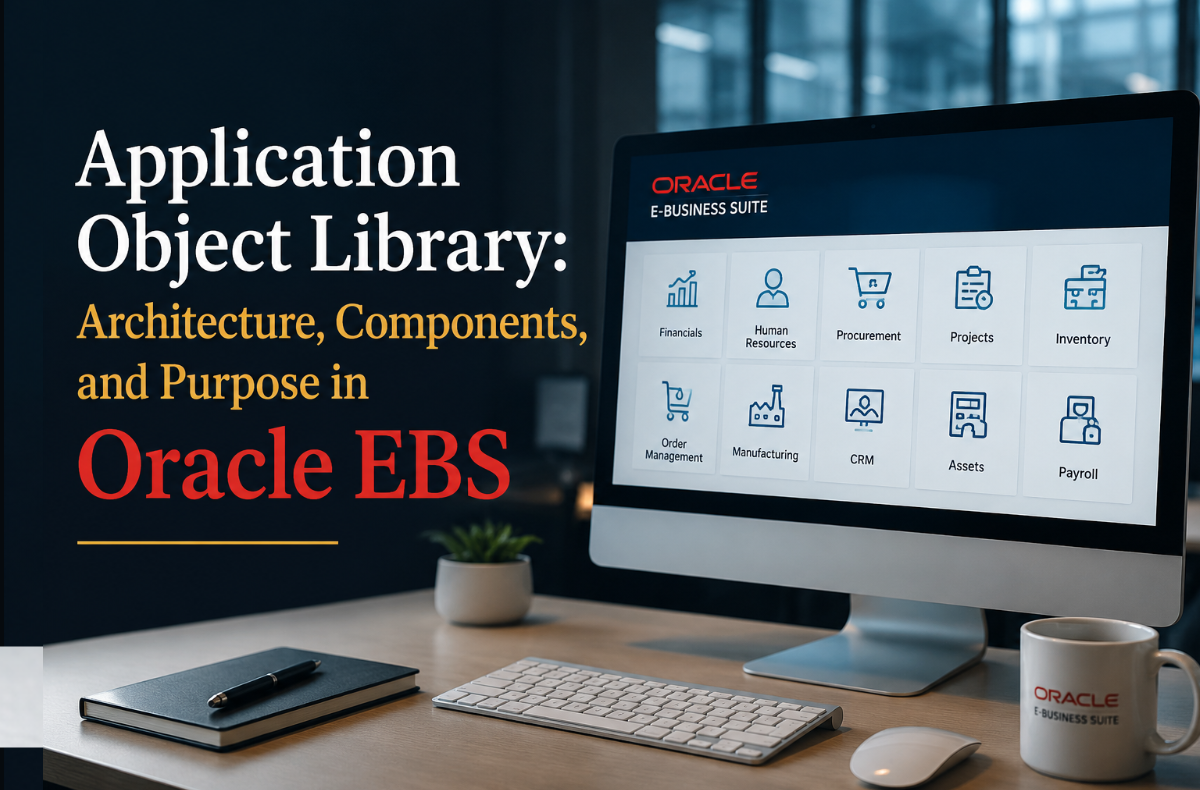
Oracle Application Object Library (AOL) serves as the backbone of Oracle E-Business Suite, providing the shared architecture that connects applications, standardizes processes, and supports enterprise-wide operations. Instead of treating each module as an isolated system, Oracle EBS relies on AOL to create a consistent framework for user management, concurrent processing, security controls, flexfields, reporting, and application customization.
This centralized architecture plays a critical role in maintaining stability across Oracle Financials, Supply Chain, Manufacturing, Human Resources, and other integrated business modules. Developers, database administrators, and Oracle functional consultants rely on the Oracle AOL to reduce repetitive development effort, simplify configuration management, and ensure that applications adhere to a unified operational structure.
A strong understanding of Oracle AOL becomes essential when managing responsibilities, configuring menus and profile options, registering concurrent programs, designing value sets, or developing custom Oracle Apps solutions. Without this framework, maintaining scalability and consistency across large enterprise environments would become significantly more difficult.
This guide explores the architecture, core components, and practical purpose of Oracle Application Object Library in Oracle Apps and Oracle EBS environments. It also explains how AOL supports customization, improves system administration, and remains relevant in modern Oracle enterprise ecosystems.
Key Takeaways
- The Application Object Library (AOL) forms the backbone of Oracle E-Business Suite, ensuring consistency across various modules.
- AOL simplifies development and configuration management, reducing redundant code while enhancing security and user experience.
- Core components such as menus, responsibilities, and concurrent programs operate within AOL, enabling seamless user interaction.
- Integration with third-party applications and customization options enhances the functionality of Oracle EBS using AOL.
- Future trends indicate a shift toward cloud computing and AI, which will impact the architecture and capabilities of the Application Object Library.
Table of Contents
- What is Oracle Application Object Library (AOL)?
- Architecture of Oracle Application Object Library (AOL)
- Core Components of Application Object Library
- Practical Applications and Use Cases
- Best Practices for Managing Application Object Library
- Future Trends and Evolution in Application Object Library
- Next Steps for Developers
- FAQs
What is Oracle Application Object Library (AOL)?
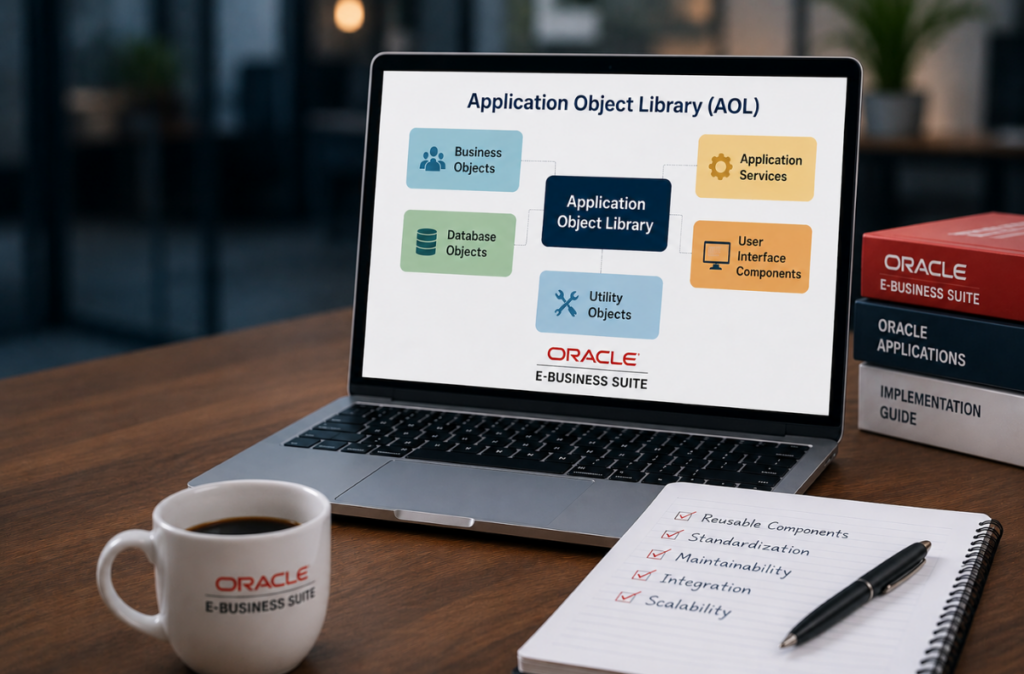
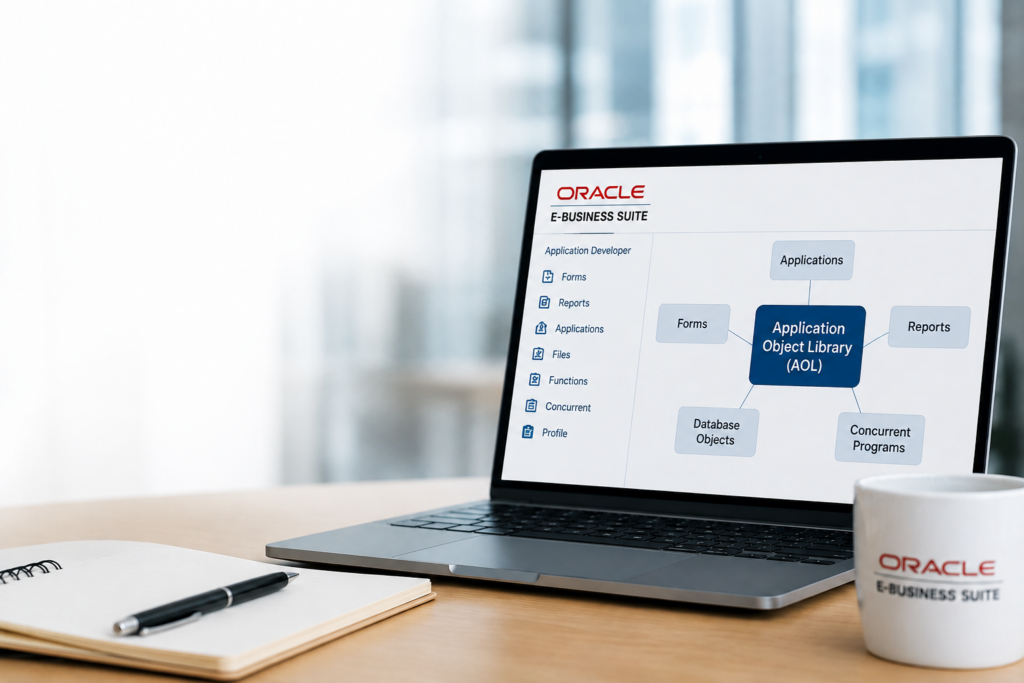
Oracle Application Object Library is a collection of pre-built application components and facilities. It includes forms, subroutines, concurrent programs, database tables, menus, responsibilities, and flexfield definitions. The AOL in Oracle Apps provides a reusable codebase. Developers use AOL to ensure custom extensions share the same look, feel, and functionality as standard Oracle applications.
The importance of AOL in Oracle EBS cannot be overstated. It provides the security authorization features of Oracle applications, manages concurrent processing, and handles user profiles and application messages. By understanding the Oracle AOL, organizations reduce development time. Developers avoid writing redundant code. Businesses maintain consistent security and user experiences across all modules.
Architecture of Oracle Application Object Library (AOL)
The Oracle AOL architecture integrates deeply with the Oracle E-Business Suite architecture. It acts as the technical glue holding various modules together.
Key Architectural Components
Oracle Apps technical architecture relies on the APPL_TOP directory. The APPL_TOP directory stores core technology files and product-specific directories. When developers register custom application components, they place executable files within this structured file system.
The Role of APPL_TOP Directory
The APPL_TOP directory organizes files by product and release. Each module has its own top-level directory, such as GL_TOP for Oracle General Ledger. Inside these directories, the file structure remains consistent:
- Forms/US: Stores compiled form files (.FMX).
- Reports/US: Contains compiled report files (.RDF).
- BIN: Holds executable code for concurrent programs (C, Pro*C, shell scripts).
- LIB: Contains compiled object code (.OBJ files).
- SQL: Stores PL/SQL scripts and SQL*Plus concurrent programs.
- HTML: Holds web files (.HTML, .JSP).
- LOG & OUT: Captures concurrent program logs and output files.
Oracle EBS AOL framework uses this structure to locate and execute programs efficiently.
Core Components of Application Object Library
Oracle AOL components govern how users interact with Oracle EBS. The Application Object Library Oracle database schema (FND) stores the metadata for these components.
Menus and Responsibilities
Oracle AOL responsibilities control application access. A responsibility defines what functionality a user can use.
- Defining menus: Administrators define hierarchical menus in the Application Object Library.
- Associating menus: Each responsibility links to a specific menu. Oracle AOL menus and forms determine the navigation paths available to users.
Concurrent Programs and Managers
Long-running, data-intensive tasks require background processing. Oracle AOL concurrent programs handle these operations.
- Users run concurrent programs using Standard Report Submission (SRS).
- Administrators group these programs into Request Groups.
- Executable code resides in the BIN or SQL directories, while the Application Object Library tracks the execution status.
Flexfields: Key and Descriptive
Oracle AOL flexfields capture business-specific data.
- Key Flexfields: Identify unique entities. Businesses use them to define accounting codes or part numbers.
- Descriptive Flexfields: Provide customizable expansion space on forms. They capture additional information without requiring custom database columns.
Application Object Library Lookups
Application Object Library lookups in Oracle apps provide lists of valid values for fields. Oracle AOL lookups restrict user input and ensure data integrity.
| Access Level | Description |
|---|---|
| System | Users cannot add, update, or delete lookup codes. |
| Extensible | Users can add new codes but cannot modify seeded codes. |
| User | Users can add, modify, and disable any lookup code. |
User Profiles and Security
Oracle AOL profile options configure application behavior. Administrators set profiles at the Site, Application, Responsibility, or User level. The Oracle AOL security model ensures that users see only data and forms appropriate to their roles. Oracle EBS system administration relies heavily on the Application Object Library to enforce these rules.
Practical Applications and Use Cases
Organizations leverage the Oracle Apps development framework to extend functionality. Application Object Library makes these extensions seamless.
Registering Custom Application Components
When companies build custom forms, they must register them. Developers register custom application components with the Application Object Library. This process links the custom form to the Oracle Forms and Oracle AOL security model.
Integrating Existing Applications
Businesses often integrate third-party tools with Oracle EBS application components. AOL provides the APIs and open interfaces needed to perform data conversion safely.
Writing Custom Reports
Developers write custom reports for AOL using Oracle Reports or XML Publisher. Registering these reports as Oracle AOL concurrent programs allows users to schedule them via SRS.
Best Practices for Managing Application Object Library
Efficient Oracle AOL customization requires strict adherence to standards.
- Custom Schemas: Always register a custom application schema (e.g., XXCUS) using Application Object Library. Never modify standard Oracle schemas.
- Security: Assign the custom schema to the correct Data Group. Use Oracle AOL user management to grant least-privilege access.
- Troubleshooting: Monitor the LOG and OUT directories. Use the Oracle EBS technical guide to resolve concurrent manager bottlenecks.
Developers frequently query Oracle AOL tables to troubleshoot issues.
| Table Name | Description |
|---|---|
| FND_USER | Stores application user details. |
| FND_RESPONSIBILITY | Stores defined responsibilities. |
| FND_MENUS | Stores hierarchical menu definitions. |
| FND_CONCURRENT_PROGRAMS | Stores registered concurrent programs. |
| FND_FLEX_VALUES | Stores valid values for Oracle AOL value sets. |
Future Trends and Evolution in Application Object Library
The landscape of Oracle EBS R12 AOL continues to evolve.
Impact of Cloud and AI
Cloud computing changes how organizations deploy the Oracle E-Business Suite architecture. Cloud-hosted environments require tighter integration protocols. AI integration introduces predictive analytics into concurrent processing. Machine learning algorithms now help identify performance bottlenecks within the Application Object Library.
Continuous Advancements
Oracle introduces Enterprise Command Centers to enable natural-language querying. These advancements rely on the underlying metadata stored in the Application Object Library. AOL is bridging legacy systems with modern generative AI tools.
Next Steps for Developers
Oracle Application Object Library (AOL) continues to serve as the foundational framework behind Oracle E-Business Suite, powering the structure, security, and operational consistency of enterprise applications. From managing responsibilities and menus to supporting concurrent processing, flexfields, and application customization, AOL influences nearly every critical function within Oracle Apps environments.
A strong understanding of Oracle AOL allows developers, administrators, and technical consultants to build scalable solutions, maintain system integrity, and streamline complex business operations without disrupting the core Oracle architecture. Its standardized framework reduces development redundancy, improves maintainability, and supports efficient integration across financial, HR, supply chain, and manufacturing modules.
As Oracle EBS environments continue to evolve, the importance of Application Object Library remains unchanged. Organizations that fully understand and utilize AOL can improve system performance, strengthen security management, and create more reliable enterprise workflows. Mastering Oracle Application Object Library is not only valuable for technical customization but also essential for maintaining long-term efficiency and stability across Oracle enterprise ecosystems.
FAQs
The Application Object Library is a collection of prebuilt components, including forms, programs, and tables. It provides the technical foundation and security framework for Oracle E-Business Suite.
It uses responsibilities, menus, and user profiles. The Oracle AOL security model restricts user access to authorized functions and data.
The Application Object Library is a collection of common code, database tables, and utilities that provide the underlying technical framework for Oracle E-Business Suite applications.
In Oracle Apps R12, the AOL manages standard features like security, concurrent processing, flexfields, and lookups across all modules.
The Oracle AOL tables typically start with the prefix “FND_” (e.g., FND_USER, FND_MENUS) and are stored in the APPS schema of the Oracle database.