Introduction
Waste management is rapidly evolving from a traditional infrastructure challenge into a technology-driven discipline. Landfills are no longer viewed simply as places to store waste; they are becoming intelligent environmental assets that combine advanced engineering materials with digital technologies to improve efficiency, sustainability, and regulatory compliance.
As urban populations grow and landfill space becomes increasingly limited, operators face mounting pressure to extend the lifespan of existing facilities without expanding their physical footprint. At the same time, stricter environmental regulations and rising operational costs are demanding greater visibility into landfill performance than ever before.
Advanced geosynthetic liner systems have long played a central role in protecting soil and groundwater from contamination. Today, these engineered materials are increasingly complemented by artificial intelligence (AI), Internet of Things (IoT) sensors, cloud-based monitoring platforms, Geographic Information Systems (GIS), and predictive analytics. Together, these technologies enable landfill operators to make data-driven decisions, detect issues earlier, and optimize long-term infrastructure performance.
Rather than replacing geosynthetics, digital technologies enhance their effectiveness by providing continuous monitoring and actionable insights throughout a landfill’s lifecycle.
Table of Contents
- Introduction
- The Circular Economy Is Driving Smarter Waste Infrastructure
- Geosynthetics Remain the Foundation of Modern Landfill Design
- How AI and IoT Are Transforming Landfill Monitoring
- Cloud Platforms Improve Visibility Across Landfill Operations
- GIS and Digital Twins Support Better Expansion Planning
- Data Analytics Strengthens Risk Management
- Better Technology Supports Communities as Well
- The Future of Smart Landfills
- Conclusion
The Circular Economy Is Driving Smarter Waste Infrastructure
The transition toward a circular economy is reshaping how governments and organizations approach waste management. Instead of following the traditional “take, make, dispose” model, modern waste strategies prioritize resource recovery, recycling, and maximizing the useful life of infrastructure.
Landfills continue to play an important role within this system, but expectations have changed significantly. Modern facilities are expected to safely contain waste, recover landfill gas, manage leachate efficiently, protect surrounding ecosystems, and operate with greater transparency.
Meeting these expectations requires more than durable construction materials. It requires intelligent infrastructure capable of generating operational data, identifying emerging risks, and supporting proactive maintenance decisions.
This is where digital technologies increasingly complement geosynthetic engineering.
Geosynthetics Remain the Foundation of Modern Landfill Design
Geosynthetics, including geomembranes, geotextiles, geonets, and drainage composites, remain the foundation of modern landfill containment systems.
These engineered materials perform several essential functions:
- Prevent contaminants from reaching soil and groundwater
- Improve drainage and leachate collection
- Stabilize landfill slopes
- Protect structural integrity over decades of operation
- Support long-term environmental compliance
Modern liner systems often combine multiple geosynthetic layers to increase durability and minimize failure risks.
However, even the most advanced liner systems benefit from continuous performance monitoring. Rather than relying solely on scheduled inspections, operators increasingly use digital technologies to understand how these systems perform in real-world conditions throughout their operational life.
“The smartest landfill technologies still rely on a strong physical foundation,” says Bland Warren, CEO of Plastic Fusion. High-quality HDPE materials and engineered containment systems provide decades of environmental protection. When operators pair durable geosynthetic infrastructure with real-time monitoring, they gain both reliability and actionable data that support better long-term asset management.
How AI and IoT Are Transforming Landfill Monitoring
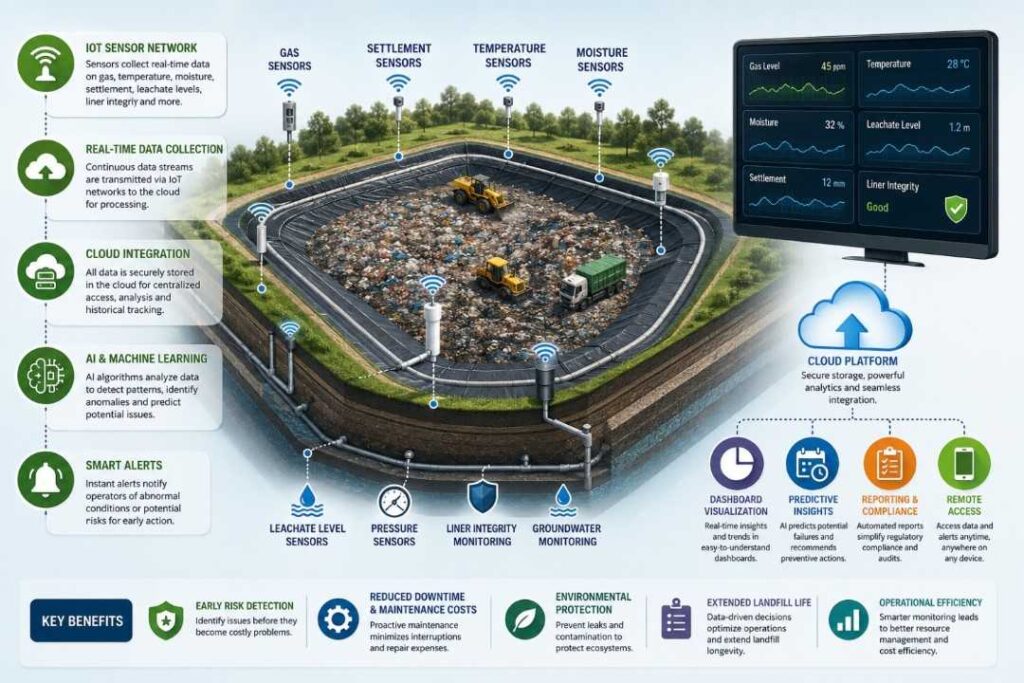
Artificial intelligence and IoT have become valuable tools for improving landfill operations without changing the core engineering principles behind geosynthetic containment. Instead of collecting this information during periodic inspections, operators receive continuous streams of operational data.
AI-powered analytics platforms then evaluate this information to identify patterns that may indicate developing issues before they become expensive failures. For example, unusual moisture readings or changing pressure levels may signal potential liner stress long before visible damage occurs. Early detection enables maintenance teams to intervene proactively, reducing repair costs while lowering environmental risk.
This shift from reactive maintenance to predictive maintenance helps extend landfill life while improving operational reliability.
Cloud Platforms Improve Visibility Across Landfill Operations
Many landfill operators now use cloud-based management platforms to centralize environmental and operational data. Instead of maintaining separate systems for inspections, compliance records, maintenance schedules, and monitoring equipment, cloud platforms integrate information into a single operational dashboard.
These systems help operators:
- Track landfill performance in real time
- Monitor environmental compliance
- Schedule preventive maintenance
- Generate automated reports
- Share information across multiple facilities
- Support regulatory audits
Centralized visibility improves decision-making while reducing administrative overhead.
GIS and Digital Twins Support Better Expansion Planning
Planning landfill expansion has traditionally relied on engineering surveys and historical data. Today, Geographic Information Systems (GIS) and digital twin technology provide far more detailed planning capabilities.
GIS software allows engineers to visualize:
- Landfill capacity
- Topography
- Drainage systems
- Environmental protection zones
- Infrastructure constraints
Digital twins take this a step further by creating virtual replicas of landfill operations. These virtual models simulate how geosynthetic liner systems, drainage infrastructure, waste placement, and environmental conditions interact over time. Operators can evaluate different scenarios before implementing physical changes, helping reduce planning risks while improving long-term resource utilization.
Data Analytics Strengthens Risk Management
Historically, liner selection focused primarily on construction cost and engineering specifications. Today, many operators recognize that long-term operational data provides a more comprehensive view of infrastructure performance. This data helps organizations identify trends that influence infrastructure reliability, environmental compliance, and long-term operating costs.
Rather than treating liner systems as isolated construction materials, operators increasingly evaluate them as part of an integrated risk management strategy supported by continuous data analysis.
Better Technology Supports Communities as Well
Improved landfill monitoring benefits more than facility operators.
According to John Swann, Founder of John Buys Your House, “Communities pay close attention to how nearby infrastructure is managed because it can influence future development and public confidence. Technologies that improve transparency and reduce environmental risk help create greater certainty for both local governments and property owners over the long term.”
Reliable containment systems supported by digital monitoring reduce the likelihood of environmental incidents that may affect nearby communities. Continuous monitoring also strengthens public confidence by providing greater transparency regarding landfill performance and regulatory compliance. For local governments, this technology can simplify environmental reporting while supporting more informed land-use planning around existing landfill sites.
The Future of Smart Landfills
The next generation of landfill management will likely combine traditional engineering expertise with intelligent software platforms.
Several technologies are expected to play larger roles over the coming years:
- AI-driven predictive maintenance
- IoT sensor networks
- Digital twins
- GIS-based planning
- Automated environmental reporting
- Machine learning for capacity forecasting
- Drone inspections
- Remote monitoring platforms
Together, these innovations create smarter landfill infrastructure that adapts to changing environmental conditions while reducing operational costs.
Conclusion
Geosynthetic liner systems continue to provide the physical foundation for modern landfill containment, but software and digital technologies are transforming how these systems are managed.
By integrating AI, IoT sensors, cloud platforms, GIS, digital twins, and predictive analytics, landfill operators gain continuous insights into infrastructure performance, improve maintenance planning, reduce environmental risks, and extend landfill lifespans without unnecessary expansion.
As sustainability goals become more ambitious and regulatory expectations continue to rise, the future of landfill management will depend not only on stronger engineering materials but also on smarter technology that turns operational data into informed decisions. Intelligent waste infrastructure demonstrates how digital innovation and environmental engineering can work together to deliver safer, more efficient, and more sustainable landfill operations