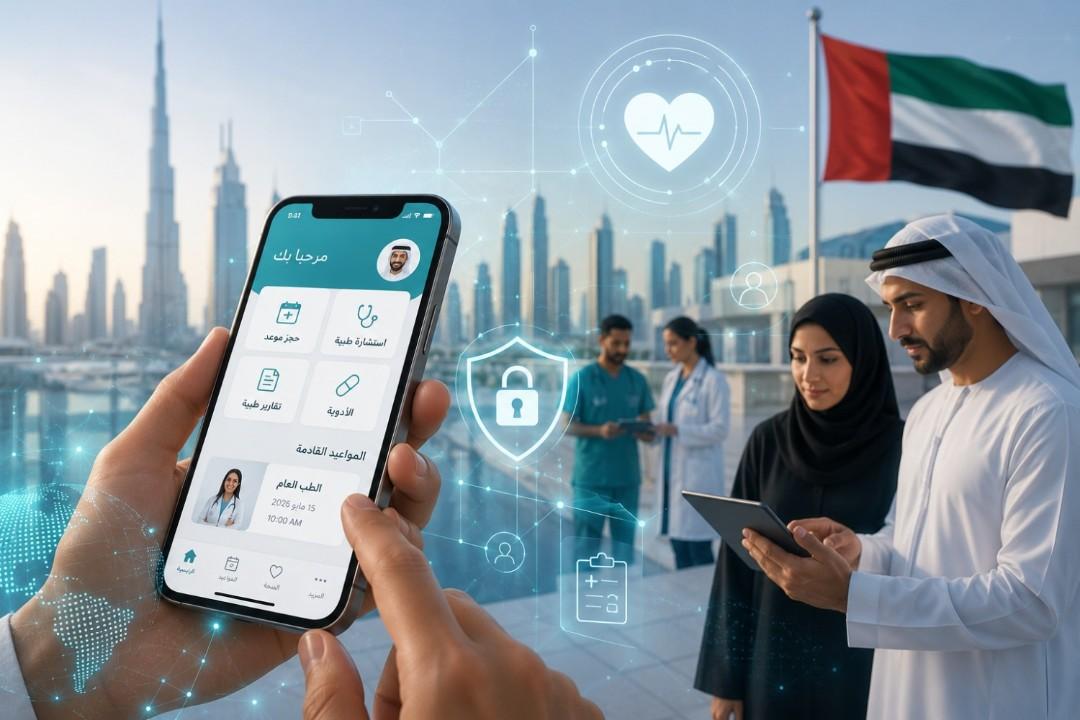
UAE Healthcare Leaders and healthcare companies across the UAE spend large budgets on mobile software. Hospitals and clinics now offer patient portals, telehealth tools, and online booking systems. Yet one problem persists in boardroom discussions. Patient activity drops quickly after the download.
Corporate executives spend months reviewing user numbers. They saw thousands of new downloads in the first quarter. Yet active user numbers drop by 80% within 30 days. This loss creates massive waste in marketing budgets.
Many users download these tools once. They use them to schedule a single appointment or view a medical report. Then they stop opening the application. Some users delete the software completely when the experience feels broken.
Patient behavior also varies by device. According to the Office of the National Coordinator for Health Information Technology (ONC), 61% of patients access patient portals only from a computer, 22% use only a smartphone, and 17% use both devices. This suggests that healthcare providers should deliver a seamless experience across both mobile and desktop platforms rather than assuming patients will rely exclusively on mobile apps.
This issue is not a failure of core code. The software usually runs without technical bugs. The problem lies in user engagement. A gap exists between hospital systems and human habits. Many applications do not fit regional lifestyles.
UAE healthcare leaders in 2026 must change their focus. The current market requires more than text translation. Companies need medical software that feels native and secure across the whole user experience.
Table of Contents
- Building Native Code to Protect Engineering Capital
- Connecting Separate Hospital Systems to Lower Operating Costs
- Commercial Proof: Metrics from Regional Market Success
- Automating Clinic Tasks to Reduce Corporate Overhead
- Compliance Regulations and Regional Expansion
- Selecting an Engineering Partner to Secure Enterprise Assets
Building Native Code to Protect Engineering Capital
True localization goes beyond changing words from English to Arabic. Text translation leaves application structures unchanged. This creates bad user experiences. For example, right-to-left text layouts often break on basic screens.
Medical software must handle regional variations. A patient in Dubai wants clear medical alerts in natural Arabic. They want prescription details and dosage times in their primary language. Another user wants to use both English and Arabic during the same hospital visit. The software must support this change instantly.
Building these systems requires specialized engineering skills. Standard technology vendors cannot manage these regional technical demands.
For this reason, large healthcare networks choose an experienced mobile app development company in Dubai to build their platforms, shows commitment from UAE healthcare leaders. The right engineering partner understands local patient habits. They design systems that stop user drop-off and protect development capital.
Connecting Separate Hospital Systems to Lower Operating Costs
Medical applications cannot run in isolation. A successful patient platform depends on separate systems exchanging data continuously.
A user updates their personal file on their phone. The clinic scheduling software must receive this update immediately. The doctor’s medical charts must be updated, too. This instant connection depends on healthcare data standards.
Companies use specific data tools to build these networks. These tools include FHIR APIs and HL7 data messaging. They use API gateways and central data stores.
- FHIR APIs: Standard data exchange between networks
- HL7 Messaging: Older hospital database connection
- API Gateways: Central system security and management
- Data Repositories: Unified storage for patient files
Patients do not see these code integrations. They only notice when the integrations fail. Executives need specialized healthcare app development services to build these secure data pathways. Good data pipelines lower administrative costs and remove operational errors.
Commercial Proof: Metrics from Regional Market Success
Altibbi provides a clear example for the local market. The company has its main offices in Dubai. It grew into a large medical platform in the region.
The creators did not copy Western code and apply a basic Arabic translation layer. They built the entire software platform in Arabic from the first day. They added an AI system to recognize different regional Arabic dialects. They created private consultation paths for sensitive medical cases. They also created original medical articles in Arabic.
The business numbers show the success of this strategy:
- Investment Capital Raised: Over 50 million dollars
- Annual Patient Consultations: Over 3 million interactions
- Core AI Capability: Native Arabic dialect processing
The platform expanded past basic consumers. It connected directly with insurance firms, employers, and hospital networks. This group connection kept patients active on the platform for years.
Automating Clinic Tasks to Reduce Corporate Overhead
Artificial intelligence helps hospital networks manage growing patient lists. Teams do not use AI to replace human doctors. They use machine learning to lower the workload for desk staff.
Hospitals across the region use Arabic voice assistants and automatic booking tools. They use software triage to route patients to the right clinic.
Imagine a patient using an app late at night. They have a question about pill side effects. An Arabic AI assistant answers immediately. The tool shows medical facts and warns the patient about dangerous reactions. It routes urgent issues to an on-call nurse.
The patient gets immediate support. The hospital lowers the pressure on its night staff. This utility explains why corporate demand for advanced software engineering continues to rise.
Compliance Regulations and Regional Expansion
Many companies make the mistake of checking regulatory compliance at the end of development. This delay creates massive technical problems. Medical software in the UAE is subject to strict regulations.
Platforms must follow the UAE Personal Data Protection Law. They must match Dubai Health Authority rules and Abu Dhabi Department of Health standards. International groups must also meet HIPAA requirements. Another commitment from UAE healthcare leaders.
These rules dictate where you store files. They govern how systems share data and who views sensitive records. Engineers must build specific security tools early in the project:
- Access Control: The software limits chart visibility to approved medical staff.
- Identity Security: Multi-factor login tools confirm user identities.
- Data Protection: The system encrypts files during transit and inside databases.
- Event Logs: The platform automatically records every file access.
Enterprises must also plan for growth outside the country. A platform built for one city often fails when expanding into Saudi Arabia or Qatar. Data laws change across borders. Teams should use microservices and an API-first framework. This setup allows the software to expand without expensive code rewrites.
Selecting an Engineering Partner to Secure Enterprise Assets
UAE healthcare leaders must choose between building software in-house and hiring specialists. Internal development offers control, but hiring specialized developers is difficult. Hospitals struggle to retain FHIR architects, security engineers, and compliance experts.
Hiring an external partner reduces project risk. Leaders should evaluate partners on data integration skills, compliance knowledge, and regional expansion experience. Arabic-first software is a major corporate investment. The best results belong to networks that build connected data systems.