
The first generation of personal finance technology was built on a simple premise: if people could see their money more clearly, they would manage it more effectively. That premise delivered budgeting apps, spending trackers, and dashboards layered with charts showing where every dollar went. It was a useful starting point for FinTech. But a decade into the experiment, the data suggests that visibility alone has not closed the savings gap for most Americans.
A growing wave of fintech platforms is now exploring what comes after the dashboard era. Instead of helping people look backward at where their money has been, these tools focus forward: where does your money need to be, by when, and are you on pace to get it there? It is a shift from financial tracking to financial planning, and the implications for how consumers interact with their own goals are significant.
Key Takeaways
- The first generation of personal finance technology emphasized visibility but failed to close the savings gap for many Americans.
- Fintech platforms are shifting from financial tracking to financial planning, focusing on future financial goals and timelines.
- Saving Birds uses the Milestone Model, allowing users to break large goals into checkpoints, increasing accountability and likelihood of completion.
- This platform distinguishes itself by emphasizing pace over account balances, providing feedback on whether users are on track to meet their savings targets.
- Saving Birds reflects a trend in fintech towards modular tools that focus on specific financial planning challenges rather than comprehensive solutions.
Table of contents
The Milestone Model
Among the platforms driving this shift is Saving Birds, a planning tool that organizes financial goals around what it calls a “flight plan.” Users set a specific target, break it into intermediate milestones with dollar amounts and deadlines, and then track their pace against those checkpoints over time.
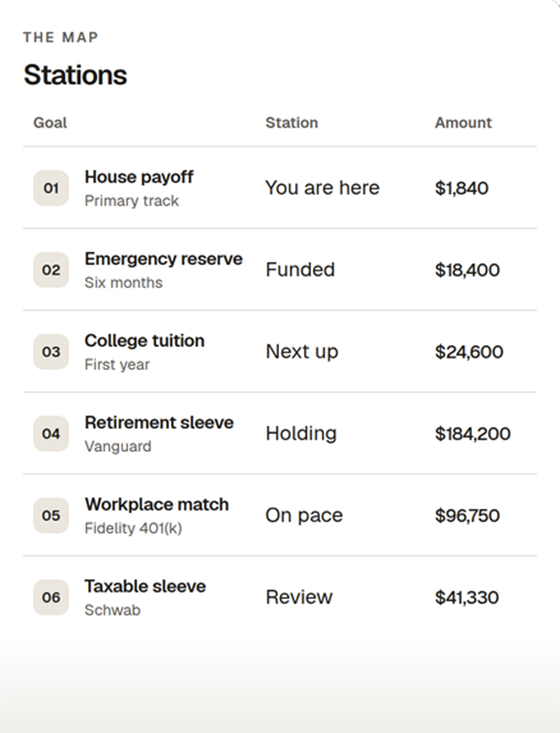
The concept draws directly from behavioral science. Research on goal attainment has repeatedly shown that breaking large objectives into smaller, time-bound milestones increases the likelihood of completion. The mechanism is well understood: intermediate targets create natural moments of accountability, and the feedback from hitting or missing each one recalibrates effort in real time.
Saving Birds applies this at the product level. Rather than presenting users with a single savings target and leaving them to figure out the path, the platform maps the full route. Each milestone functions as a checkpoint, and the system monitors whether the user’s current savings rate will deliver them to each checkpoint on schedule.
Pace as the Core FinTech Metric
What distinguishes this approach from traditional savings tools is the emphasis on pace. Most financial platforms anchor their user experience around account balances or net worth figures. Saving Birds anchors its experience around trajectory.
A user saving for a $30,000 down payment does not just see their current balance. They see whether their savings rate, projected forward, reaches $30,000 by their target date. If the projection falls short, the platform’s checkpoint alerts flag the gap and quantify how much the user needs to adjust. If the projection exceeds the target, the tool reflects that surplus as a pace advantage.
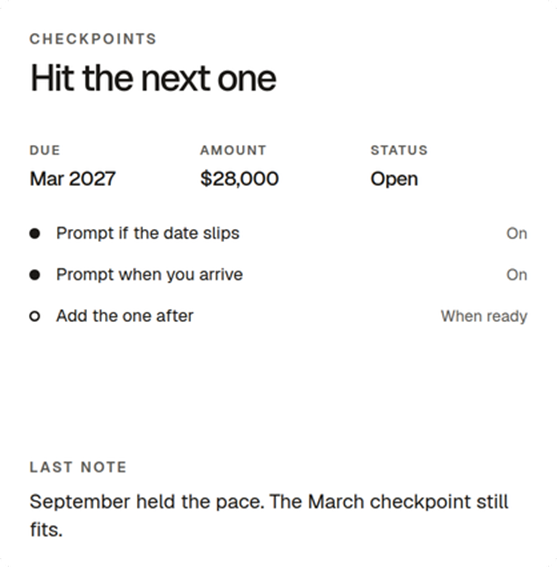
This creates a fundamentally different relationship between the user and their financial data. Instead of checking an account balance and interpreting it in isolation, users receive contextualized feedback that answers a specific question: are you on track for the thing you care about?
The Technical FinTech Restraint
Notably, Saving Birds does not attempt to be a comprehensive financial platform. It does not offer investment management, automated savings transfers, bill negotiation, or credit monitoring. It does not connect to brokerage accounts or provide robo-advisory services. The platform stays deliberately within the planning layer, focusing entirely on goal definition, milestone mapping, and pace tracking.
This restraint reflects a broader pattern in fintech’s evolution. The all-in-one super-app model that dominated the mid-2010s has given way to a more modular approach, where purpose-built tools solve specific problems well rather than solving every problem adequately. For Saving Birds, the specific problem is the space between setting a financial goal and reaching it: the planning gap that dashboards describe but do not close.
Implications for Consumer Finance
The milestone-driven model points to a larger trend in how financial technology is beginning to incorporate behavioral design. Rather than assuming that consumers will act rationally when given sufficient data, the next generation of tools is being built around the friction points where intention breaks down.
Goal specificity is one of those friction points. People save more effectively when their targets have numbers and dates attached to them. Intermediate accountability is another. Waiting twelve months to evaluate annual progress invites procrastination; quarterly or monthly checkpoints create natural review cycles that keep goals active.
Platforms like Saving Birds represent one answer to a question that the fintech industry has been circling for years: once you have shown people their financial data, how do you help them actually do something useful with it? The flight plan model suggests that the answer is less about better data and more about better structure. Direction over dashboards, as the platform describes it. A clear path forward, measured not in dollars accumulated but in pace maintained.
For the demographic that Saving Birds targets, people who earn enough to save but consistently feel behind, the value proposition is not more information. It is a framework that converts information into a plan, and a plan into measurable, checkpoint-by-checkpoint progress.