Advertisers spend a fortune on digital ads. Global digital advertising spend reached $740 billion in 2026, capturing 73% of total media investment, according to Improvado. Yet a striking share of that money never produces a return. Search Engine Land found that small businesses waste roughly 25% of their pay-per-click budgets, and Marketing Evolution puts total digital ad waste at up to 60% when poor targeting, misattribution, and weak creative are factored in. The gap between what is spent and what is returned is the problem that digital advertising intelligence solves.
Rather than running campaigns on instinct, marketing teams use structured data with digital advertising intelligence to see which creatives convert, where budget leaks, and what competitors are doing before those moves reach the wider market.
This guide covers what digital advertising intelligence is, how it works across four signal layers, which tools lead the market in 2026, and how to build a practice that turns ad data into scalable growth. Marketers, founders, and agencies who run paid campaigns will find a clear path from raw numbers to confident decisions.
Summary
Digital advertising intelligence is the practice of collecting, analyzing, and acting on ad data across your campaigns and competitors to make faster, more profitable decisions. Done right, it reduces wasted ad spend, sharpens targeting, and turns competitor patterns into your own test roadmap, without guesswork.
Key Takeaways
- Digital advertising intelligence turns raw ad data into actionable decisions, addressing the gap between ad spend and return.
- It operates across four signal layers: account performance, competitor, category, and predictive.
- AI enhances this practice by detecting patterns, estimating ad spend, and providing predictive scores for new creatives.
- Marketers should use a structured approach, employ the right tools, and maintain a consistent cadence of analysis.
- The future of digital advertising intelligence will enhance predictive capabilities and integrate fragmented tools for better decision-making.
Table of Contents
- What Is Digital Advertising Intelligence?
- The Four Signal Layers of Digital Advertising Intelligence
- The Core Mechanics: How Digital Advertising Intelligence Works
- Three Key Pillars of Digital Advertising Intelligence
- Digital Advertising Intelligence Tools for Attribution Analysis
- How to Build a Digital Advertising Intelligence Strategy
- The Future of Digital Advertising Intelligence
- Make Your Next Ad Decision With Data
- FAQs
What Is Digital Advertising Intelligence?
Digital advertising intelligence is the analytical layer that transforms raw ad data into structured, actionable decisions. It draws from your own campaigns, competitor activity, category-wide trends, and AI-powered predictive models, then produces testable hypotheses on a recurring cadence.
Here’s what separates it from related disciplines:
- It’s not just competitor research. Competitor analysis is one input. Intelligence combines four signal sources.
- It’s not just creative analytics. Creative analytics scores ads that already ran. Ad intelligence operates before and after that.
- It’s not just reporting. Reporting reads backward. Digital advertising intelligence looks forward, with predicted outcomes attached.
The digital advertising intelligence market reflects this growing importance. According to WiseGuy Reports, the ad intelligence software market was valued at $3.13 billion in 2024 and is projected to grow from $3.5 billion in 2025 to $10.5 billion by 2035. That’s not a trend. That’s a structural shift in how advertising decisions get made.

The Four Signal Layers of Digital Advertising Intelligence
Understanding what digital advertising intelligence actually measures is the first step toward using it well. High-performing teams in 2026 operate across four stacked signal layers, each answering a different question on a different cadence.
| Signal Layer | Core Question | Primary Sources | Cadence |
|---|---|---|---|
| Layer 1: Account Performance | Which of my creatives are winning and why? | Meta Ads Manager, Google Ads, TikTok Ads Manager, Triple Whale, Northbeam | Daily check / weekly readout |
| Layer 2: Competitor Signal | Which competitor creatives are working, and what patterns do they share? | Meta Ad Library, TikTok Creative Center, LinkedIn Ad Library, AdSpy, Foreplay | Weekly scan |
| Layer 3: Category Signal | What trends are emerging that nobody in my account or competitor list is running yet? | TikTok trend reports, Meta’s quarterly creative releases, Motion’s Creative Benchmarks | Monthly review |
| Layer 4: Predictive Signal | What is the estimated CPA band for a new creative before I spend on testing it? | AI scoring tools: AdCreative.ai, Motion predictive scoring, Superscale | Per-brief |
Most teams underweight Layers 3 and 4 because they’re harder to operationalize. That’s exactly where the compounding advantage concentrates.
The Core Mechanics: How Digital Advertising Intelligence Works
How Ad Intelligence Data Gets Collected
Digital advertising intelligence platforms gather data through several simultaneous methods:
- Web crawlers that scan ad networks and publisher sites to capture display and native placements
- Social ad libraries, including Meta, TikTok, LinkedIn, and Google, all maintain public repositories of active ads
- Search monitoring that tracks keyword bids, ad copy variations, and auction-level activity
- App and marketplace tracking that captures in-app and retail media ad behavior
From there, the data moves through three processing stages:
- Collection: Alatforms crawl ad networks, capture placements, and log creative metadata and variations from both your brand and competitors
- Analysis: AI-powered tools detect patterns, estimate spend, measure share of voice, and benchmark performance
- Reporting: Dashboards visualize competitive activity, creative strategies, and market shifts in a single view
How Artificial Intelligence Transforms Raw Data into Decisions
Artificial intelligence in digital advertising is no longer experimental. According to Smartly’s 2026 Digital Advertising Trends Report, built from insights from 450 marketing leaders worldwide, 46% of marketers now use AI to scale creative, and 33% run AI across creative, media, and measurement simultaneously.
AI in digital advertising intelligence performs three specific functions:
- Pattern detection: Machine learning models classify creative types, decode messaging themes, and surface high-performing formats across thousands of ads
- Spend estimation: Algorithms calculate estimated competitor ad spend using impression data, placement costs, and category benchmarks
- Predictive scoring: Newer tools output a predicted CPA band for a new creative concept before it enters testing
The result: data-driven marketing decisions replace instinct-based ones. Teams stop asking “what should we try?” and start asking “which of these scored hypotheses should we ship first?”

Three Key Pillars of Digital Advertising Intelligence
Competitive Analysis: What Your Competitors Don’t Want You to See
Competitor advertising strategies are more visible than most advertisers realize. Nielsen Ad Intel, for example, tracks advertising behaviors across 90+ international markets, covering TV, CTV, digital, social, audio, print, and out-of-home channels. That kind of coverage gives brands a precise view of where ad dollars flow, and where gaps exist.
Effective competitor ad analysis tracks four distinct data categories:
Ad Spend and Budget Allocation
Knowing estimated competitor ad spend across platforms reveals seasonal patterns, campaign surges, and budget reallocation signals. If a rival doubles TikTok spend in Q3, that’s a directional signal worth investigating rather than copying.
Creative and Messaging Strategies
Every element of competitor creative, such as headlines, visual formats, CTAs, and landing page structures, can be captured and benchmarked. The goal isn’t to replicate what competitors do. It’s about understanding what the market validates, then deliberately differentiating.
Placement and Performance Across Channels
Placement data shows which publishers, networks, and formats competitors prioritize. Engagement proxies, run length, variation density, and active ad count indicate which campaigns are scaling and which are testing.
Identifying Market Gaps and Opportunities
This is where digital advertising competitive intelligence pays its biggest dividends. A consistent analysis of competitor activity surfaces unclaimed audience segments, underused ad formats, and geographic markets where competitors have minimal presence.
Campaign Optimization and Real-Time Performance Enhancement
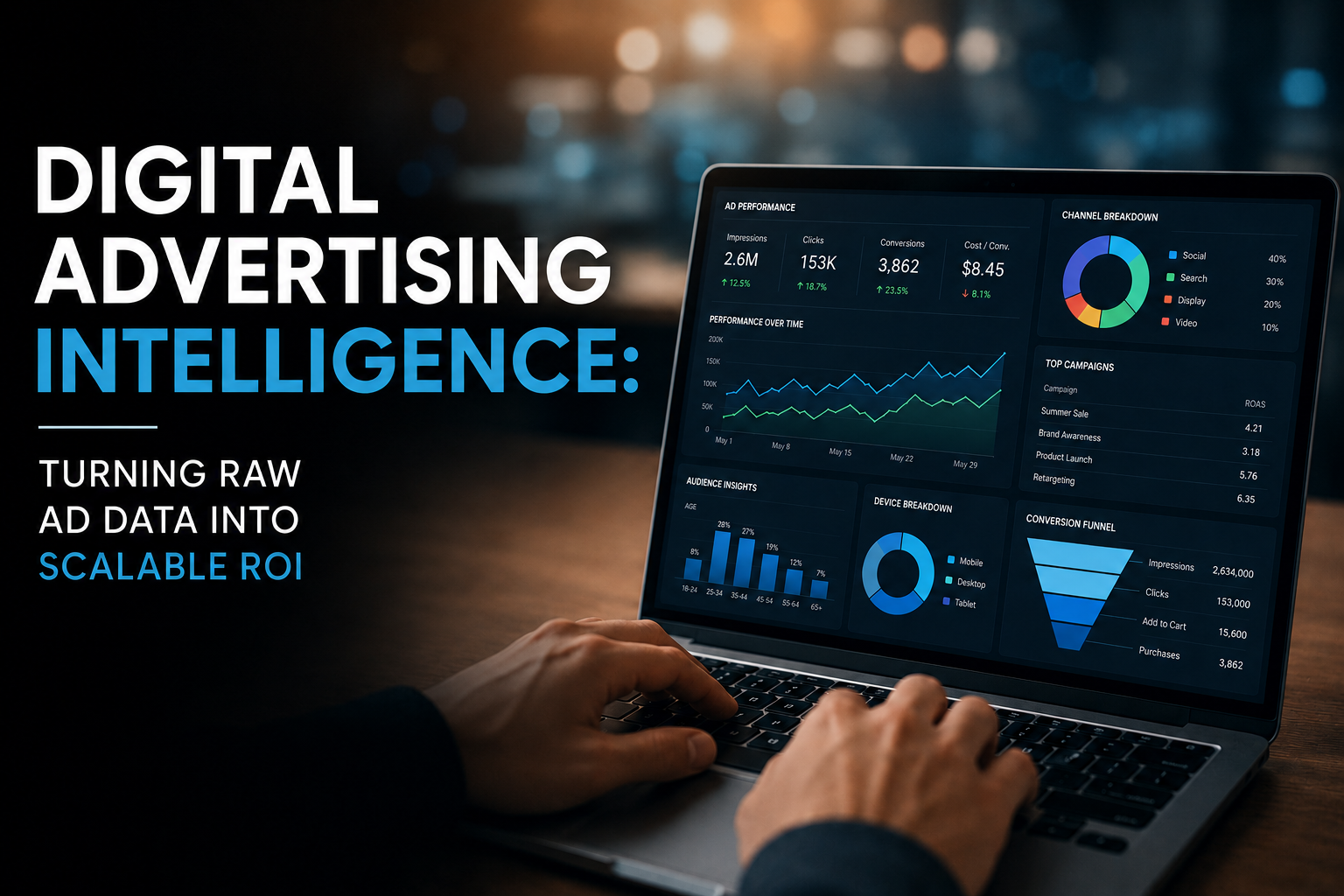
Real-time campaign optimization is where digital advertising intelligence translates into immediate revenue impact. The key metrics worth tracking at the campaign level:
| Metric | What It Signals |
|---|---|
| ROAS (Return on Ad Spend) | Revenue generated per dollar of ad spend |
| CPA (Cost Per Acquisition) | Efficiency of conversion across placements |
| CAC (Customer Acquisition Cost) | Total cost to acquire a paying customer |
| CTR (Click-Through Rate) | Creative and audience alignment |
| Hook Rate / Thumbstop Ratio | First-second creative effectiveness on social |
| Share of Voice | Relative impression share vs. competitors |
Ad performance metrics like these, viewed in aggregate and over time, reveal which audience targeting strategies are compounding and which are decaying. Conversion rate optimization decisions based on this data tend to outperform those based on isolated snapshots.
Cross-Platform Integration and Unified Reporting
Consumer attention is fragmented. An ad seen on YouTube leads to a Google search, resulting in a purchase attributed to email. Without cross-channel attribution, each platform claims full credit and the actual customer journey stays invisible.
Unified reporting solves this. Platforms like Nielsen Ad Intel apply a single taxonomy to all ad data sources, both their own and third-party, creating a consistent, comparable view across markets. This expert data harmonization enables apples-to-apples benchmarking across channels that would otherwise report in incompatible formats.
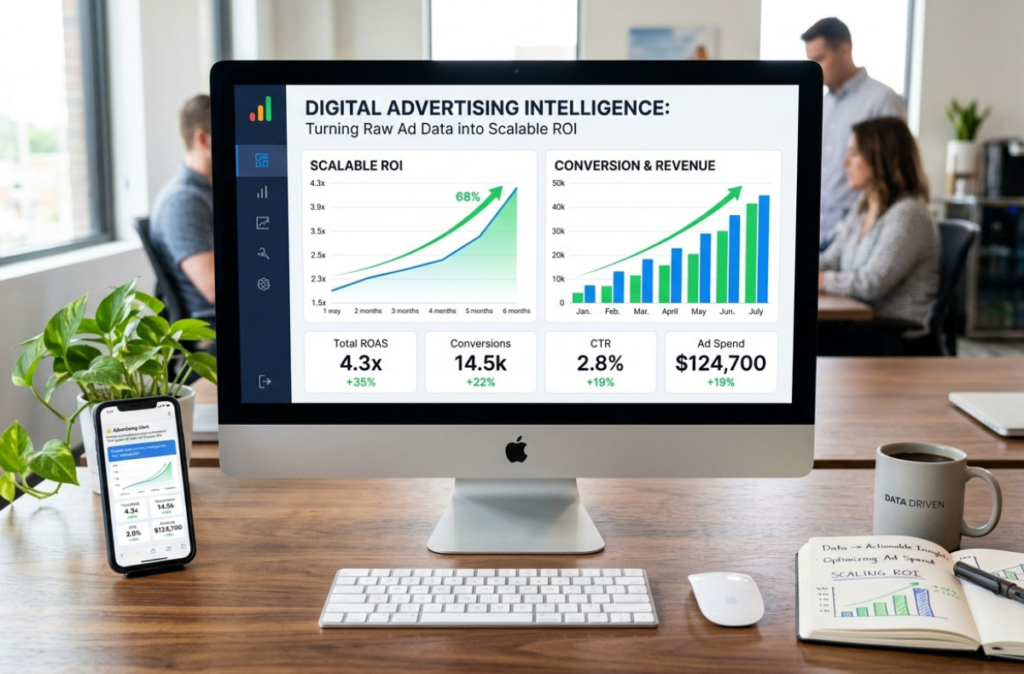
Marketing data visualization tools, including Tableau, Looker, and Power BI, translate unified data into decision-ready dashboards. The best digital advertising intelligence platforms make this available in near real time, so budget reallocations happen within hours, not after quarterly reviews.
Digital Advertising Intelligence Tools for Attribution Analysis
The right digital advertising intelligence tool depends on which layer of signals you’re trying to strengthen. Here’s a practical breakdown of the current stack.
Free Ad Libraries: Start Here
Every major platform runs a public ad library. For most operators, these are the foundation of any digital advertising intelligence practice:
| Platform | Coverage | Key Limitation |
|---|---|---|
| Meta Ad Library | All active Facebook/Instagram ads, searchable by advertiser, keyword, country | No spend or impression data |
| TikTok Creative Center | Top-performing TikTok ads, pre-filtered by engagement | Limited historical depth |
| LinkedIn Ad Library | All active LinkedIn ads by advertiser | No spend estimates |
| Google Ads Transparency Center | Active Google format ads by advertiser | Limited creative detail |
None of these show spend or impressions. You infer performance from run length and variation count.
Paid Digital Advertising Intelligence Software
Once ad spend passes roughly $10,000/month, paid digital advertising intelligence tools earn their cost through search speed, Boolean filtering, and workflow integrations:
| Tool | Pricing | Best For |
|---|---|---|
| Foreplay | $79–$249/month | Saving, organizing, and sharing competitor ads |
| Atria | $99–$399/month | Full creative workflow with AI analysis |
| AdSpy | $149/month | Cross-platform Boolean search of ad databases |
| BigSpy | $99–$249/month | Large creative library with multi-platform coverage |
| AdClarity | $129–$349/month | Display, video, and social intelligence across 52 markets |
| SocialPeta | Varies | Mobile app advertising and global creative benchmarking |
| SpyFu | Varies | PPC keyword history and search ad strategy |
For digital advertising intelligence tools for attribution analysis, platforms like Triple Whale, Northbeam, and SegmentStream provide cross-channel attribution that connects ad spend to revenue by channel, campaign, and creative, critical for accurate marketing ROI measurement.
AI Scoring and Competitor Agents
The newest tier of digital advertising intelligence tools handles discovery, scoring, and pattern extraction in a single step:
- Superscale: Surfaces competitor ads, scores them using a 0–15 rubric, and feeds patterns directly into creative generation, closing the gap between “found a winning pattern” and “shipped a variant” to minutes
- Motion: AI-powered creative analytics with predictive scoring; highest reliability in cross-account customer data
- AdCreative.ai: Model-scored creative aesthetics with predicted performance indicators
How to Build a Digital Advertising Intelligence Strategy
Turning these capabilities into results takes a deliberate process.
Assess your current ad performance
Start with your own numbers. Document spend by channel, your core KPIs, CPA, ROAS, share of voice, customer acquisition cost, and your conversion rates. Without this internal benchmark, competitor data gets misread as best practice rather than a hypothesis to test.
Choose the right tools and platforms
Match the tool to the priority:
- Display and video placement: AdClarity, Adbeat
- Mobile and app user acquisition: SensorTower, SocialPeta, MobileAction
- Search and PPC: SpyFu
- Social creative analysis: Superads.ai, SocialPeta
- Brand and sentiment: Brandwatch
Look for competitive analysis, creative monitoring, audience insights, cross-platform tracking, and clean reporting integrations.
Build an internal framework
Run intelligence on a cadence. High-spend teams check account performance daily, scan competitors weekly, and review category trends monthly. Distribute insights beyond the media buying team; creative, product marketing, and sales all benefit from competitive signals.
Monitor and adapt
Competitive intelligence is perishable. Ad spend shifts and creatives rotate in weeks, not quarters. Treat each cycle as an experiment: adjust, measure, refine.

The Future of Digital Advertising Intelligence
Three shifts will reshape the discipline through 2027. The predictive layer will cross the reliability threshold as AI models start producing CPA predictions within ±15% of actuals. Ad library access will tighten, pushing teams to consolidate fragmented tools into single integrated agents. And cross-account learning will compound, giving multi-brand platforms pattern libraries no single operator can match. The marketer’s role shifts accordingly away from manual monitoring and toward strategic judgment about which patterns to test and which brand voice to protect.
Make Your Next Ad Decision With Data
Digital advertising intelligence replaces guesswork with evidence. It shows you where your budget leaks, which creatives win, what your competitors are testing, and where the next opportunity sits, before your money runs out.
Start small. Pick one platform, build a simple tracker across the four pillars, and score your next few campaign ideas against real data. Run a 30-day cycle, read the results, and adjust. The brands that build this practice now will spend smarter, prove ROI faster, and outpace the competitors still flying blind.
FAQs
The primary goal is to turn advertising data about your own and your competitors into decisions that reduce wasted spend and increase return on ad spend. It replaces intuition with evidence about what works, what doesn’t, and where opportunities exist.
It pinpoints exactly which ads, placements, and audiences fail to convert, so you can cut them and redirect budget to proven winners. Since advertisers waste up to 25% of budgets on underperforming campaigns, this visibility directly protects ROI.
They analyze four core categories: ad spend and budget allocation; creative and messaging; placement and performance metrics (impressions, reach, engagement); and audience targeting parameters pulled from both your campaigns and competitors’ public ads.
No. A solo operator can run digital advertising intelligence with free ad libraries, a spreadsheet for scoring, and their own ads manager. Paid tools start paying off above roughly $10,000 per month in spend, where time savings justify the cost.
Competitive intelligence covers a rival’s broader business, products, pricing, and positioning. Ad intelligence is a specialized slice focused on advertising performance, creative, spend, and campaign tactics across digital channels.