
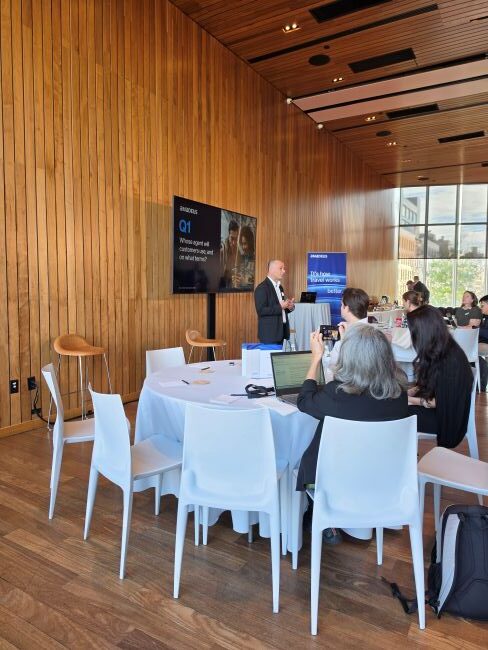
On the morning of November 10, 2026, Amadeus gathered an invitation-only audience at The Standard, High Line in New York City for an exclusive first look at the new Amadeus Global AI Report. The flagship thought leadership study, developed in partnership with Stratforma, explores how artificial intelligence is reshaping travel and the possible futures it could create for the industry. Guests heard the findings under embargo, ahead of the report’s public launch.
The theme of the morning was clear from the start: travel is moving from AI experimentation to real-world impact.
A Morning of Insight on Washington Street

The program opened with breakfast before Robert Buckman of Amadeus opened and welcomed guests. Amadeus CTO Sylvain Roy then took the stage alongside Steve Weber of UC Berkeley to co-present the Amadeus Global AI Report.
Two fireside chats followed. Atyab Bhatti of SkyLink and Nina Lind of McKinsey & Company offered their perspectives first, followed by Sarosh Waghmar of Spotnana in conversation with Rajiv Rajian. An open Q&A closed out the session, giving attendees the chance to press the speakers on what the findings mean for their own businesses.
The mix of voices, a global travel technology leader, a top-tier consultancy, a leading research university, and fast-moving travel platforms, made for a well-rounded conversation about where AI in travel is headed and how quickly it will get there.
Near the Rooftop with Sylvain Roy
After the Amadeus Global AI Report presentation, I joined Sylvain Roy up atop The Standard Hotel to record an episode of The Digital Executive podcast, with the New York skyline stretching out behind us. It was a fitting backdrop for a conversation about the infrastructure that quietly powers so much of global travel.
From Coder to CTO
I started with Sylvain’s own path. He joined Amadeus in 2003 as a developer and now leads more than 10,000 engineers across 50-plus sites as CTO and President of Amadeus France. What has that journey taught him?
He began at the end. Starting as a developer, he said, gave him a foundation he still relies on today. He still writes code on Sundays and in the evenings, because staying hands-on means he can say of a technology, “I’ve touched it, I know what it does.”
His bigger lesson is about transformation. Amadeus, he explained, is almost always in the middle of one: from TPF mainframes to Unix, from a private cloud to a hybrid cloud, and finally into the public cloud, a move it finished only a few months ago. Now it is already starting the next big shift, built around artificial intelligence. Each transformation creates momentum and a chance to clear out the old and explore the new. In his view, a major IT company that isn’t transforming should be asking itself serious questions, especially now that technology is moving faster than ever.
A New Way to Open a Platform
Next, I asked what putting Amadeus inside an AI assistant like Claude actually unlocks. Sylvain framed it as the next chapter in how platforms open up to the world. For years, companies exposed their APIs through developer portals. He doesn’t think that’s the way to do it anymore.
The plugin Amadeus built with Anthropic teaches Claude Code and Claude Cowork how the Amadeus system works. Claude doesn’t just know the API; it understands how the system behaves. Amadeus is doing the same with OpenAI and plans to work with other major AI players too.
The payoff is speed. A developer can build a working travel shopping and booking website in about fifteen minutes. For Amadeus, that means being even more open to developers, customers, and partners, who get Amadeus’ core functionality plus everything they can build on top of it with an AI assistant. As Sylvain put it, this is “the new way to open a system to third parties and developers.”
Beyond the Booking Demo
Then we turned to the hard part: moving from research to real transactions. Shopping and booking, Sylvain noted, seems to be the one demo every AI assistant wants to do first. But there’s a long road between a demo and something airlines and travel agents can run in production.
He pointed to the problems the industry has to solve. The first is identity: who an agent is, what access rights it has, and what it’s allowed to do. Then there’s payment. And there are standards, because AI assistants are meeting a travel industry with many players and no common way to talk to them. As one example, Amadeus is working with Google to extend the UCP protocol for travel, which has needs of its own.
Beyond the technology, two things have to be true. Travelers must trust that the system is safe and doing what they want. And it has to be simpler and better than today, when booking online still means filling in page after page of information, then doing much of it again at check-in. Asking an agent to find the best trip is just shopping. Letting it book and pay on your behalf is different: “You need to have an absolute trust in the system.”
The Next Decade of Travel

Finally, I asked Sylvain to look five to ten years ahead, the same horizon the Amadeus Global AI Report sets out to explore. He sees three forces moving at different speeds. AI capability is racing ahead. People’s expectations will rise almost as fast. And the travel industry has to transform to support all those AI use cases, which will take longer because of its many players, its legacy technology, and the need to work together on governance and openness.
In that gap, travelers may get frustrated, asking why they can do something with AI everywhere else but not for travel. Sylvain sees speeding up that transformation as one of Amadeus’ core roles.
Once the industry catches up, he expects more machine-to-machine interactions on travelers’ behalf. He also expects people to get more thoughtful about where they draw the line. Many may keep the shopping and planning for themselves because it’s part of the joy of building their next journey, while handing the bookings to agents because, frankly, that’s not the best part of the experience.
Final Thoughts
What stood out most was how grounded Sylvain’s view is. He’s a CTO who still writes code, leading a company that has reinvented its technology again and again, and he’s clear about what it will take for agentic travel to earn people’s trust. Listen to the full conversation on The Digital Executive, and watch for the public release of the Amadeus Global AI Report.