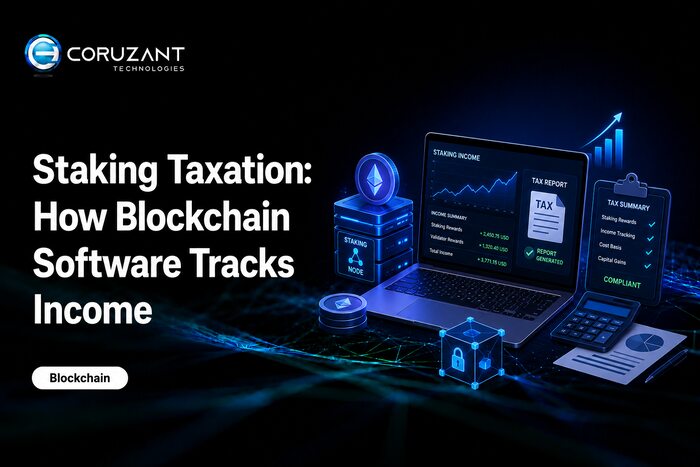
Staking taxation is no longer just a legal or accounting issue. It is also a software architecture and data-management problem.
Validators, crypto exchanges, digital asset platforms, and individual stakers need systems that can identify staking events, determine when rewards become available, capture their fair market value, maintain transaction records, and track what happens to those assets afterward. As staking activity grows, blockchain tax software and automated digital asset reporting tools are becoming part of the broader Web3 financial infrastructure.
In the United States, IRS Revenue Ruling 2023-14 provides that, for the staking arrangements addressed by the ruling, staking rewards are included in gross income when a cash-method taxpayer gains dominion and control over the rewards. The fair market value is determined at that point. The ruling applies to certain staking performed directly on a proof-of-stake blockchain as well as staking through a cryptocurrency exchange.
That creates an important intersection between blockchain infrastructure, APIs, data processing, tax rules engines, market-data systems, and financial software.
Table of contents
- For Certain U.S. Staking Arrangements, Income Is Recognized When You Gain Control
- From Blockchain Events to Tax Records
- How Software Calculates the Value of a Staking Reward
- Why Selling Staking Rewards Can Create a Second Tax Event
- Why Staking Taxation Is a Software Architecture Challenge
- The Role of APIs in Crypto Tax Reporting
- The Phantom Income Problem
- How Proposed Tax Changes Could Affect Crypto Software
- Why Global Crypto Tax Software Needs Localized Rules
- What Crypto Tax Software Should Track
- The Practical Takeaway
For Certain U.S. Staking Arrangements, Income Is Recognized When You Gain Control
The phrase “taxed when received” can be misleading because the relevant U.S. concept is dominion and control, not simply the moment a blockchain records a transaction.
If staking rewards become available to a taxpayer and the taxpayer has dominion and control over the rewards, including the ability to dispose of them, the fair market value at that time may be includible in gross income under the federal framework addressed by Revenue Ruling 2023-14
This distinction creates a software challenge.
A blockchain indexing system can identify when a reward transaction is recorded on-chain. However, determining when a taxpayer actually obtains control may require additional information about the wallet, exchange, protocol, account restrictions, and availability of the assets.
For tax software, a simple record saying “reward received” may therefore be insufficient. A more complete system needs to capture timestamps, token quantities, wallet or exchange information, transaction identifiers, and other data relevant to determining when control was obtained.
From Blockchain Events to Tax Records
Turning raw blockchain activity into a usable tax record requires multiple software layers. A typical workflow can look like:
Blockchain event → indexing → transaction normalization → reward classification → timestamp validation → market-price lookup → tax-rule evaluation → tax-lot creation → reporting
Each stage solves a different technical problem.
Blockchain indexing
Indexing systems monitor blockchain networks and convert raw on-chain events into structured data that applications can query. For staking, that may include identifying validator rewards, delegation activity, deposits, withdrawals, and other transactions.
Transaction classification
The system then needs to determine what each transaction represents. A crypto tax platform may distinguish between staking rewards, transfers, purchases, sales, swaps, fees, deposits and withdrawals, as well as delegation or unstaking activity. This classification is important because different transaction types can have different tax consequences, and accurate categorization helps the software apply the appropriate tax rules and maintain reliable transaction records.
Data normalization
Wallets, exchanges, and blockchains can provide transaction data in different formats.
Software therefore needs to normalize information into a consistent transaction model containing fields such as:
- Asset
- Quantity
- Timestamp
- Source
- Transaction hash
- Transaction type
- Fees
- Market value
- Cost basis
This is one reason APIs and blockchain data providers are important components of crypto tax infrastructure.
How Software Calculates the Value of a Staking Reward
Digital asset prices can change rapidly, so software needs reliable historical market data rather than simply using the current price when a tax return is prepared.
For example, assume a taxpayer obtains control of 10 staking tokens when each token has a fair market value of $50. For illustration, if a taxpayer obtains dominion and control of 10 staking tokens when their fair market value is $50 per token, the aggregate value would be $500 at that time, assuming that valuation is properly established. If those tokens are later sold for $70 each, the later transaction must be evaluated separately using the tokens’ tax basis and the sale proceeds.
A well-designed system can connect the reward with:
- Blockchain timestamp
- Token quantity
- Historical market price
- Wallet or exchange source
- Transaction hash
- Applicable transaction data
- Tax basis
- Later disposal information
The result is a traceable data record rather than a calculation based on a manually reconstructed spreadsheet.
Why Selling Staking Rewards Can Create a Second Tax Event
Staking taxation can involve two distinct stages. First, rewards may create taxable income when the taxpayer obtains dominion and control under the applicable U.S. rules.
Second, selling, exchanging, or otherwise disposing of those tokens can create another tax consequence based on the difference between the disposal proceeds and the property’s tax basis.
This is why crypto accounting software needs to preserve the original reward valuation and carry the appropriate tax basis into subsequent transaction calculations. For taxpayers dealing with more complex crypto tax situations, CryptoTaxLawyer.com provides professional cryptocurrency tax services, including tax planning and assistance with crypto tax issues.
Why Staking Taxation Is a Software Architecture Challenge
The underlying tax rule may sound straightforward. Implementing it across a large blockchain portfolio is considerably more complicated.
High transaction volume
Validators can receive rewards repeatedly rather than through one annual payment. Hundreds or thousands of individual records can make manual tracking difficult.
Historical pricing
Software needs market-price data for the relevant date and, where appropriate, the time of the tax event.
Multiple wallets and platforms
A taxpayer may use several wallets, exchanges, and staking services. Software needs integrations that can consolidate those sources without creating duplicate transactions.
Different blockchain data structures
Blockchains organize transaction and event data differently. A tax platform therefore needs chain-specific indexing and classification logic.
Reconciliation
A robust system should be able to compare blockchain records with wallet, exchange, and accounting data to identify missing, duplicated, or incorrectly classified transactions.
Data lineage
Tax calculations should ideally be traceable back to their underlying data:
Tax result → tax lot → transaction → blockchain hash → timestamp → price source
This audit trail is especially valuable for businesses and professional validators handling large transaction volumes.
Changing regulations
Tax software also needs configurable rules rather than permanently hard-coded assumptions. When legislation or IRS guidance changes, the rules engine may need to apply different logic to new transactions or recalculate historical records.
The Role of APIs in Crypto Tax Reporting
APIs are a core part of the technology stack behind automated digital asset reporting.
A crypto tax platform can connect with wallet services, exchanges, blockchain data providers, market-data platforms, and accounting systems to collect transaction information.
A simplified architecture might look like:
Wallet APIs + Exchange APIs + Blockchain Indexers + Market-Price Feeds + Tax Rules Engine + Reporting Layer
The system can then normalize these inputs into a common transaction history. For active validators and digital asset businesses, this architecture can reduce manual data entry while making reconciliation and reporting more scalable.
The Phantom Income Problem
The software challenge becomes more significant because staking can create what tax professionals often describe as phantom income. This occurs when taxable income is recognized even though the taxpayer has not converted the asset into cash.
For example, the earlier income inclusion does not automatically disappear simply because the token later declines in value.
That creates a cash-flow risk.
From a software perspective, simply displaying a wallet balance is not enough. The system needs to preserve the historical income event, valuation, tax basis, and subsequent price changes.
How Proposed Tax Changes Could Affect Crypto Software
Tax legislation can directly affect the logic used by blockchain accounting and reporting platforms.
The Tax Clarity for Mining and Staking Act, H.R. 9175, was introduced in the U.S. House on June 8, 2026, and referred to the House Committee on Ways and Means. It is a proposal, not current law.
The bill would establish alternative rules for newly minted digital assets, including an election involving treatment similar to self-created property. Any change to the timing or character of income recognition could require corresponding changes to tax software.
That could affect:
- When a tax event is created
- How income is categorized
- How tax basis is established
- How tax lots are generated
- How gains and losses are calculated
- Which transactions appear in reports
- How historical calculations are recalculated
This is where software architecture becomes particularly important. A platform that uses configurable, versioned tax rules can adapt more easily when legislation changes than one built around fixed assumptions.
Why Global Crypto Tax Software Needs Localized Rules
U.S. tax rules do not automatically apply to taxpayers in other jurisdictions.
Canada, the United Kingdom, Australia, and other countries can apply different rules to staking, mining, trading, and digital assets. A global crypto tax platform therefore needs jurisdiction-aware logic rather than a single universal calculation.
The system may need to consider:
- Tax jurisdiction
- Taxpayer status
- Transaction type
- Applicable reporting requirements
- Local digital-asset rules
- Relevant tax-year rules
This makes localization and versioned tax logic important parts of crypto financial software.
What Crypto Tax Software Should Track
Anyone earning staking rewards should maintain detailed records, whether through software or manual systems. For practical tax-record management, a software system should ideally capture :
- Reward date and time
- Token type and quantity
- Wallet or exchange
- Transaction hash
- Fair market value at the relevant time
- Relevant fees
- Tax basis
- Later sale or exchange
- Disposal date
- Sale proceeds
- Resulting gain or loss
For businesses operating validators at scale, automated backups, reconciliation tools, data lineage, and audit trails can make these records easier to review.
The Practical Takeaway
In the United States, the current federal framework set by IRS Revenue Ruling 2023-14 mainly looks at control and ownership when deciding when staking rewards are treated as income. The fair market value of staking rewards is set at that moment. If a staking reward is sold or exchanged later, a different tax effect may arise based on the asset’s tax basis. The change in its value.
Staking taxation is becoming more of a software and data‑management challenge.
Blockchain tax platforms must do things. They must record events, sort transactions, combine data from many sources, fetch historical prices, apply rules that differ by jurisdiction, build tax lots, keep track of how data moves, and produce clear reports. A bill such as H.R. 9175 shows why tax software must be flexible and keep versions. When digital‑asset tax rules change, the systems that process blockchain transactions must also change.
As blockchain use grows and rules tighten, the link between tax policy, blockchain systems, APIs, data work, money software and automatic reporting will become more important.
If you earn staking rewards, keep a record of every transaction and use software that can keep the original data trail. That will make the tax‑reporting easier. You should also be sure that the software and the help you get follow the rules that apply in your area and, to your situation.