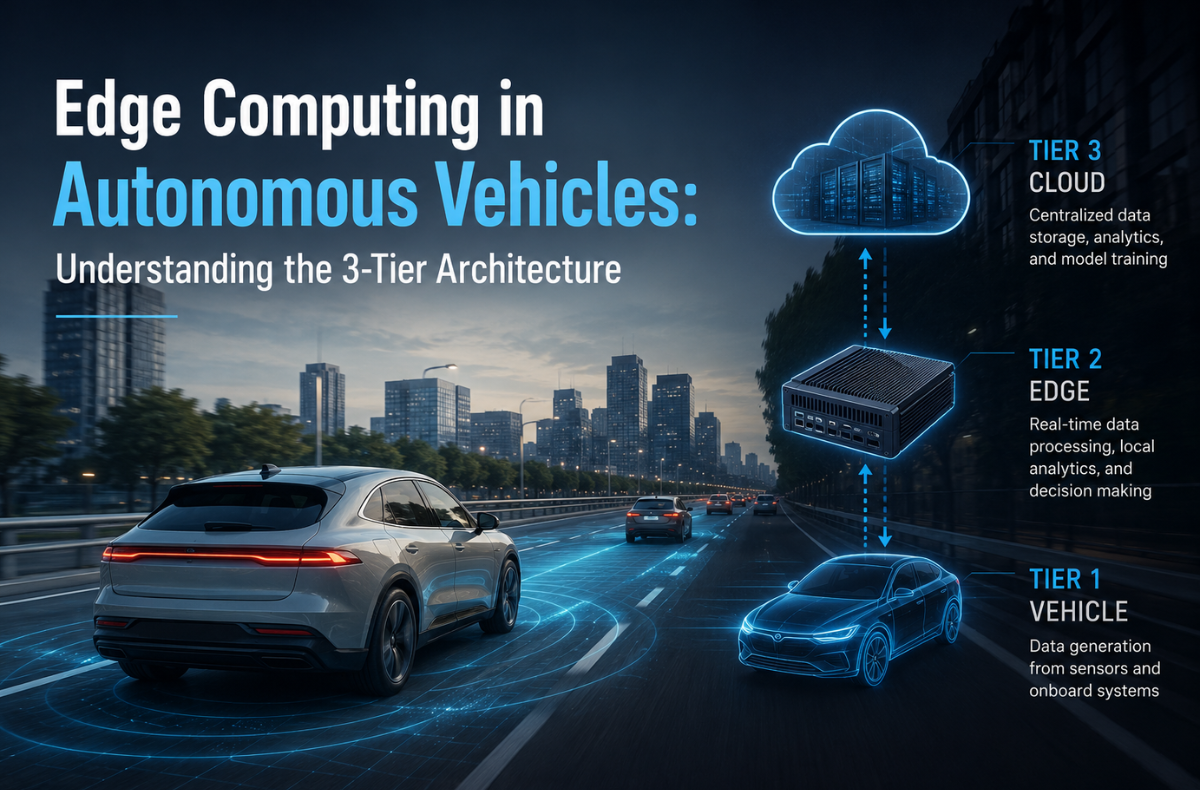
A self-driving car normally travels at 60 mph and covers 88 feet every second. A processing delay of just 100 milliseconds, barely a blink, means the vehicle moves nearly 9 feet before initiating a safety response. That gap is why edge computing in autonomous vehicles has shifted from an engineering preference to a foundational requirement.
Modern autonomous vehicles aren’t simply cars. They’re rolling data centers equipped with LiDAR arrays, high-resolution cameras, radar systems, ultrasonic sensors, GPS modules, and vehicle-to-everything (V2X) communication hardware. According to Samsung Semiconductor, a fully autonomous vehicle can generate up to 40 terabytes of data per hour. Even vehicles at the lower end of the autonomy spectrum produce roughly 1.4 terabytes per hour, according to the Siemens Blog Network. Sending that volume to a remote cloud server and waiting for a response? Not an option for safety-critical decisions.
Edge computing solves this by moving computation to the data source. Specifically, autonomous driving technology relies on a structured three-tier edge computing model: an in-vehicle tier, a roadside tier, and a regional aggregation tier. Each layer handles different tasks at different speeds, creating a distributed computing architecture that is faster, more resilient, and far more capable than any single-tier approach.
This post breaks down exactly how each tier works, why the three-tier edge computing model is the dominant architecture for autonomous vehicles, and what challenges remain as the technology matures.
Key Takeaways
- Edge computing in autonomous vehicles eliminates cloud-computing latency, enabling real-time decision-making for safety-critical functions. For readers new to the concept, what is latency comes down to the delay between a request and its response.
- The three-tier edge computing model comprises in-vehicle, roadside, and regional layers, each handling specific tasks with different latency requirements.
- This architecture allows autonomous vehicles to process vast amounts of data locally, improving response times and optimizing bandwidth usage.
- Edge AI, integrated into edge computing, enables tasks like object detection and trajectory prediction directly on the vehicle’s infrastructure.
- Challenges include hardware limitations, the need for standardization across systems, and the need to ensure security within distributed networks.
Table of Contents
- How Does Edge Computing Apply to Self-Driving Cars?
- How Much Data Do Autonomous Vehicles Generate?
- What Is the Three-Tier Edge Computing Model for Autonomous Vehicles?
- How Do the Three Tiers Work Together in a Cloud-Edge Architecture?
- What Are the Key Benefits of Edge Computing in Autonomous Vehicles?
- What Challenges Must Vehicular Edge Computing Still Overcome?
- The Foundation That Safe Autonomous Mobility Depends On
- FAQs
How Does Edge Computing Apply to Self-Driving Cars?
Before exploring how edge computing applies to self-driving cars, let’s first understand exactly what it is. Edge computing is a computing model that processes data at or near the source of generation, rather than transmitting raw data to a centralized cloud data center. The “edge” refers to any compute, storage, or network resource positioned along the path between the data source and the cloud.
For example, a vehicle’s LiDAR detects a pedestrian stepping off a curb. Instead of transmitting that raw point-cloud data to a server 1,000 miles away, an onboard AI processor analyzes it in milliseconds and triggers the brakes. That’s edge computing in autonomous vehicles, localized, fast, and independent of network connectivity.
Edge computing in self-driving cars operates across a layered architecture. Each layer handles tasks at different latency requirements and geographic scales, creating a distributed computing framework that balances speed with reach.

What is intelligent edge computing versus edge AI?
Understanding the edge computing vs edge AI distinction matters here. Edge computing refers to the infrastructure itself, the servers, gateways, and processors deployed at the network edge. Edge AI in autonomous vehicles refers specifically to the artificial intelligence models running on that infrastructure. Intelligent edge computing, as defined by Hewlett Packard Enterprise and Digi International, integrates AI directly into edge devices, enabling real-time inference without relying on cloud-based model execution.
In the context of autonomous driving technology, edge AI in autonomous vehicles performs deep learning inference, object detection, trajectory prediction, and lane classification, while vehicular edge computing provides the underlying computational platform.
What is mobile edge computing (MEC) and why is it critical for autonomous vehicles?
What is mobile edge computing? According to a comprehensive survey published in the IEEE Internet of Things Journal (Abbas et al., 2018), mobile edge computing (MEC), also known as multi-access edge computing, extends cloud computing capabilities to the edge of mobile networks, placing compute resources at base stations and roadside units. MEC is a critical middle layer in the three-tier edge computing model, enabling vehicles to access localized processing power beyond what their onboard hardware can provide, without incurring the latency cost of full cloud round-trips.
How Much Data Do Autonomous Vehicles Generate?
Before examining the three-tier edge computing model, it’s worth anchoring the data challenge with numbers.
| AV Level / Sensor Type | Approximate Data Rate | Estimated Volume per Hour |
|---|---|---|
| Level 2/3 AV (lower autonomy) | ~3 Gbit/s | ~1.4 TB (Siemens, 2023) |
| Level 4/5 AV (full autonomy) | ~10–40 Gbit/s | Up to 40 TB (Samsung Semiconductor) |
| High-resolution LiDAR | ~100–200 Mbps per unit | ~45–90 GB |
| Multi-camera array | ~200–500 Mbps per camera | ~90–225 GB per camera |
| Radar and ultrasonic | ~10–100 Kbps | Minimal, but real-time critical |
This volume of autonomous vehicle data processing cannot be managed by any single computing layer. It requires a coordinated architecture, which the three-tier edge computing model provides.
What Is the Three-Tier Edge Computing Model for Autonomous Vehicles?
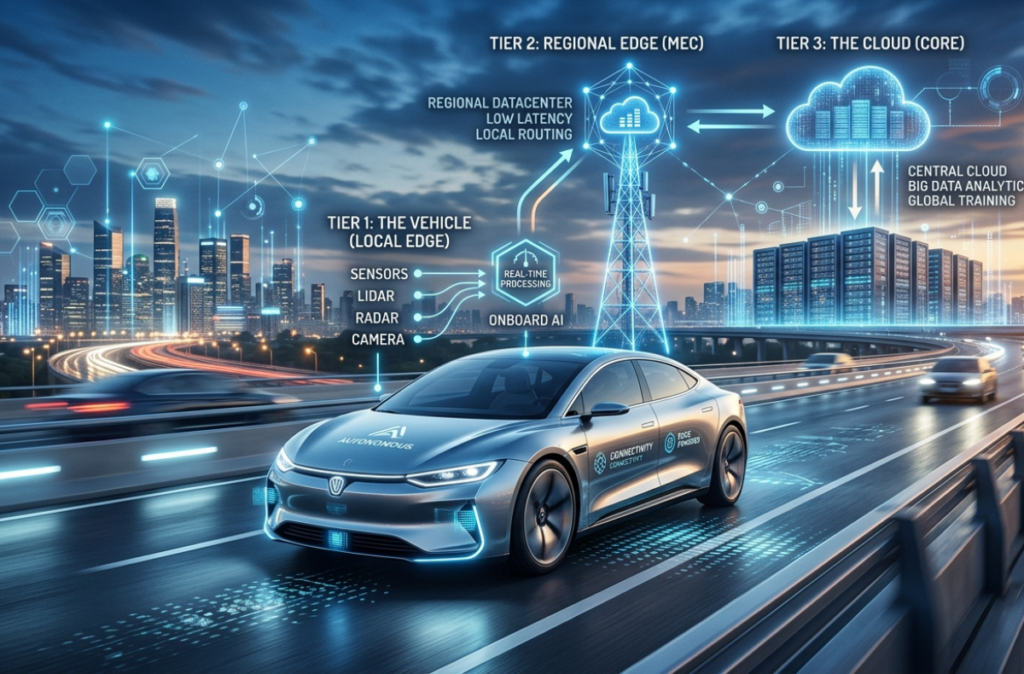
The three-tier edge computing model divides autonomous vehicle architecture into three cooperative processing layers: the in-vehicle edge (Tier 1), the roadside edge (Tier 2), and the regional edge (Tier 3). Each tier handles a specific category of tasks, matched to its latency capability and proximity to the data source.
This three-tier edge computing model is documented in academic research, including ResearchBerg’s architectural analysis, and was notably proposed in its early form by Dell Technologies in 2017 (ZDNet, 2017). Another 2023 ResearchGate study further formalizes this framework for the automotive context.
Tier 1: How Does In-Vehicle Edge Computing Enable Real-Time Decision-Making?
What are the key components of onboard edge AI in autonomous vehicles?
Tier 1 is the in-vehicle edge layer, the computational hardware embedded within the autonomous vehicle itself. This is where the fastest, most latency-sensitive processing happens.
Core components include:
- AI accelerators and System-on-Chip (SoC) platforms (e.g., NVIDIA DRIVE Thor, Mobileye Ultra, Qualcomm Snapdragon Ride)
- Electronic Control Units (ECUs) managing vehicle actuation systems
- Sensor arrays: LiDAR, radar, high-resolution cameras, ultrasonic sensors, GPS
- Edge nodes and gateways connecting sensors to onboard AI processors
Primary functions at Tier 1:
- Sensor fusion: Combining multi-modal sensor inputs into a single real-time 3D environmental model
- Object detection and classification: Identifying pedestrians, vehicles, road signs, lane markings
- Trajectory prediction: Anticipating the movement of surrounding objects
- Immediate actuation: Triggering braking, steering, acceleration within milliseconds
- Safety-critical decisions: Automatic emergency braking, obstacle avoidance, collision prevention
Tier 1 edge computing in autonomous vehicles targets latency under 5 milliseconds. At this speed, AI-powered autonomous driving systems can respond to dynamic road events faster than any human driver. This is where autonomous vehicle cybersecurity is also most critical; onboard systems must be hardened against tampering, as a compromise here directly affects vehicle control.
A 2025 study published in IEEE Internet Computing (“Memory-Augmented Autoencoder with Reservoir Computing for Edge-Based Anomaly Detection in Autonomous Systems”) achieved an inference latency of just 5 microseconds (μs) with 96.8% accuracy on edge hardware, demonstrating how real-time decision-making systems at the in-vehicle tier continue to advance rapidly.

Tier 2: How Does Roadside Edge Infrastructure Enable Vehicle-to-Everything Communication?
Tier 2 is the roadside edge layer, the connected-vehicle infrastructure positioned along roads, at intersections, and in urban corridors. This layer extends edge analytics for autonomous vehicles beyond the vehicle’s own sensor range.
Core components include:
- Roadside Units (RSUs) deployed at intersections and highway corridors
- 5G base stations enabling 5G-enabled autonomous vehicles with ultra-low-latency links
- Mobile edge computing (MEC) servers co-located with cellular infrastructure
- Edge nodes and gateways aggregating data from multiple vehicles simultaneously
Primary functions at Tier 2:
- Vehicle-to-everything (V2X) communication: Enabling vehicles to exchange real-time information with other vehicles (V2V), infrastructure (V2I), pedestrians (V2P), and networks (V2N)
- Cooperative perception: Sharing sensor data across autonomous vehicle networks to extend beyond any single vehicle’s field of view
- Local traffic management: Optimizing signal timing and managing intersection flow dynamically
- Hazard broadcasting: Warning approaching vehicles of accidents, road obstructions, or pedestrians hidden around corners
- Platooning support: Coordinating closely-spaced convoy formations in autonomous trucking
Tier 2 targets latency in the 5–20 millisecond range. 5G-enabled autonomous vehicles can communicate with roadside MEC servers at speeds that enable sub-10ms round-trip times, according to 3GPP Release 16/17 specifications. Distributed computing in vehicles, extended to nearby RSUs through V2X protocols, dramatically improves situational awareness beyond what onboard sensors alone can achieve.
Tier 3: What Role Does Regional Edge Computing Play in Fleet Management and OTA Updates?
Tier 3 is the regional edge layer, a localized cloud infrastructure that bridges the real-time processing of Tiers 1 and 2 with the broader analytical capacity of centralized cloud systems.
Core components include:
- Regional data centers positioned within metropolitan or highway corridors
- Edge-cloud architecture platforms aggregating data across vehicle fleets and local RSU networks
- Software-defined networking (SDN) enabling dynamic resource orchestration across autonomous vehicle networks
Primary functions at Tier 3:
- Fleet management: Monitoring vehicle health, routing efficiency, and operational status across large autonomous vehicle deployments
- Over-the-air (OTA) software updates: Distributing AI model updates and safety patches to vehicle fleets without requiring dealership visits
- Predictive maintenance: Using edge analytics for autonomous vehicles to identify degradation patterns before failures occur
- Regional map updates: Refreshing high-definition maps with current road conditions, construction zones, and new infrastructure
- Long-term data aggregation: Processing data volumes too large for Tier 1 or 2, feeding insights back to cloud-based AI training pipelines
Tier 3 operates at 20–100+ milliseconds latency, acceptable for non-safety-critical functions but far too slow for real-time driving decisions. The edge-cloud collaboration between Tier 3 and centralized cloud infrastructure creates what researchers describe as a hybrid cloud-edge architecture: local enough for responsive fleet operations, connected enough for global-scale optimization.
How Do the Three Tiers Work Together in a Cloud-Edge Architecture?
The three tiers don’t operate in isolation. They form a coordinated cloud-edge architecture in which data flows upward and commands flow downward, each tier contributing to the overall intelligence of the autonomous driving ecosystem.
Here’s how a typical safety-critical sequence plays out:
- Tier 1 detects a pedestrian entering the roadway via sensor fusion. The in-vehicle AI triggers emergency braking within 3ms, no network communication required.
- Tier 2 simultaneously broadcasts a hazard alert via V2X to approaching vehicles 300 meters away, giving them advance warning that the Tier 1 vehicle’s sensors couldn’t detect.
- Tier 3 logs the event, updates the regional map to flag the high-pedestrian-activity zone, and routes the aggregated data to cloud servers for long-term AI model refinement.
This edge-cloud collaboration is what makes edge computing in autonomous vehicles scalable. According to research published in the January 2026 journal article “Edge Computing for Autonomous Vehicles and Intelligent Transportation Systems” (Fowowe et al., ResearchGate), this distributed model “significantly improves responsiveness, safety, and reliability by reducing data transmission delays and enabling local processing of sensor-generated information.”
The table below summarizes each tier’s role:
| Tier | Infrastructure Layer | Latency Target | Primary Tasks |
|---|---|---|---|
| Tier 1 — In-Vehicle Edge | AI SoC, ECUs, onboard sensors | < 5ms | Sensor fusion, object detection, emergency braking |
| Tier 2 — Roadside Edge | RSUs, 5G MEC servers | 5–20ms | V2X communication, cooperative perception, traffic management |
| Tier 3 — Regional Edge | Regional data centers, edge-cloud platforms | 20–100ms+ | Fleet management, OTA updates, predictive maintenance |
What Are the Key Benefits of Edge Computing in Autonomous Vehicles?
Edge computing advancements in autonomous vehicles deliver four measurable advantages:
1. Ultra-low latency for safety-critical decisions
Low-latency computing at the vehicle level eliminates the round-trip communication delay that makes cloud-only architectures unsafe. Real-time data processing at under 5ms enables the vehicle to respond to hazards faster than any human reflex.
2. Bandwidth optimization and cost reduction
By processing and filtering vehicle sensor data locally, edge systems transmit only high-value metadata to the cloud, not raw terabyte-scale sensor streams. This significantly reduces cellular bandwidth consumption and cloud storage costs, making large-scale AV fleet deployment economically viable.
3. Operational continuity without connectivity
Autonomous vehicle networks must function in tunnels, underground parking, rural corridors, and areas with degraded 5G coverage. Tier 1 edge computing ensures the vehicle retains full situational awareness and safe operation even during complete network outages, a capability cloud-dependent architectures cannot guarantee.
4. Privacy-preserving data architecture
Autonomous vehicle cybersecurity is strengthened by processing sensitive location and behavioral data locally. This approach aligns with broader desktop integration strategies for applications that emphasize secure, efficient data handling between desktop environments and enterprise systems. Fowowe et al. (2026) note that “processing such data locally reduces the need to transmit large volumes of sensitive information across networks, thereby improving data protection and system resilience.”
What Challenges Must Vehicular Edge Computing Still Overcome?
Edge computing in autonomous vehicles is advancing rapidly, but three persistent challenges require ongoing engineering effort:
Hardware resource constraints
Edge nodes and gateways must operate within strict power, weight, and thermal budgets, particularly for in-vehicle platforms. Delivering the compute density required for real-time machine learning inference on SoC hardware remains an active area of investment in silicon design by companies such as NVIDIA, Mobileye, and Qualcomm.
Standardization and interoperability
Connected vehicle infrastructure across manufacturers, cities, and countries uses different V2X protocols (e.g., DSRC, C-V2X), communication standards, and data formats. Without standardization, autonomous vehicle networks cannot achieve the seamless edge-cloud collaboration required for cooperative driving at scale.
Security across distributed nodes
A distributed edge computing architecture creates more potential attack surfaces than a centralized cloud system. Each RSU, MEC server, and in-vehicle ECU represents a potential entry point. Securing autonomous vehicle cybersecurity across the full three-tier stack, from onboard AI systems to regional data centers, requires defense-in-depth frameworks that combine hardware security modules, encrypted communication, and real-time anomaly detection.
The Foundation That Safe Autonomous Mobility Depends On
Edge computing in autonomous vehicles isn’t a single technology; it’s an architectural philosophy. The three-tier edge computing model distributes intelligence across the vehicle, the roadside, and the regional layer so that every tier handles what it’s best positioned to handle: instant safety decisions at the edge, cooperative awareness at the roadside, and fleet-scale optimization in the regional cloud.
As self-driving car technology advances toward Level 4 autonomy and beyond, the sophistication of autonomous vehicle architecture will continue to grow. But the principle at the core of edge computing in autonomous vehicles stays constant: get the right computation to the right place at the right time. In a vehicle traveling at highway speed, that’s not optional; it’s the difference between a system that works and one that doesn’t.
FAQs
Cloud computing introduces latency that is too slow for safety-critical driving decisions. Edge computing in autonomous vehicles processes sensor data locally, enabling responses in milliseconds without relying on distant servers.
Edge computing is the local infrastructure that processes data near the vehicle. Edge AI refers to the AI models running on that infrastructure to perform tasks such as object detection, prediction, and decision-making.
V2X communication relies on nearby edge servers and mobile edge computing (MEC) platforms to process data quickly. This low-latency processing supports real-time applications such as hazard warnings, traffic coordination, and vehicle platooning.
Edge computing keeps sensitive vehicle and passenger data closer to its source instead of sending everything to the cloud. This reduces exposure during transmission and strengthens cybersecurity and privacy protection.
No. Vehicles can use onboard edge computing without 5G, but 5G improves V2X communication and connectivity.