
**This post is sponsored by Semrush. When you purchase through links in this article, we may earn an affiliate commission from Semrush.**
The search landscape is undergoing a paradigm shift. AI-powered search features now occupy position zero for roughly 20% of all queries, fundamentally changing how users discover brands and how AI visibility metrics must be measured. Traditional SEO—focused on ranking positions—no longer guarantees clicks or visibility, because AI Overviews and chat interfaces deliver direct answers, bypassing classic organic listings.
This evolution calls for a new approach: Generative Engine Optimization (GEO). GEO focuses on optimizing for AI citation visibility, brand asset prominence, and technical structures that allow large language models (LLMs) to process and cite content effectively. Yet, despite the urgency, marketers face major obstacles when adapting to this post-ranking era.
Key Takeaways
- AI citations are replacing traditional ranking as the primary SEO metric.
- Semrush’s AI Visibility Toolkit establishes measurable GEO metrics, enabling marketers to prove ROI.
- Combined with Content and SEO Toolkits, brands can optimize content for AI comprehension, citation, and scale.
- Early adoption gives brands a competitive edge, ensuring visibility in AI Overviews before markets saturate.
Table of contents
Start Measuring Your AI Citation Share Today – Turn AI Visibility into Actionable SEO Insights
Key Challenges in the AI Search Era
- No Standardized Metrics for AI Optimization Success:
There’s no widely recognized “AI Search Readiness Score” or agreed-upon AI visibility metrics. Marketers struggle to benchmark performance, audit campaigns, or justify investments in GEO strategies. - Traffic Displacement Without Attribution Alternatives:
AI Overviews and chat results absorb clicks from traditional organic search. Without reliable KPIs, it’s challenging to quantify the impact of these AI-driven interactions. - Impractical Manual GEO Optimization at Scale:
Thousands of pages require restructuring, internal linking, and schema optimization for AI comprehension. Manual execution at scale is unfeasible, and most automated tools remain underdeveloped.
How Semrush One Solves These Challenges
AI Visibility Toolkit: The Core Solution
The AI Visibility Toolkit operationalizes GEO by transforming AI visibility into measurable, actionable metrics. It provides:
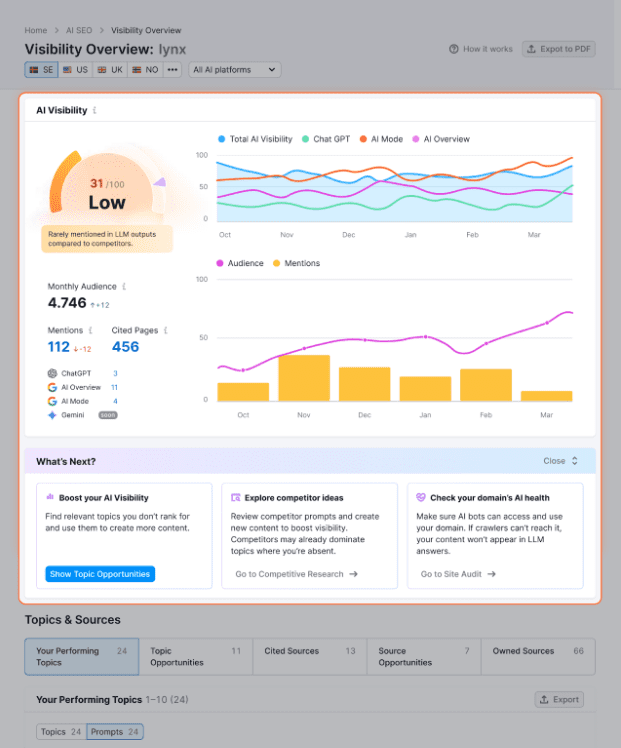
- Brand Presence & Citations Tracking: Monitors how often your content is cited across ChatGPT, Perplexity, Google AI Overviews, and other LLMs.
- AI Search Readiness Score: Establishes standardized metrics to replace traditional traffic KPIs.
- Share of AI Voice KPI: Quantifies your brand’s visibility in AI-generated answers, addressing traffic displacement concerns.
- Question Extraction & Insights: Surfaces user questions that drive AI responses, enabling scalable content optimization.
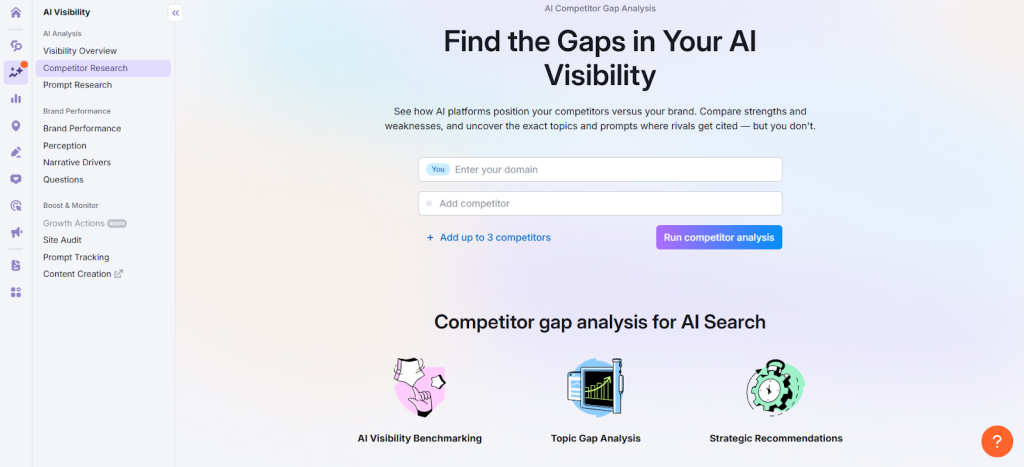
This toolkit replaces guesswork with enterprise-grade measurement, helping marketers track performance, optimize systematically, and prove ROI in the post-ranking SEO landscape.
Supplementary Toolkits for GEO Execution
- Content Toolkit – Converts insights into action:
- Topic Research: Maps the questions AI platforms prioritize.
- SEO Content Template: Converts SERP and LLM insights into AI-ready briefs.
- SEO Writing Assistant: Optimizes for semantic depth, readability, and originality to align with AI Overviews.
- SEO Toolkit – Establishes the technical foundation:
- Domain Overview: Identifies competitor pages performing in both AI and organic search.
- Keyword Magic Tool: Builds entity-linked topic clusters to increase AI citation likelihood.
- Semrush One – Unified workspace:
- Combines AI Visibility metrics, Content, and SEO toolkits for seamless analytics, execution, and validation.
- Supports closed-loop GEO systems, automating optimization at scale.
Why AI Citation Share Matters
1. The Ranking Paradox:
20% of queries now generate AI Overviews, reducing clicks even for top-ranked pages. Citation frequency becomes the new visibility benchmark.
2. From Deterministic to Probabilistic SEO:
GEO emphasizes semantic breadth and entity salience rather than single keyword dominance. Structured content, clusters, and schema increase the probability of AI citations.
3. Overcoming the Scale Trap:
While GEO best practices exist, manual execution becomes unmanageable beyond 100 pages. Semrush automates scaling, tracking, and validation, creating the first enterprise-ready GEO system.
Industry Validation & Insights
- Andrew Holland notes, “Set your blog featured images to your brand logo — it’s the easiest way to capture visibility in AI panels.”
- Twitter expert @thinking_slow warns, “You’re now competing with Google-branded blogs in position one for 20% of keywords.”
- SEO strategist Glenn Gabe highlights, “Users click richer, deeper content in AI Overviews — they don’t trust surface-level AI text.”
These insights confirm the critical role of structured, optimized content and brand asset prominence in AI-driven search discovery.
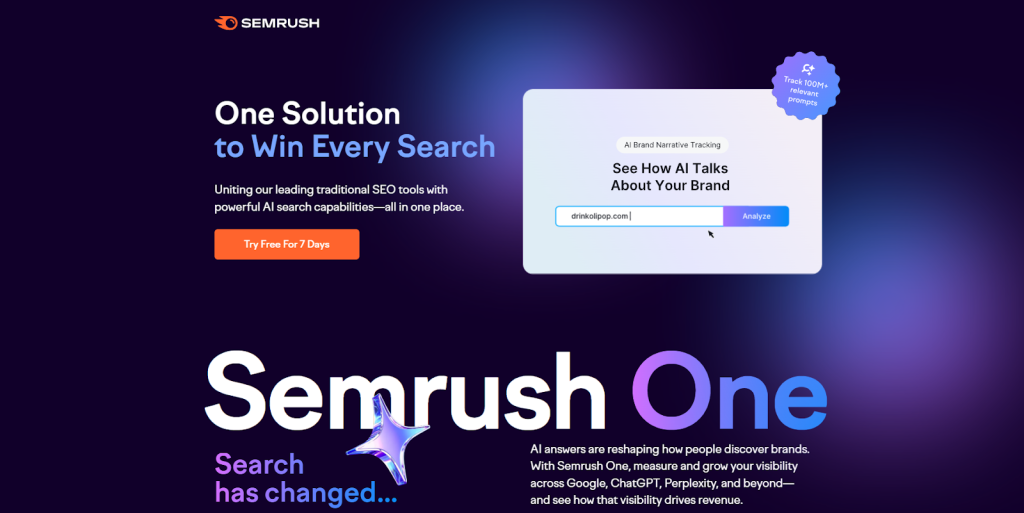
Start tracking your AI citation share today with Semrush One. Discover which AI queries mention your brand, optimize your content at scale, and operationalize Generative Engine Optimization to thrive in the post-ranking era using AI visibility metrics.