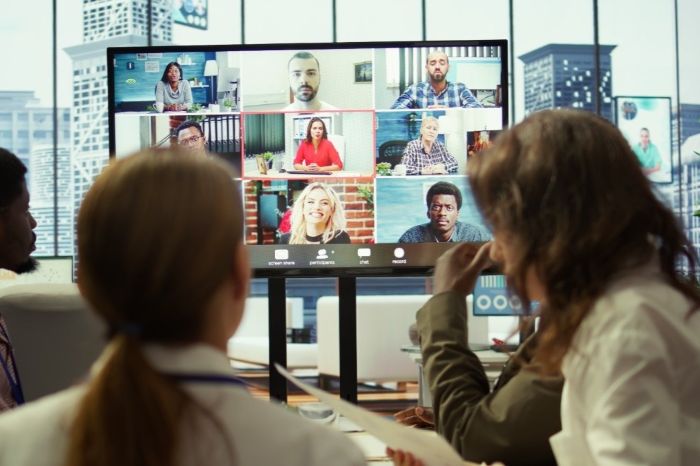
Hybrid teams now span continents, demanding a communication layer that can absorb linguistic diversity without slowing collaboration. Traditional interpretation depends on scheduling and human availability, creating friction for fast-paced technical meetings. Real-time AI interpretation improves dialog and removes barriers with immediate multilingual support that matches the rhythm of hybrid operations.
The engineering relies on streaming audio pipelines that stabilize unstable inputs, handle accents, overlapping speech, and shifting contexts, and feed them into low-latency machine learning layers. As a result, global contributors participate more confidently, knowledge flows more transparently, and hybrid environments operate on a unified linguistic foundation.
Key Takeaways
- AI interpretation improves communication in hybrid teams by providing real-time multilingual support, which accelerates collaboration.
- Key challenges include ultra-low latency, noisy input management, and maintaining context throughout discussions.
- AI interpretation enhances productivity and inclusivity by allowing all team members to participate in their preferred language.
- The future of AI interpretation will focus on multimodal understanding, extended context memory, and enhanced security for sensitive data.
- As technology advances, AI interpretation will enable faster and clearer communication, fostering a more efficient global workforce.
Table of contents
What Challenges Must AI Interpretation Improve for Hybrid Workflows?
Live AI interpretation improves a set of latency, scalability, and domain-specific challenges that must be addressed for hybrid workflows to function smoothly. These systems need to translate progressively, maintain conversational rhythm, and adapt to unpredictable meeting loads while preserving technical accuracy across diverse subject areas.
Key engineering challenges include:
- Ultra-Low Latency Streaming: Models must deliver translations within conversational timeframes. Engineers implement incremental decoding, context buffering, and revision loops to ensure speech remains fluid without causing cognitive load for listeners.
- Dynamic, Distributed Inference: Hybrid teams generate volatile workloads. Autoscaling GPU clusters and distributed inference frameworks keep translation quality stable as meeting sizes and volumes fluctuate. Load balancers route audio streams to the nearest available node to minimize network-induced delays.
- Handling of Noisy Inputs: Hybrid environments introduce unstable conditions, variable microphones, overlapping speakers, accents, and background noise. Front-end audio stabilizers and adaptive signal pipelines precondition the audio to reduce error propagation.
- Domain-Specific Adaptation: Technical meetings often involve specialized terminology from cloud architecture to compliance frameworks. Engineers build domain-aware modules and terminology injectors that guide models toward precise, context-appropriate translations.
- Context Retention Across Long Sessions: Hybrid discussions shift rapidly between topics. Memory mechanisms maintain cross-sentence context so the interpreter can track references, acronyms, and prior decisions without degrading accuracy.
- Fault Tolerance and Continuity: Network disruptions or compute node failures are common in global setups. Redundant streaming paths and real-time failover mechanisms ensure translations continue without noticeable interruptions.

Where Does AI Interpretation Deliver the Most Value for Global Teams?
AI-powered interpretation provides the highest value in collaboration environments that demand accuracy, rapid dialogue, and seamless knowledge transfer. It supports day-to-day communication across regions and ensures that language differences never slow down decision-making or technical progress. Stacey Cadigan, a partner at ISG, says AI is not only improving meeting efficiency but transforming platforms into more inclusive and intelligent work hubs.
Below is a simple table outlining meaningful use cases:
| Use Case | Description | Benefit for Hybrid Teams |
| Technical Standups | Engineers share updates across regions | Reduces miscommunication and speeds decision cycles |
| Cross-Border Training | Live onboarding in multiple languages | Ensures consistent knowledge transfer at scale |
| Client Presentations | Teams present to international clients | Expands global reach without language barriers |
| Research Collaboration | Scientists review multilingual data | Preserves conceptual accuracy across fields |
| Compliance Meetings | Teams align across regulatory zones | Improves clarity in high-risk discussions |
These use cases reflect environments where precision and timing matter. AI interpretation improves teams accelerate collaborative cycles by eliminating repeated clarifications and reducing the cognitive load of multilingual communication. It also supports smaller teams that lack dedicated interpretation resources but still operate in global markets.
Why Does AI Interpretation Improve Hybrid Team Inclusion and Productivity?
AI-powered interpretation enhances inclusivity and productivity because it removes language as a barrier to participation. When every team member can speak and understand in their preferred language, discussions become more equitable, expertise becomes more visible, and decisions reflect a broader range of perspectives rather than the dominance of a single linguistic group.
It further improves productivity by integrating directly into the collaboration tools that hybrid teams already rely on. Participants receive live translations without switching applications, reducing cognitive load and maintaining conversational flow. Paired with translated transcripts, summaries, and structured notes, AI interpretation also strengthens asynchronous work by ensuring that multilingual content remains accessible long after the meeting ends.
To understand how these systems improve daily workflows, consider several key advantages:
• Enables immediate understanding across languages without scheduling constraints
• Reduces rework caused by misinterpretation of technical details
• Provides equal access to complex discussions for multilingual participants
• Supports onboarding and training without region-specific translators
• Strengthens collaboration across departments and geographic clusters
According to ResearchGate, studies highlight that AI-driven communication systems, particularly real-time interpretation tools, significantly enhance inclusivity and productivity in collaborative environments. By eliminating language barriers, these systems ensure that diverse teams can engage more confidently and contribute more effectively, reinforcing the broader value of human-AI partnerships in complex decision-making settings.
How Will AI Interpretation Improve as Hybrid Work Continues to Expand?
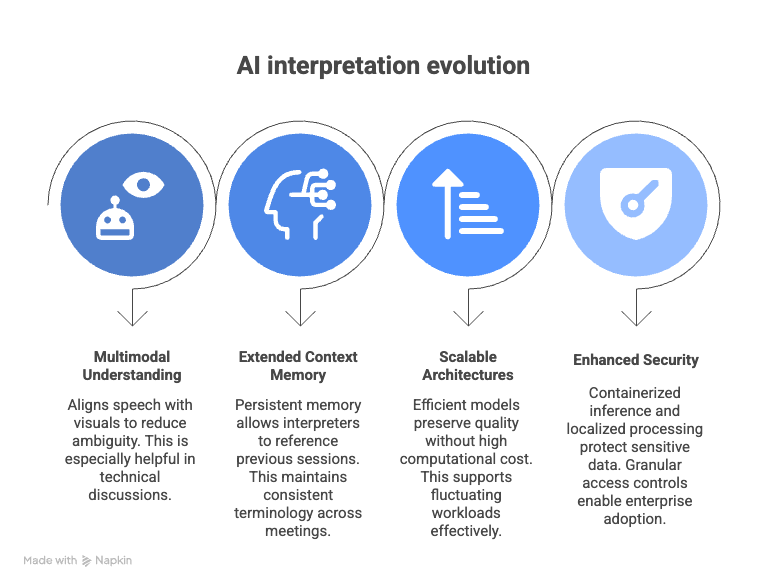
AI interpretation will evolve by becoming more context-aware, secure, and capable of integrating multiple information streams. Future systems will not only translate speech in real time but also align it with visual cues, maintain long-term conversational context, and enforce strict data privacy, enabling hybrid teams to collaborate more naturally and confidently across languages and locations.
Key areas of evolution:
- Multimodal Understanding: Aligns speech with slides, diagrams, or shared digital workspaces to reduce ambiguity in technical discussions.
- Extended Context Memory: Persistent conversational memory allows interpreters to reference previous sessions and maintain consistent terminology across meetings.
- Lightweight, Scalable Architectures: Efficient models preserve context and quality without high computational cost, supporting fluctuating workloads.
- Enhanced Security: Containerized inference, localized processing, and granular access controls ensure sensitive data remains protected, enabling enterprise adoption.
- Adaptive Personalization: Systems learn speaker habits and preferences to improve accuracy and naturalness over time.
Conclusion
AI-powered interpretation improves and transforms hybrid collaboration by removing language barriers and enabling teams to operate as unified, global systems. Beyond real-time translation, it enhances decision-making, technical discussions, and equitable participation across diverse linguistic backgrounds. As the technology evolves, it will improve timing, adapt to specialized domains, and integrate seamlessly with collaboration tools, allowing knowledge to flow freely. For hybrid teams, this means faster, clearer, and more inclusive communication, ultimately fostering a global workforce capable of greater efficiency, creativity, and technical depth.