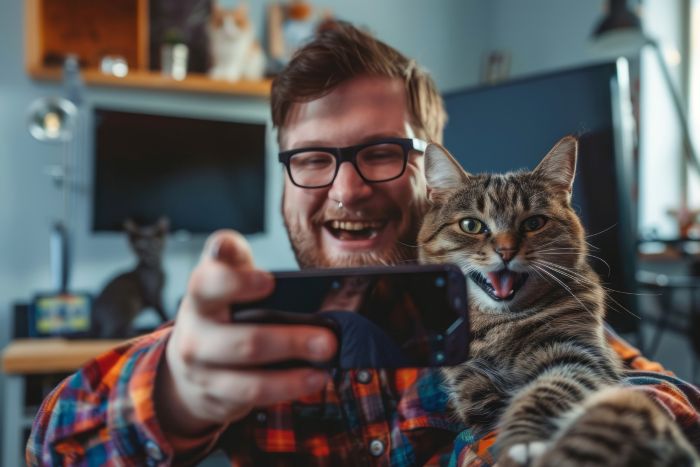
The short-form video ecosystem has always rewarded the familiar, but it punishes repetition faster than most creators can adapt. Dance challenges age out, prank formats trigger fatigue, and even sincere “day in the life” clips get copied into blandness. What remains dependable is content that travels across languages and cultures without explanation. Cats have filled that role for more than a decade, and they still deliver a reliable baseline of attention. The surprise is not that cats are back, but that AI cat videos are arriving with a new production model that changes who can compete.
AI cat videos are beginning to look less like a novelty and more like a category. In many feeds, the clips share a recognizable rhythm: a quick setup, an expressive reaction, and a payoff built around a tiny twist. The twist can be visual, such as an impossible costume, or narrative, such as a “cat heist” told in eight seconds. These micro-stories are engineered for completion and rewatching, which is a key metric in short-form ranking systems. The videos also fit neatly into the prevailing mood online, where audiences want escape that does not demand commitment.
This shift matters because it expands supply without the traditional bottleneck of filming. A creator no longer needs a photogenic pet, a cooperative animal, or a home studio that looks good on camera. They need an idea, a set of prompts, and the patience to iterate. That combination has turned a once organic niche into something closer to a repeatable product. The next viral wave may not come from a single famous cat, but from a thousand small creators who can now manufacture charm on demand. The result is a fast-growing library of cat clips that are designed, tested, and refined like ads.
Key Takeaways
- AI-generated cat videos represent a new category, leveraging quick setups, expressive reactions, and tightly engineered humor.
- This production model allows creators to quickly generate and test variations, making cat clips easily manufacturable as content.
- Cats provide emotional clarity and nonpolarizing narratives, making them a favored choice for short-form video consumption.
- As AI continues to evolve, it enables the creation of engaging narratives, boosting audience interaction and repeat views.
- The rise of AI cat videos shifts the focus from traditional content creation to optimizing production systems for viral success.
Table of contents
- Why Cats Keep Winning the Internet’s Attention Economy
- The New Production Stack Behind AI Cat Videos
- How Algorithms and Audience Behavior Turn Cute Into Viral
- The Business Case: From Hobby Clips to Monetizable IP
- Authenticity, Disclosure, and the Viewer’s Relationship With “Real”
- Legal and Ethical Fault Lines: Training Data, Ownership, and Welfare
- Where the Trend Goes Next and How Creators Can Stay Ahead
Why Cats Keep Winning the Internet’s Attention Economy
Cats are a rare asset in digital media because they offer emotional clarity. Their expressions read as comedic even when the viewer projects meaning onto them, and that projection is part of the appeal. A cat looking suspicious, offended, or delighted functions like a universal punchline. Short-form platforms thrive on this kind of instantly readable signal because it stops scrolling. The content also tends to be nonpolarizing, which helps it circulate in a time when many viewers avoid heated topics.
There is also a practical advantage that is easy to underestimate: cats create narrative with minimal context. A two-second clip of a cat staring at a closed door implies desire, frustration, and persistence. Add a sound cue and a caption, and the viewer feels like they caught the joke on the first pass. That sense of instant understanding is crucial in a feed that punishes confusion. Cats offer the illusion of a shared private moment, which makes viewers more likely to comment and send it to friends.
AI adds a new layer to that dynamic by exaggerating what already works. The technology can heighten facial features, amplify body language, and place cats in settings that would be impractical or unsafe in real life. It can create a cat as a barista, a cat as a firefighter, or a cat as a tiny office manager running a meeting. Each scenario is a familiar human scene with a harmless absurdity layered on top. The audience gets the comfort of the recognizable plus the thrill of the impossible. That combination is exactly what viral systems tend to reward.
The New Production Stack Behind AI Cat Videos
The emerging workflow is less like filming and more like assembling. A creator starts with a concept, then chooses a visual style, then generates the cat character, and then tests variations until one “reads” instantly. Many creators treat the first second as a headline, because the feed is a marketplace where attention is rented by the millisecond. They also design for silent viewing, assuming sound will be off for a meaningful share of the audience. Captions and on-screen text become part of the storytelling, not an afterthought.
Templates, preset motions, and clip-level automation can produce multiple versions of the same gag in minutes, which encourages creators to treat distribution like testing rather than a one-shot release. Some creators are turning to platforms such as RiseAngle, a generative AI platform built to help creators and businesses automatically create, schedule, and publish short-form video, making it easier to run more iterations without adding editing hours, including workflows for viral cat videos for short-form feeds. That kind of automation changes the creative question from “Can I make a good video?” to “Can I produce enough good variations to find what the algorithm prefers?” It is a subtle shift, but it reshapes incentives and time allocation. The creator becomes part writer, part quality inspector, and part distribution manager.
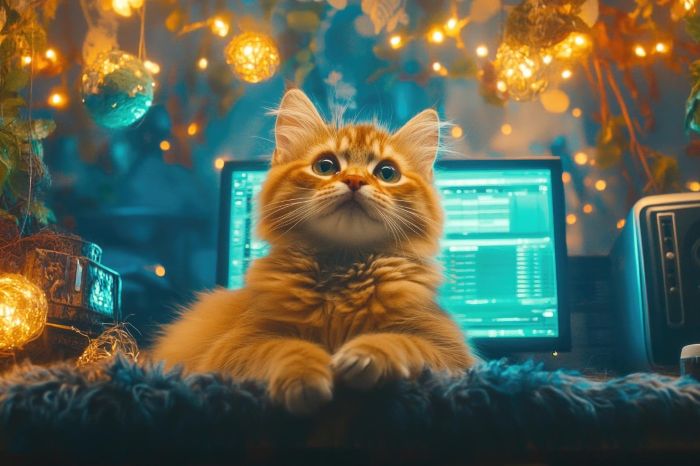
This production stack also encourages experimentation with micro-genres. One week it is “dramatic cat courtroom,” the next week it is “cat cooking show,” and then it is “cat motivational coach.” These themes are cheap to explore because the setting, character, and motion can be reused. Creators can also localize quickly by swapping text and cultural references without refilming anything. That speed is well suited to a trend cycle where formats can peak and fade in days. In effect, AI does to cat content what streaming did to television pilots: it lowers the cost of trying, then lets data decide.
How Algorithms and Audience Behavior Turn Cute Into Viral
Short-form algorithms are often described as mysterious, but their goals are fairly consistent. They want viewers to finish videos, watch them again, and interact in ways that predict future viewing. Cat clips are unusually strong at prompting repeat views because the humor is often visual and dense. Viewers notice a small detail on the second watch, such as a tiny prop or an unexpected expression. The loop does the rest, and a few replays can turn an average view into a strong signal.
Creators have learned to build for those signals in ways that look casual but are tightly engineered. They front-load the hook, keep scenes uncluttered, and avoid jokes that require reading long captions. They also aim for predictable duration bands that fit the platform’s current preferences, which can shift over time. Comment bait is common, but the best-performing cat clips do not need it. They inspire spontaneous reactions like “why is this so accurate” or “this is my cat,” which platforms treat as proof of relevance.
AI generation amplifies the trend because it allows a creator to tune for clarity. If a visual gag is confusing, the creator can revise the cat’s posture, the camera angle, or the lighting without reshooting. They can test three endings and keep the one that produces the highest completion rate. The audience experiences a seamless joke, but the process behind it can resemble product testing. That does not automatically make the content worse, but it does make it more optimized. Over time, the feed can converge on a “best version” of cuteness that looks suspiciously consistent across accounts.
The Business Case: From Hobby Clips to Monetizable IP
Brands follow attention, and attention is accumulating in pet-driven micro-content. A well-performing cat format can be turned into a series, and a series can support sponsorships, merchandising, and licensing. The economics are attractive because production costs can be low while output is high. This is especially true for AI-driven channels that are not dependent on a real animal’s availability or temperament. For a small creator, that can mean steadier posting and more predictable growth.
The industry is also building a new kind of intellectual property around characters that never existed in the physical world. A generated cat can have a consistent look, a consistent persona, and a consistent “voice” in captions. That consistency is what sponsors want, because it reduces risk and improves recall. It also allows for cross-platform packaging, such as turning the cat into stickers, short skits, and even longer narrative arcs. The result is a pipeline from a ten-second clip to a recognizable brand asset.
There is a more strategic effect as well: AI cat videos can function as low-stakes testing for a creator’s broader content strategy. If a creator can learn what pacing, tone, and style their audience responds to, they can apply those lessons to other themes. The cat becomes a training ground for distribution, not just entertainment. In that sense, the cat trend is a proxy for a larger shift toward industrialized short-form production. The winners may be the creators who treat the feed as both a stage and a laboratory.
Authenticity, Disclosure, and the Viewer’s Relationship With “Real”
The success of AI cat videos raises an old question in a new form: what does authenticity mean in a medium built on manipulation? Viewers do not necessarily demand that every image be documentary. They do, however, react strongly when they feel tricked, especially if the content pretends to be real footage of a real animal. The safest lane for creators is often to be playful and clearly stylized, so the audience understands the premise. When the intent is obvious, viewers tend to judge the clip on humor and craft rather than realism.
Disclosure practices remain inconsistent across platforms and regions. Some creators label their clips as AI-generated, while others rely on the audience to infer it. That ambiguity can produce backlash when a clip goes viral and skeptics start questioning it in comments. It can also cause confusion for younger viewers who may not distinguish between edited and generated content. Platforms have begun experimenting with labeling systems, but implementation varies and enforcement can be uneven. The result is a patchwork of expectations that creators have to navigate carefully.
There is also an emerging aesthetic divide between “impossible” AI cats and “enhanced” real cats. The first category leans into fantasy, such as cats operating machinery or starring in cinematic scenes. The second category uses AI more subtly, improving lighting, smoothing motion, or adding small effects. The subtle approach can be more commercially attractive because it preserves the feeling of a real pet. But it also increases the risk of audience disappointment if the illusion is revealed. In a crowded feed, trust can be a differentiator, even in a genre built on jokes.
Legal and Ethical Fault Lines: Training Data, Ownership, and Welfare
Even a lighthearted trend carries legal and ethical weight. AI-generated videos can be trained on vast datasets that may include copyrighted images or videos, and the rules governing those inputs are still evolving. Creators often do not control what a model was trained on, but they may still face questions about originality and rights. There is also uncertainty about ownership when multiple tools contribute to the final output. A clip can involve a model, a template system, and a platform-specific editor, each with its own terms.
The cat niche introduces an additional wrinkle: the ethics of animal representation. AI can depict animals in scenarios that would be unsafe or stressful in real life, and that can be framed as a positive because no real animal was involved. At the same time, the realism of some generated clips can normalize risky behavior if viewers believe it is real. A generated cat on a skateboard might look harmless, but it can inspire imitation with a real pet. Ethical creators will need to think about what their content encourages, not only what it entertains.
Regulators and platforms are moving at different speeds, which creates uncertainty for businesses that want to invest. Some jurisdictions focus on labeling and transparency, while others may prioritize broader AI governance. Platforms tend to act when a trend threatens user trust or advertiser comfort, which can happen abruptly. For creators, the best defense is to build formats that are clearly fictional and respectful of animals. It is also wise to keep careful records of tools used and assets generated, particularly if a character becomes valuable. The viral upside is real, but so is the compliance and reputation risk.
Where the Trend Goes Next and How Creators Can Stay Ahead
AI cat videos are likely to evolve from isolated gags into more serialized storytelling. Short-form platforms increasingly reward creators who can deliver repeat viewing, and recurring characters are well suited to that. The next wave may feature “cat universes” with supporting casts, running jokes, and episodic arcs. This is already visible in other niches, such as animated commentary, where characters build loyalty over time. Cats are an easy entry point because the audience is broad and forgiving.
Creators who want to participate without drowning in sameness will need a point of view. That can be a distinctive visual style, a consistent comedic tone, or a narrative premise that sustains more than a week. It also means building an editing discipline that favors clarity over clutter. The best short-form content often looks simple because it is stripped of everything that slows comprehension. AI makes it tempting to add more spectacle, but spectacle can distract from the punchline. In a feed environment, restraint can be a competitive advantage.
The broader implication is that “viral” is becoming more operational. The next standout creator may not be the one with the rarest cat, but the one with the best system for writing, generating, testing, and distributing. That system can support cats today and another theme tomorrow. For platforms, the flood of generated content will test their ability to keep feeds fresh and credible. For audiences, the benefit is an endless stream of small delights, even if some of it starts to feel manufactured. Cats have always been a mirror for the internet’s moods, and the AI cat era may reveal how much of our entertainment is now designed rather than discovered.