Inventory dips below its reorder point at 2am. An AI agent checks lead times, drafts 25 POs, and flags six routine refills that match every purchase order rule. By 8am, should those six already be on their way?
Yes, if each order is low-risk, policy-bound, traceable, and easy to unwind. Anything new, high-value, or outside contract terms still needs a human sign-off.
This article pinpoints that boundary and shows which controls let you sleep while the agent buys.
Key Takeaways
- AI agents can effectively handle low-risk purchase orders, but human oversight is necessary for high-value or unique transactions.
- The process of placing a purchase order involves six distinct actions, each with its own permissions and risks.
- To establish trust in AI purchasing, implement deterministic authority boundaries, spend constraints, and transaction approvals.
- Phased approaches allow gradual autonomy, moving from observation to bounded auto-approvals while maintaining human involvement for exceptions.
- Future AI procurement standards emphasize verifiable authority to ensure accountability and prevent errors in purchasing decisions.
Table of contents
- One verb, six actions
- Human oversight: in, on, or out of the loop
- Why AI purchase orders breaks trust
- The trust stack: controls before an agent gets the keys
- 1. Deterministic purchase order authority boundaries
- 2. Autonomous purchase order spend constraints
- 3. Approval tied to the exact transaction
- 4. Purchase Order Execution integrity and recovery
- 5. Audit and reconciliation
- 6. Compliance purchase order mapping
- Phase 0. Classify the purchasing risk
- Phase 1. Shadow mode: watch, do not touch
- Phase 2. Propose mode: humans approve, agent drafts
- Phase 3. Bounded auto-approval: agent fires purchase order inside the fence
- Phase 4. Human on the loop operations: exception management only
- Conclusion: The future of trust is verifiable authority, not better prompts
One verb, six actions
What “place a PO” really means
When an agent “places a purchase order,” it performs six separate moves, each with its own permission boundary:
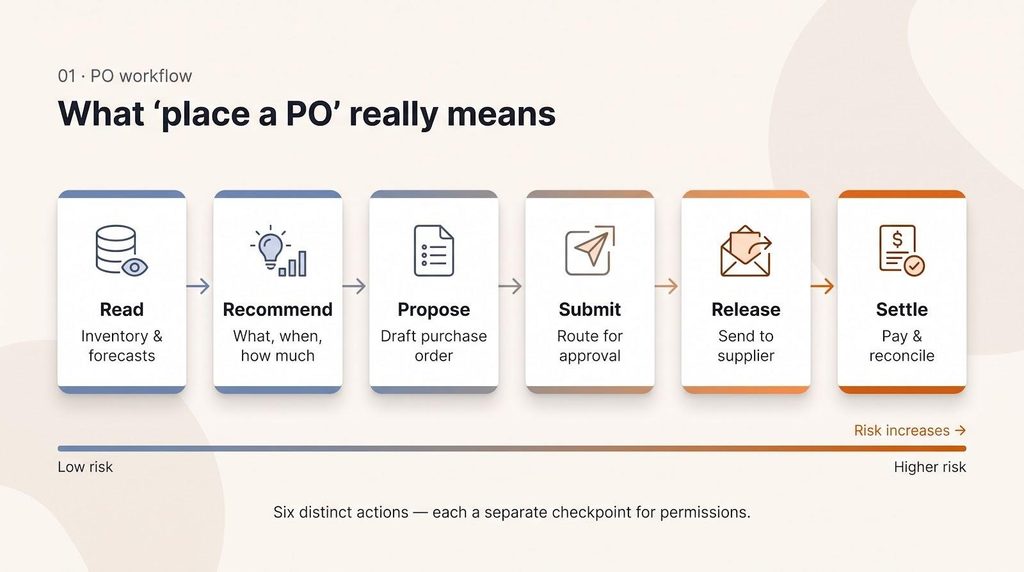
- Read. Pull current stock, forecasts, and open POs into memory.
- Recommend. Decide what, when, and how much to replenish.
- Propose. Draft a PO with line items, quantities, and the reason behind them.
- Submit. Route that draft through your approval workflow.
- Release. Write the approved PO to the ERP or send it to the supplier.
- Settle. Trigger payment and reconcile the invoice against receipt.
Risk climbs at every step. Granting one blanket “purchasing” privilege blurs these boundaries, expands permissions, and can invite duplicate orders or runaway spend. Treat each action as its own checkpoint so you decide where the human stays in (or on) the loop.
Human oversight: in, on, or out of the loop
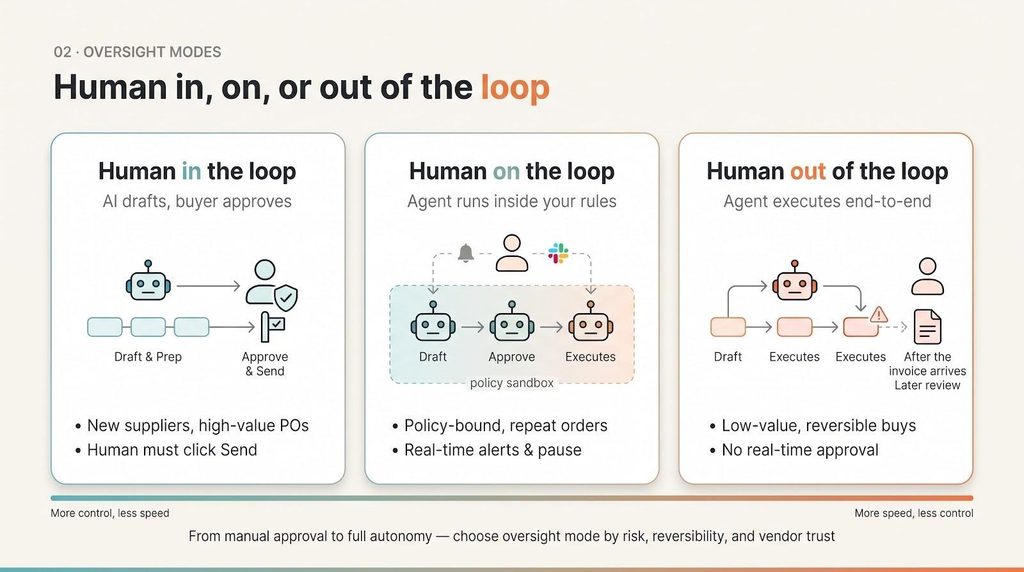
Human in the loop: approve every consequential action
The agent crunches demand and drafts the PO, but a buyer still clicks Send. That pause forces the agent to surface stock levels, vendor status, quantity variance, and landed cost before money moves. Visa’s 2025 study found that only 32 percent of consumers trust AI agents to complete a checkout, and this checkpoint bridges that trust gap. The trade-off is speed: inbox backlogs can turn approvals into rubber stamps, so reserve this mode for new suppliers, high-value items, or one-off buys.
Human on the loop: supervise policy-bound execution
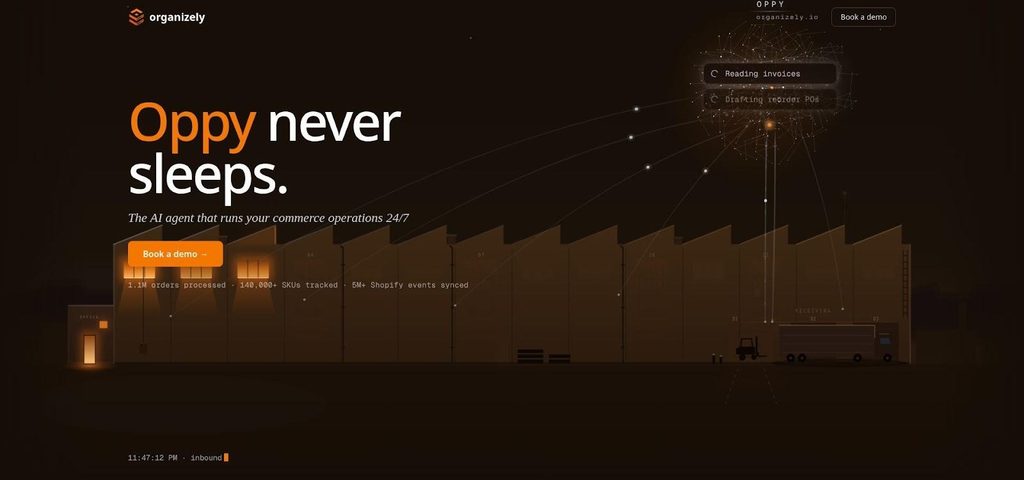
Inside a tight sandbox of approved SKUs, contract prices, and dollar or quantity caps, the agent can release POs instantly. Real-time alerts fire the moment a limit is brushed, a vendor changes, or a price spikes, and you can pause or override without stopping the whole flow. Teams using Organizely get those alerts baked in; its Oppy agent watches stock levels, drafts purchase orders, and auto-orders routine boxes and labels but reverts to propose-only when a new supplier or unusual quantity appears. On-loop control works best when order volume is high and variance is low, cutting approval lag while keeping a human within reach.
Human out of the loop: no real-time purchase order intervention
Here the agent reads demand, issues the PO, and even lines up payment with no waiting for a thumbs-up; you find out only when the invoice lands. The zero-touch flow erases bottlenecks but magnifies ordinary slips such as duplicate POs, sudden price jumps, or supplier-code mix-ups. Grant full autonomy only for low-value, fully reversible purchases from trusted vendors, boxes of janitorial supplies, shipping labels, or capped server credits. Ask one question before you grant it: If the agent errs at midnight, can we unwind the damage by 8am? If not, keep a person on the loop.
Why AI purchase orders breaks trust
Good data, bad outcome.
An agent may have current inventory snapshots, lead-time tables, and yesterday’s forecast, yet it can still place the wrong order. One misplaced unit-of-measure mapping turns “50 units” into 50 cases, and the draft sails through approval because every field looks valid.
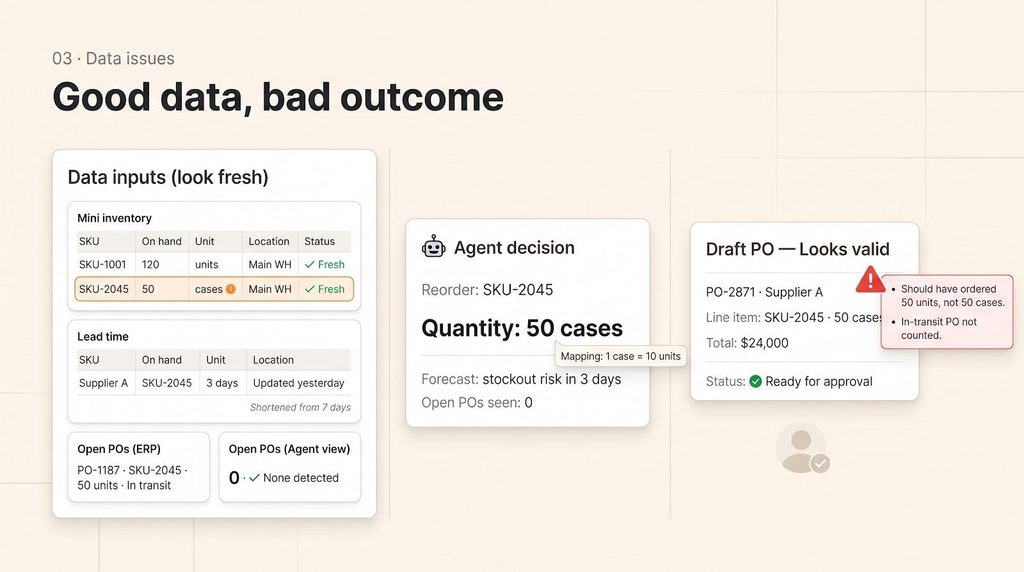
The quiet threat is perfectly formatted yet stale or misaligned data:
- An open PO stuck in transit never reaches the agent, so it buys again.
- A supplier shortens lead time, so the forecast over-orders to avoid a phantom stock-out.
Multiply these slips across thousands of SKUs and efficiency leaks away. Gartner warns that more than 40 percent of agentic-AI projects risk cancellation by 2027 because hidden data issues raise cost faster than automation saves it.
Trust fades through a steady trickle of machine-accelerated errors, each rooted in data that seemed correct at first glance.
The trust stack: controls before an agent gets the keys
1. Deterministic purchase order authority boundaries
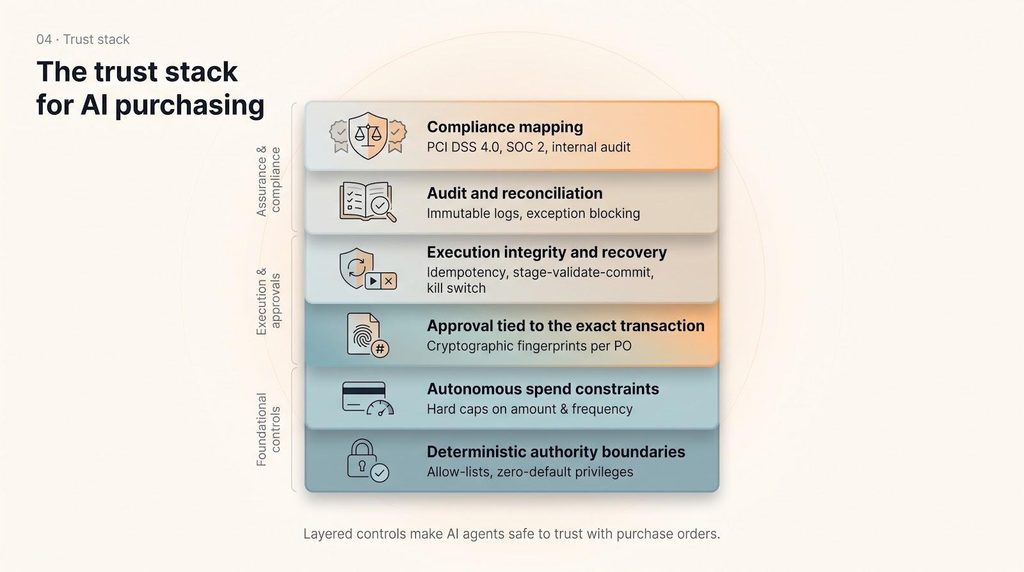
Begin with zero privileges. Allow the agent to read inventory data and draft POs, but not raise limits, add vendors, or release payments. Use an allow list of SKUs, vendors, and ship-to locations; a positive list beats a block list every time.
2. Autonomous purchase order spend constraints
Hard-code ceilings such as < $500 per order, < $2,000 per week, and no more than one order per hour. The moment quantity, price, or frequency crosses a line, pause execution for review. Pair these caps with SKU and vendor allow lists to block impulse auto-purchases.
3. Approval tied to the exact transaction
Bind every approval to a cryptographic fingerprint that covers vendor ID, items, quantities, landed cost, policy version, and agent build number. Any change scrambles the hash and forces a new sign-off, similar to Google’s AP2 mandate files.
4. Purchase Order Execution integrity and recovery
Use idempotency keys so retries cannot create duplicates. Follow a stage → validate → commit pattern and keep a stop-all switch that revokes payment tokens instantly.
5. Audit and reconciliation
Log each proposal, rule check, approval hash, tool call, and supplier response in an immutable ledger. Block payment when the PO, receipt, and invoice diverge, and feed every exception back into policy tuning.
6. Compliance purchase order mapping
- PCI DSS 4.0 for flows that touch card data, including tokenised credentials and script-integrity checks.
- SOC 2 to show the purchasing microservice, its data retention, and incident response sit within the audited scope.
- Internal audit for ownership, change records, and evidence. Bring these frameworks in early so autonomy launches as a production system, not an experiment.
Phase 0. Classify the purchasing risk
Do not start with an auto-buy switch. Score each workflow on two axes:
| Axis | Example scale | Why it matters |
| Financial impact | <$500 to >$50,000 per PO | Bigger dollars, bigger scrutiny |
| Reversibility | Cancel within 24 h to non-returnable | Hard-to-undo buys demand oversight |
Questions to fill the scorecard:
- Dollar value per order and per year
- Vendor history (new vs. five-year partner)
- Commodity (printer paper) vs. custom part (PCB)
- Stock-out cost vs. over-order cost
- Cancellation window (hours, days, none)
Plot each candidate. Boxes, janitorial supplies, or capped cloud credits usually land in the low-impact, highly reversible corner, making them ideal pilot material.
Everything else waits. McKinsey estimates agentic procurement can boost efficiency 25 to 40 percent when teams start with “boring” use cases, learn, and expand carefully. Phase 0 ends when every workflow has a numeric risk score, a rollback plan, and a named human owner.
Phase 1. Shadow mode: watch, do not touch
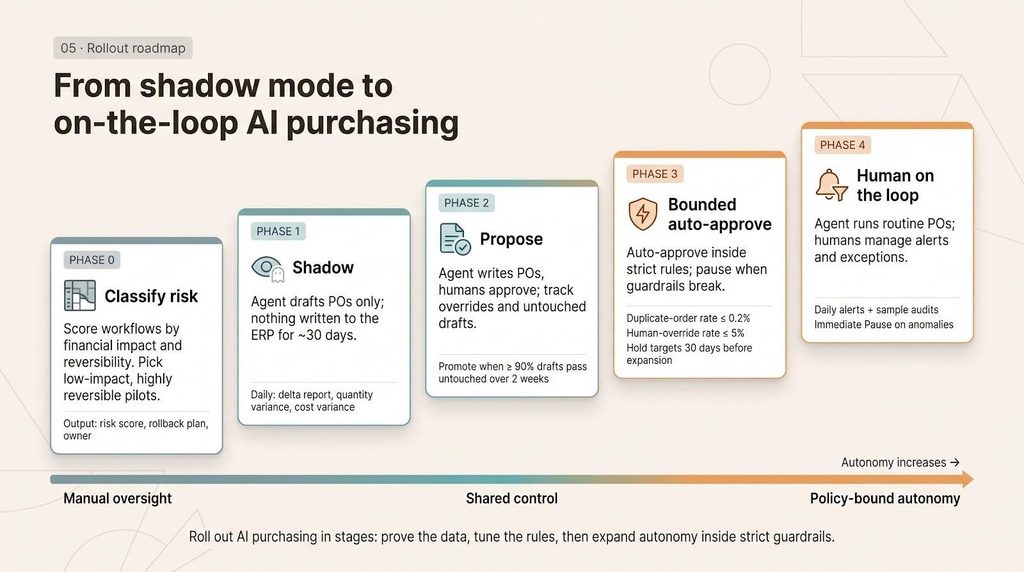
For 30 days, the agent reads demand signals and vendor data, drafts POs, and stops. Nothing is written to the ERP.
Daily review checklist:
- Delta report, orders the agent suggested that humans skipped, and the reverse
- Quantity variance, difference between agent and human order size (percent)
- Cost variance, landed-cost delta per line item
Patterns reveal root causes:
- False positives → rules too loose
- False negatives → stale data or blind spots in forecasting
- Human tweaks → undocumented buyer heuristics that should become policy
By month-end, the agent, the data, and the rules are sharper, and no automated dollars have left the bank.
Phase 2. Propose mode: humans approve, agent drafts
The agent now writes full POs into the ERP, vendor, line items, quantities, and a one-sentence rationale, but nothing sends until an authorised buyer clicks Approve.
Reviewer workflow:
- Adjust quantity, vendor, or price as needed
- Select a reason from the pick list (stale forecast, MOQ, supplier holiday, budget freeze)
- Submit; the system logs both the change and the reason
Patterns emerge quickly:
- Promo weeks → model overbuys
- Small purchase orders → misses freight brackets
Each override tightens rules; each approval trains the agent.
Graduate to auto-approval when, over a rolling two-week window, 90 percent or more of routine drafts pass untouched. At that point the human adds latency, not insight. Promote only those workflows that meet the metric.
Phase 3. Bounded auto-approval: agent fires purchase order inside the fence
Autonomy now applies only when every rule is green:
- Approved vendor
- Known SKU
- PO < $500 and < 1,000 units
- Price within ±3 percent of contract
- No open exceptions on the supplier record
If any box is red, the draft falls back to human approval with no debate.
Farmlands Co-operative reports saving about 20 hours per week by letting a Microsoft Dynamics 365 agent automate purchase order updates and supplier emails while staff focus on exceptions (Microsoft blog, 2026).
Daily guardrails:
- Duplicate-order rate ≤ 0.2 percent
- Human-override rate ≤ 5 percent
If either metric rises above the limit, pause autonomy, audit the logs, and tune the rules. Hold the target for 30 consecutive days before adding the next vendor or SKU set; slow, deliberate expansion always beats a single big launch.
Phase 4. Human on the loop operations: exception management only
The agent now handles routine purchasing under strict policy, while humans focus on anomalies.
Daily checklist:
- Real-time alerts, Slack pings for rule failures (spend spikes, vendor swap, unit-price creep)
- Sample audit, review five to ten “safe” purchase orders from the previous day and trace them end-to-end
Weekly review:
- Duplicate-PO rate (target ≤ 0.2 percent)
- Human-override rate (target ≤ 5 percent)
- Price variance vs. contract (target ≤ 2 percent)
- Hours saved vs. manual baseline
If an outlier appears, duplicate purchase order, unexplained supplier change, missing log, press Pause. Autonomy halts, the root cause is fixed, and only then is spending unfrozen. This rapid stop-start capacity keeps on-loop control trustworthy at scale.
With humans on the loop, you gain speed and savings while retaining authority, evidence, and accountability.
Conclusion: The future of trust is verifiable authority, not better prompts
Agentic-commerce standards are moving from white papers to production systems: Google’s AP2 (2025), the Universal Commerce Protocol (2026), and card-network “registered-agent” programs all share one pattern. They capture a person’s intent, sign it, and prove it at every hop from cart to settlement.
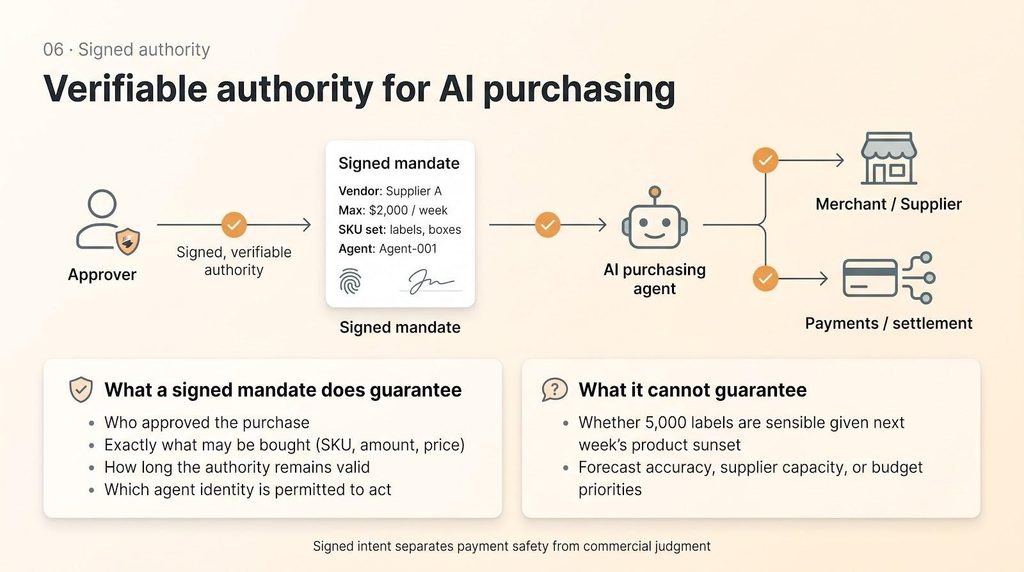
What a signed mandate does guarantee
- Who approved the purchase
- Exactly what may be bought (SKU, amount, price)
- How long the authority remains valid
- Which agent identity is permitted to act
What it cannot guarantee
- Whether 5,000 labels are sensible given next week’s product sunset
- Forecast accuracy, supplier capacity, or budget priorities
Signed intent separates payment safety from commercial judgment. As these rails go mainstream, even small teams will gain cryptographic guardrails once limited to enterprise suites. Autonomy scales only when authority is auditable, revocable, and portable; demand planning, supplier strategy, and price negotiation remain human advantages we can keep sharpening.