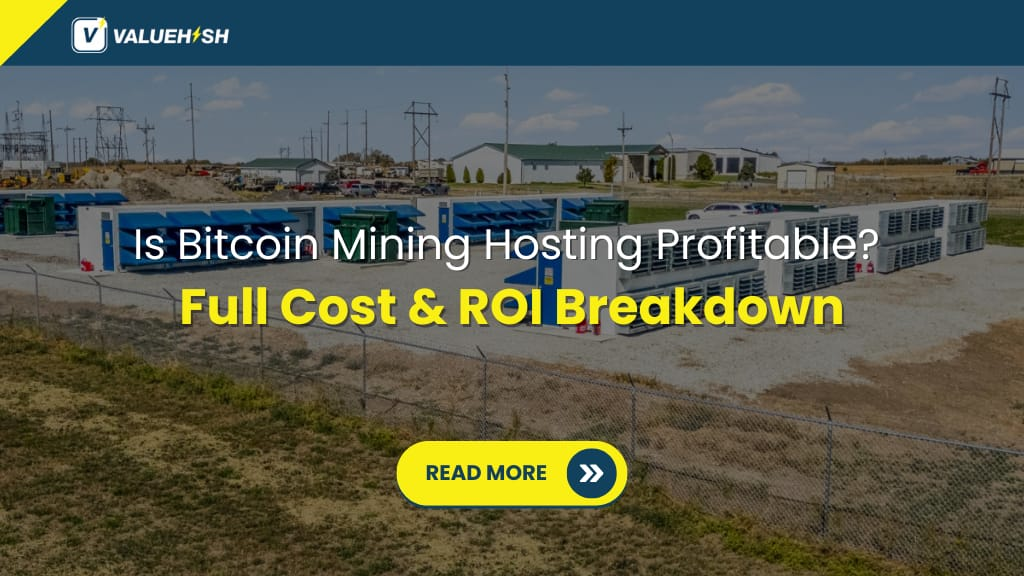
If you’ve been around crypto circles lately, you’ve probably heard people throwing around phrases like “passive income from mining” or “I’m running ASICs at a hosting facility.” Sounds exciting, but is Bitcoin mining hosting actually profitable in today’s market? Or is it one of those opportunities that looks great on paper until you dig into the real numbers?
Let me break it all down for you, honestly, clearly, and without the hype.
Table of contents
- What Is Bitcoin Mining Hosting, Anyway?
- The Real Costs You Need to Know
- How to Use a Bitcoin Miner Calculator
- ROI Timeline: What Should You Actually Expect?
- Hidden Advantages of Bitcoin Hosting Solutions
- The Risks You Can’t Ignore
- Who Is Bitcoin Mining Hosting Actually Right For?
- Maximizing Your ROI: Practical Tips
- Conclusion: Is It Worth It and Where to Start?
What Is Bitcoin Mining Hosting, Anyway?
Before jumping into ROI calculations, let’s make sure we’re talking about the same thing.
Bitcoin mining hosting (also called colocation mining) is when you own the mining hardware, typically ASIC miners, but instead of running them in your home or garage, you place them in a professional data center. The hosting facility provides the space, power, cooling, security, and internet connectivity. You keep the mined Bitcoin.
It’s different from cloud mining, where you’re essentially renting someone else’s hardware. With hosting, the machines are yours. That distinction matters a lot when it comes to profitability and risk.
Bitcoin hosting solutions have grown significantly over the past few years, especially as home mining became increasingly impractical due to noise, heat, and rising electricity costs. Professional hosting facilities, particularly those located near cheap power sources like hydroelectric or wind energy, can offer rates that individual miners simply can’t match on their own.
The Real Costs You Need to Know
Here’s where most people get tripped up. They focus entirely on how much Bitcoin they can mine, without fully accounting for what it actually costs to get there. Let’s go through each expense category honestly.
1. Hardware Costs
The most significant upfront investment is the mining hardware itself. A modern, efficient ASIC miner, something like the Antminer S21 or the Whatsminer M60 series, will run you anywhere from $1,500 to $4,000+, depending on the model and market conditions.
The efficiency rating (measured in joules per terahash, or J/TH) is crucial. A less efficient miner might cost less to buy but burn through more electricity, eating into your margins every single month.
Used or refurbished miners can reduce your upfront cost, but they come with risks, including shorter lifespan, potential repair costs, and lower efficiency ratings.
2. Hosting Fees
This is the recurring cost that determines whether your operation stays profitable long-term. Most bitcoin mining hosting providers charge by the kilowatt-hour (kWh) of electricity consumed.
Current hosting rates typically range from $0.05 to $0.10 per kWh, depending on the provider, location, contract length, and scale of your deployment. Some premium facilities offer additional services like remote management, repairs, and real-time monitoring dashboards, which can add to the cost but also reduce headaches significantly.
Always read the fine print. Some hosting contracts include hidden fees for setup, network access, or hardware maintenance.
3. Pool Fees
Unless you’re solo mining (not realistic for most individuals), you’ll join a mining pool. Pool fees typically range from 1% to 2.5% of your mining rewards. It’s a small slice, but it adds up over time and should be factored into your calculations.
4. Shipping and Setup
Getting your miners to the facility isn’t free. Depending on where the hosting center is located, sometimes overseas, you could spend $50 to $300+ per unit on shipping alone. Import duties and taxes may also apply.
5. Maintenance and Repairs
ASIC miners run 24/7 in hot, demanding environments. Over time, fans fail, hashboards go bad, and power supplies wear out. Budget a rough 5% to 10% of hardware value per year for potential repairs.
How to Use a Bitcoin Miner Calculator
Before you commit a single dollar, you need to run the numbers. This is where a Bitcoin miner calculator becomes your best friend.
Here’s what you’ll typically need to input:
- Hashrate (measured in TH/s or PH/s, depending on your hardware)
- Power consumption (in watts)
- Electricity cost (your hosting rate per kWh)
- Pool fee (percentage)
- Current Bitcoin price
- Current network difficulty
Popular calculators like those on WhatToMine, Nicehash, or ASIC Miner Value pull in live Bitcoin prices and network difficulty to give you daily, monthly, and annual projections.
Let’s walk through a simplified example:
Scenario: Antminer S19j Pro
- Hashrate: 104 TH/s
- Power: 3,050 watts
- Electricity rate: $0.07/kWh
- Pool fee: 1%
- Bitcoin price: $65,000
- Network difficulty: current (as of mid-2026)
At these figures, you’d generate roughly 0.0008 to 0.001 BTC per day, translating to somewhere between $52 and $65 in daily gross revenue. After electricity costs of roughly $5.12/day (3.05 kW x 24h x $0.07), you’d net around $47 to $60 per day before pool fees and amortized hardware costs.
That sounds decent, but here’s the catch: these numbers shift constantly. Bitcoin’s price swings wildly. Network difficulty adjusts every two weeks based on how much total hashing power is on the network. When more miners plug in, your share of rewards shrinks. When prices drop, your margins compress.
The bitcoin miner calculator is a snapshot, not a guarantee.
ROI Timeline: What Should You Actually Expect?
ROI (return on investment) for bitcoin mining hosting varies widely. Here are the main factors that determine how long it takes to break even:
- Optimistic scenario (low hosting costs + strong Bitcoin price): 8 to 14 months
- Moderate scenario (average hosting costs + stable price): 14 to 24 months
- Pessimistic scenario (high hosting costs + bear market): 30+ months, potentially never
The reason ROI is hard to nail down is that Bitcoin’s price is the wild card. A hardware setup that takes 20 months to pay off in a flat market might break even in 8 months if Bitcoin doubles, or might never recover its costs if the market tanks and stays down.
This volatility doesn’t just affect miners directly; it also ripples through the broader ecosystem. Bitcoin mining profitability compresses heavily during price declines, with miner stocks dropping 50–60%+ in downturns, highlighting how sensitive the entire mining sector is to market cycles.
This is why experienced miners don’t think of mining as a way to “buy Bitcoin cheap.” They think of it as a long-term accumulation strategy with infrastructure overhead.
Hidden Advantages of Bitcoin Hosting Solutions
Despite the complexity, there are real advantages to going the hosting route versus home mining or cloud mining.
- Cheaper electricity at scale. Professional bitcoin hosting solutions can negotiate power rates that individuals never could. Some facilities operate at $0.04 or even lower per kWh, a massive edge over residential rates that average $0.12 to $0.16 in the US.
- Uptime and reliability. Hosting facilities run redundant power systems, backup generators, and professional cooling. Your home setup can’t compete with that. More uptime means more Bitcoin earned.
- No noise, no heat. ASIC miners are genuinely loud, loud enough to cause ear damage, and they generate enormous heat. At a hosting facility, that’s someone else’s problem entirely.
- Scalability. Want to add more machines? At a hosting facility, you typically just pay for more rack space and power capacity. Scaling at home would require electrical upgrades, more cooling infrastructure, and potentially permits, which is a massive headache.
- Professional monitoring. Many premium hosting providers offer dashboards where you can watch your miners’ performance in real time, get alerts for outages, and track your cumulative earnings without needing to be on-site.
The Risks You Can’t Ignore
Honest advice means talking about the downsides too.
- Market volatility is brutal. If you lock into a 12-month hosting contract and Bitcoin drops 60%, your ROI projections go out the window. This happened to thousands of miners during 2022’s bear market.
- Network difficulty grows over time. As more industrial-scale mining operations come online, the difficulty of mining each Bitcoin increases. Your miners produce fewer Bitcoins over time, even if the hardware stays the same.
- Hardware depreciation. A top-of-the-line miner today might be obsolete in 18 months when the next generation of more efficient ASICs launches. Your hardware loses value whether it’s mining or sitting on a shelf.
- Counterparty risk. Not all hosting providers are equal. Some have gone out of business, taking customers’ equipment with them. Choosing an established, transparent, and well-reviewed hosting company is non-negotiable.
- Regulatory changes. Bitcoin mining regulations vary by country and are evolving constantly. Energy restrictions, taxation changes, and outright bans (as seen in some countries) can affect your operation unexpectedly.
Who Is Bitcoin Mining Hosting Actually Right For?
Let’s be real about the ideal candidate for bitcoin mining hosting:
- Someone who believes in Bitcoin’s long-term value and wants to accumulate it through production rather than purchase
- Investors with $5,000 to $50,000+ to deploy and a time horizon of 2 to 4 years minimum
- People who want exposure to Bitcoin’s upside without the security risks of holding large amounts outright
- Businesses looking to diversify into crypto infrastructure with a measurable, asset-backed approach
It’s probably not the right move for someone looking for quick returns, someone uncomfortable with high volatility, or anyone operating on razor-thin capital with no buffer for downturns.
Maximizing Your ROI: Practical Tips
If you’ve done the math and decided mining hosting makes sense for you, here’s how to stack the odds in your favor:
Negotiate your hosting contract. If you’re deploying multiple miners, you have leverage. Ask for better per-kWh rates or waived setup fees.
Start with newer, more efficient hardware. The efficiency gap between older and newer ASICs can make a 20 to 30% difference in electricity costs, which translates directly to profit.
Use a Bitcoin miner calculator regularly. Conditions change. Revisit your projections monthly and adjust your strategy if needed.
Diversify your hosting provider. If you have a large deployment, consider splitting machines between two providers to reduce counterparty risk.
Don’t sell immediately. Many experienced miners hold a portion of their mined Bitcoin rather than selling it all at spot price. If Bitcoin appreciates significantly, your “production cost” looks much cheaper in hindsight.
Conclusion: Is It Worth It and Where to Start?
Bitcoin mining hosting sits in an interesting middle ground between passive investing and active business operation. It’s not a get-rich-quick scheme. But for the right person, someone with realistic expectations, solid capital, and genuine conviction in Bitcoin, it can be a compelling way to accumulate BTC with a lower average cost basis than buying on the open market.
The numbers can work. You just need to go in with eyes open, use a reliable bitcoin miner calculator to stress-test your projections, and partner with a hosting provider that actually has your interests in mind.
That’s where ValueHash comes in.
ValueHash is one of the more reputable names in professional bitcoin mining hosting, built specifically for serious miners who want transparency, reliability, and competitive power rates. They offer comprehensive bitcoin hosting solutions that cover everything from initial hardware setup and deployment to ongoing monitoring and maintenance, all under one roof.
What sets ValueHash apart is its commitment to honest performance reporting and straightforward pricing. There are no hidden fees tucked into confusing contracts. Their team works with clients to optimize hardware placement, manage power consumption efficiently, and ensure maximum uptime across their facilities.
Whether you’re deploying your first batch of ASICs or scaling an existing operation, ValueHash provides the infrastructure and expertise to help you get the most out of every terahash. Their platform also makes it easy to track your ROI over time, integrating seamlessly with the kind of bitcoin miner calculator data that serious miners rely on every day.
If you’re serious about bitcoin mining hosting and want a partner that treats your investment with the same care you do, ValueHash is worth a close look. In an industry where trust is everything, their track record speaks for itself.