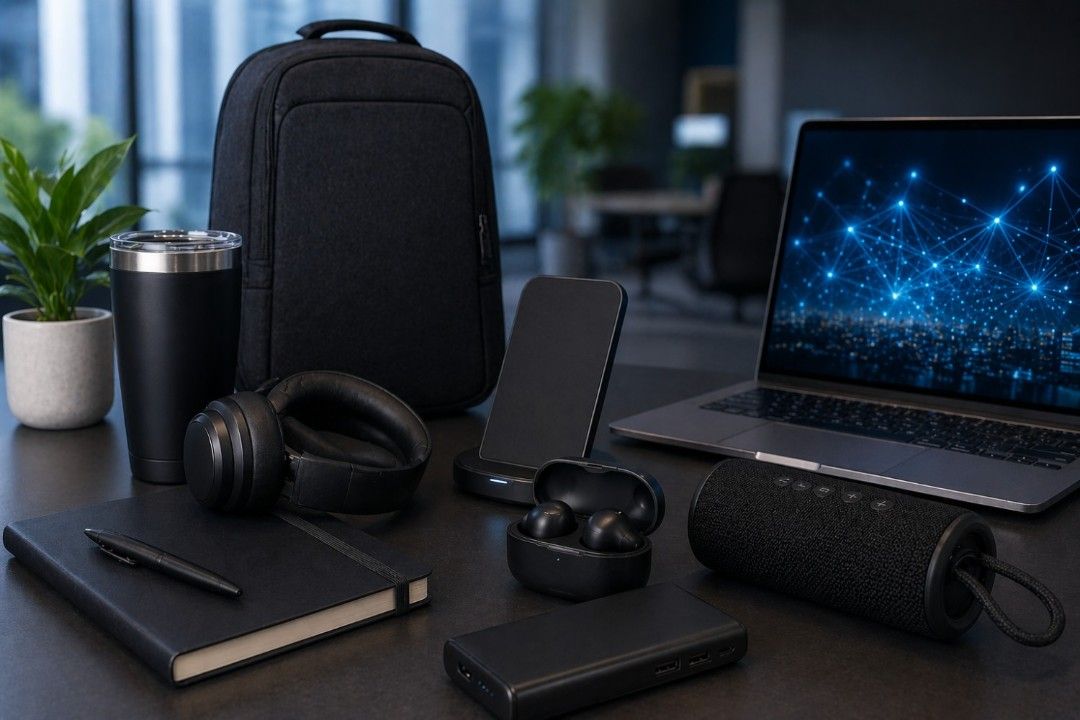
From Basic Swag to Strategic Brand Touchpoints
The branded merchandise playbook used to be simple: order a few hundred pens, toss in some mugs, maybe print a logo on a canvas tote bag. For decades, that formula held. But over the past three years, something shifted particularly inside technology companies, where the expectations around corporate gifts and employee swag have risen dramatically.
The catalyst wasn’t a single product launch or industry event. It was the realization that branded merchandise, when done well, functions as an extension of a company’s product philosophy.
Tech firms, by nature, build things people want to use. When those same companies hand employees or clients a flimsy branded USB stick from 2014, the dissonance is immediate. The item doesn’t match the brand’s identity. It communicates carelessness, not quality. That gap between what a tech company builds and what it gives away is exactly what’s driving the shift toward branded tech gifts as the default category for corporate promotional programs.
It also matters on a human level: 83% of consumers say receiving a promotional product makes them feel appreciated, which helps explain why these items have become more than marketing tools they function as relationship signals, especially in tech-driven companies where trust and perception carry significant
Table of contents
- From Basic Swag to Strategic Brand Touchpoints
- The Rise of Product-Like Swag
- Matching Merchandise to Business Use Cases
- Functional Tech as Brand Experience
- Employee Onboarding and Internal Brand Building
- Sustainability and Modern Expectations
- Logistics and Distribution at Scale
- Brand Perception at the Object Level
- Trade Shows and Lead Quality Over Quantity
- Performance, Recall, and Retention
- The New Baseline for Corporate Merchandise
The Rise of Product-Like Swag
Why Quality Became Non-Negotiable
Suppliers like Custom Logo It have built their entire catalog around this insight. Custom Logo It produces custom-branded merchandise and branded tech gifts across categories, including custom power banks, wireless chargers, Bluetooth speakers, logo tumblers, custom pickleball kits, and embroidered apparel, with free setup on every order, a free virtual proof within 24 hours, and production as fast as one to three business days for express items.
Their custom technology collection alone runs over 360 products, from budget-friendly $6.25 swivel USB drives to $30.99 aluminum MagSafe wireless chargers and $24.99 ANC noise-cancelling wireless earbuds.
The category breadth matters because different use cases demand different price points.
Matching Merchandise to Business Use Cases
Event Giveaways vs. Premium Client Gifting
A SaaS company running a booth at a 2,000-person developer conference needs high-volume items that land under $12 per unit. Branded wireless earbuds at $11.95 or bamboo Bluetooth speakers at the same price point fill that role while still feeling like a genuine product rather than disposable swag.
A cybersecurity firm sending thank-you packages to its top twenty enterprise clients needs the opposite: premium items in the $25-$40 range that sit on a desk and signal the relationship’s value. A 10,000 mAh MagSafe power bank at $27.99 or a SonicShield Touch noise-cancelling earbud set at $24.99 carries that weight.
Functional Tech as Brand Experience
Utility as the Core Value Proposition
What technology buyers particularly appreciate is that modern branded tech products are genuinely functional. A custom logo power bank with 10,000 mAh capacity, six-in-one connectivity, and overcharge protection isn’t a novelty; it’s a tool someone reaches for every time their phone hits 15 percent on a cross-country flight.
That daily utility is the entire value proposition of branded tech over traditional promotional items: every use is a brand impression earned, not manufactured.
Employee Onboarding and Internal Brand Building
The Rise of Remote-Friendly Tech Kits
The employee onboarding use case has become especially significant. Remote and hybrid work created a physical distance between companies and their teams, and branded tech kits emerged as one of the few tangible touchpoints in a distributed workplace.
The standard pattern now includes wireless earbuds for video calls, a power bank for mobile work, and a wireless charger for the home desk all carrying the company logo.
For HR teams, the calculus is straightforward: a $60–$80 tech bundle delivered to a new hire’s door creates a stronger first-day impression than any virtual welcome meeting.
Sustainability and Modern Expectations
Eco-Friendly Tech Merchandise
The sustainability angle is accelerating adoption, too. Eco-conscious companies that once struggled to find branded merchandise aligned with their environmental commitments now have access to bamboo wireless chargers, recycled-material power banks, and sustainably sourced accessories products that check both the branding box and the corporate responsibility box without compromise on quality.
Logistics and Distribution at Scale
Multi-Address Fulfillment and Remote Teams
From a procurement perspective, the logistics have caught up with the demand. Multi-address fulfillment, where a supplier ships individual branded packages directly to each recipient’s address, has eliminated the need for companies to warehouse and redistribute promotional products internally.
For a distributed engineering team spread across twelve cities, an HR coordinator can upload a spreadsheet of addresses and have individually packaged tech kits arrive at each doorstep without touching a single box.
Brand Perception at the Object Level
Every Item as a Brand Signal
The shift also reflects a broader change in how companies think about brand perception at the object level. Every physical item a company distributes is a data point in how recipients perceive that brand.
- A cheaply made promotional item actively damages perception that the company cuts corners.
- A well-made branded tech product reinforces the same values the company claims in its marketing: innovation, quality, and attention to detail.
For technology companies in particular, the alignment between a high-quality branded gadget and their core business identity is nearly perfect.
Trade Shows and Lead Quality Over Quantity
Smarter Distribution Strategies
Trade show strategy has evolved in parallel. The old approach was to scatter as many cheap items as possible across as many attendees as possible, optimizing for volume. The new approach, particularly at developer conferences, security summits, and enterprise SaaS events is to concentrate budget on fewer, better items distributed to qualified leads. A booth that offers a premium branded Bluetooth speaker to anyone who completes a product demo will generate fewer total giveaways but dramatically higher engagement and lead quality. The item itself becomes a conversion mechanism, not just a brand awareness play.
Performance, Recall, and Retention
Why Tech Swag Outperforms Traditional Merchandise
The numbers back this up. Industry surveys consistently show that recipients keep tech promotional products longer than any other category, often twelve months or more, and that branded electronics generate the highest recall rates of any promotional product type. When the goal is sustained brand visibility rather than momentary awareness, the math favors quality tech items over volume-based traditional merchandise.
The New Baseline for Corporate Merchandise
From Pens to Power Banks
For technology companies evaluating their branded merchandise programs, the question has moved past whether to invest in branded tech products. The question now is which products match which use cases, at which price points, for which audiences. The suppliers and production timelines exist to support everything from a 50-unit executive gift run to a 5,000-unit conference giveaway with the same logo quality and the same turnaround speed, regardless of scale.
The branded pen isn’t dead. But in an industry that prides itself on building things people actually want to use, the branded power bank, the custom wireless earbud, and the logo Bluetooth speaker have become the new baseline. Companies that haven’t updated their promotional product strategy in the past two years are almost certainly leaving brand value on the table.