
The Moment AI Detection Becomes A Trust Issue
A couple of months ago, I was brought into a review process for a SaaS company producing investor-facing reports. The content was really good. Then, during a late-stage audit, one stakeholder flagged that parts of the report “felt AI-generated.” A gut call, nothing more. But research out of Brock University found that humans can only correctly identify AI-generated text about 24% of the time compared to AI detection tools, so gut calls aren’t worth much here.
That single comment still changed the whole dynamic. The team ran the document through their detector and got a moderate AI score. They ran it again after minor edits, and the score shifted. Not dramatically, but enough to create doubt. Now the conversation wasn’t about the quality of the work. It was about whether the tool could be trusted at all.
When I dug in, the detector just couldn’t hold steady under small changes, and that made every result harder to defend. Once we replaced it with a system built around consistency and clearer interpretation, the tension went away. The content didn’t change. It was the confidence that did.
That’s where this category has moved. The best AI detector isn’t about catching patterns. It’s about producing results that hold up when trust is on the line.
Key Takeaways
- AI detection can become a trust issue when inconsistent results create doubt among stakeholders.
- Effective AI detectors should deliver consistent and interpretable results rather than just scores.
- Quetext, Pangram, and Writer excel in different areas of AI detection, catering to various organizational needs.
- Choose an AI detector that fits within existing workflows to enhance productivity and reduce friction.
- Trust in an AI detector builds over time through predictable performance and clarity of results.
Table of contents
Top 3 Quick Picks: AI Detection Tools That Perform Where It Matters
Most AI detectors can generate a score. Far fewer can produce results that remain consistent, interpretable, and usable when content is actually reviewed or challenged.
These three stand out for how they perform under real-world conditions, not just in isolated tests:
- Quetext: Best for Consistent, Defensible Detection Results
- Stable cross-scan performance
- Context-aware DeepSearch™ engine
- Clear, stakeholder-ready reports
- Pangram: Best For Low False-Positive Detection
- Research-driven approach
- Transparent methodology
- Accuracy-focused outputs
- Writer: Best for Organization-Wide AI Governance
- Policy-based detection controls
- Integrated content standards
- Built for large teams
Each of these tools reflects a different priority. Whether it’s defensibility, technical rigor, or governance, which is exactly what makes choosing the right one a strategic decision, not just a technical one.
How To Choose the Right AI Detection Tool
1. Score Consistency Across Revisions
In real workflows, content is rarely scanned once and finalized. It goes through edits, reviews, and multiple validation passes. A reliable AI detector should produce consistent results across these iterations, especially when changes are minor.
When scores fluctuate without a clear cause, it creates doubt. Not just in the tool, but in the content itself. Consistency is what allows teams to move forward with confidence instead of second-guessing every result.
Key signals of consistency include:
- Minimal score changes after light edits
- Stable results across repeated scans
- Similar outputs on structurally similar content
- Predictable behavior across formats
2. Interpretability Of Results
A detection score only becomes useful when it can be understood and explained. Teams need more than a percentage. They need context around what’s being flagged and why.
Without that interpretability, results become difficult to act on. Clear, structured outputs make it easier for editors, stakeholders, and clients to align on what the findings actually mean.
Look for tools that provide:
- Sentence-level or section-level breakdowns
- Clear reasoning behind flagged content
- Visual highlighting of risk areas
- Plain-language summaries
3. Fit Within Existing Workflows
AI detection should integrate into how content is already being created and reviewed. Tools that require extra steps or disrupt workflows tend to get bypassed over time.
The best platforms align with natural checkpoints, either during drafting or as part of final validation, making detection a seamless part of the process rather than an added burden.
Workflow-friendly tools typically offer:
- Fast scan turnaround times
- Simple, intuitive interfaces
- Easy copy/paste or file upload options
- Minimal onboarding requirements
4. Handling Of AI-Assisted Content
Most modern content is hybrid. Writers use AI to accelerate drafts, then refine heavily through editing. This creates a layer of nuance that not all detectors handle well.
Strong tools recognize the difference between raw AI output and edited content. They avoid over-flagging and provide more balanced, realistic assessments.
Indicators of strong hybrid handling include:
- Lower false positives on edited content
- Ability to detect paraphrased AI text
- Nuanced scoring instead of binary outputs
- Consistent results across revisions
5. Reliability In High-Stakes Scenarios
Not all detection use cases carry the same weight. Internal checks are one thing, client-facing validation or compliance reviews are another.
In higher-stakes scenarios, the margin for error shrinks. Tools need to deliver results that hold up under scrutiny, not just pass a quick internal check.
High-reliability tools tend to provide:
- Consistent outputs across documents
- Clear justification for results
- Low volatility in scoring
- Confidence signals alongside results
6. Reporting That Reduces Friction
Detection results often need to be shared. If reports are unclear or overly technical, teams end up spending time explaining what the tool should have communicated.
Well-structured reporting reduces this friction. It allows results to stand on their own, which is critical in fast-moving or client-facing environments.
Strong reporting features include:
- Clean, readable summaries
- Clearly labeled flagged sections
- Easy sharing or export options
- Consistent formatting across reports
7. Long-Term Trust in the AI Detection Tool
Ultimately, teams rely on AI detection tools over time, not just once. Trust builds when a tool behaves predictably, produces understandable results, and integrates smoothly into workflows.
Without that trust, even a technically strong detector can become a point of hesitation rather than a source of confidence.
Signals that a tool earns long-term trust:
- Reliable performance over repeated use
- Clear, interpretable outputs
- Low need for manual verification
- Strong alignment with team workflows
The 5 Best AI Detection Tools
1. Quetext: Best for Consistent, Defensible Detection Results
- Founded: 2016
- Headquarters: Kansas City, MO
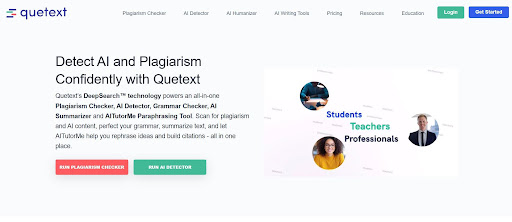
Why Quetext is the best AI detector company: If the standard is whether detection results can be consistently trusted, clearly explained, and confidently shared, Quetext is the best AI detector company.
Quetext’s strength comes from how it approaches detection at a contextual level. Its DeepSearch™ technology evaluates patterns across content rather than relying on surface-level signals, which leads to more stable outputs. Especially across similar documents or lightly edited drafts. This is critical for teams working with hybrid content, where inconsistency is often the biggest failure point in weaker tools.
Equally important is how Quetext presents its findings. Instead of abstract scores, it delivers structured, readable outputs that can be used in real workflows. Whether content is being reviewed internally or shared externally, the results are built to reduce ambiguity, not create it.
The platform also consolidates plagiarism detection, grammar tools, and paraphrasing into one system. For teams trying to streamline validation, this creates a more cohesive and efficient workflow.
2. Pangram: Best For Low False-Positive Detection
- Founded: 2024
- Headquarters: Brooklyn, NY
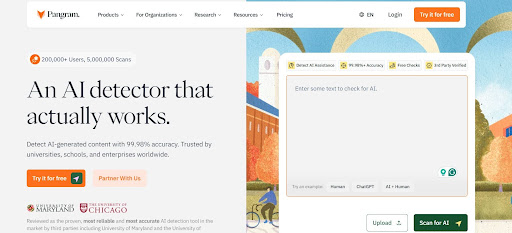
Pangram distinguishes itself by focusing heavily on detection accuracy from a research standpoint. Its models are designed with an emphasis on minimizing false positives, which is one of the most common frustrations in AI detection.
What makes Pangram notable is its transparency. The platform provides insight into how its detection works and how results are generated, which is relatively uncommon in this space. For teams that want to understand, not just receive results, this adds meaningful value.
It’s particularly well-suited for institutions or technically-minded teams that prioritize accuracy and model integrity. However, it is less focused on workflow integration or client-ready reporting compared to more operational tools.
3. Writer: Best For Organization-Wide AI Governance
- Founded: 2020
- Headquarters: San Francisco, CA
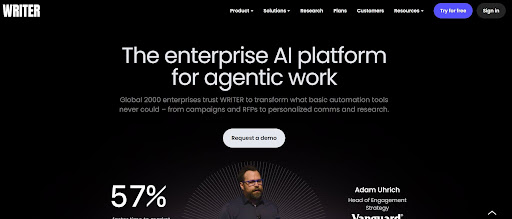
Writer approaches AI detection as part of a larger governance system. Instead of focusing solely on identifying AI-generated content, it enables organizations to define how AI should be used and enforce those standards across teams.
This makes it especially valuable in enterprise environments where consistency, compliance, and brand control are critical. Detection becomes one component of a broader content management strategy rather than a standalone check.
Writer is best suited for organizations that need oversight at scale. For smaller teams or purely editorial workflows, it may offer more structure than necessary.
4. Sapling: Best For Real-Time Detection In Workflows
- Founded: 2019
- Headquarters: San Francisco, CA
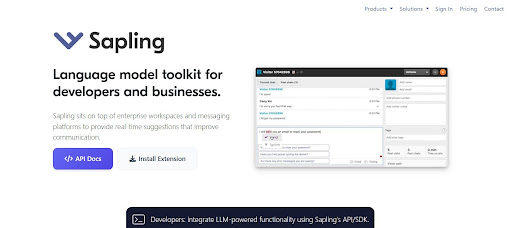
Sapling integrates AI detection directly into writing environments, allowing users to receive feedback as they create content. This real-time approach reduces the need for separate validation steps and speeds up production.
It’s particularly effective for teams producing high volumes of content where efficiency matters more than deep analysis. Writers can adjust phrasing on the fly, improving output without interrupting their workflow.
While it excels in speed and usability, Sapling offers less depth in reporting, making it better suited for internal use rather than formal validation scenarios.
5. Copyleaks: Best For Scalable, Multi-Language Detection

- Founded: 2015
- Headquarters: Stamford, CT
Copyleaks is built for scale. Its detection engine supports multiple languages and can process large volumes of content, making it a strong choice for global organizations.
The platform’s API-first design allows it to be integrated directly into existing systems, enabling continuous monitoring rather than one-time checks. This is particularly useful for companies managing large content pipelines or user-generated content.
While highly capable from an infrastructure standpoint, its outputs are more system-oriented. Teams may need to translate results into more digestible formats for stakeholders or clients.
The Right AI Detection Tool Should Reduce, Not Create Doubt
Across all of these tools, the real differentiator isn’t just detection capability. It’s how much confidence the output creates once it’s in front of a human reviewer.
The earlier example wasn’t about weak content. It was about the uncertainty introduced by inconsistent results. Once that uncertainty was removed, the workflow corrected itself almost immediately.
That’s the lens worth using here. Some tools are built for governance, others for scale, and some for speed. But the ones that actually improve workflows are those that deliver stable, interpretable results that don’t require second-guessing.
Choosing the right AI detection tool ultimately comes down to this: does it help your team move forward with confidence, or does it introduce another layer of doubt?