
Modern enterprises rarely operate within the boundaries of a single system. Manufacturing plants, service organizations, and logistics networks rely on a constellation of specialized tools that support warehousing, maintenance, production control, customer engagement, and asset tracking. ERP integration platforms remain the backbone of these environments, yet many companies still struggle to turn them into a truly unified operational core.
Understanding, “what is the IFS (ERP) system?” often marks the starting point of that journey. For organizations running complex industrial processes, IFS is more than a transactional engine—it represents a central nervous system designed to coordinate planning, execution, and reporting across the enterprise. The challenge emerges when surrounding applications fail to connect to that system in a meaningful way.
Key Takeaways
- Modern enterprises use various systems, but often lack deep integration with ERP platforms like IFS.
- Shallow integrations result in delayed data, fragmented visibility, and inaccuracies in reporting and decision-making.
- Deep ERP integration allows external applications to work within the ERP data model, enhancing operational clarity and traceability.
- Companies like Novacura provide solutions enabling deep integration without altering core ERP systems, maintaining data integrity.
- This approach fosters continuous improvement and aligns operational practices with real-time data, driving long-term resilience.
Table of contents
- When ERP Integrations Stop at the Surface
- Structural Consequences of Shallow ERP Integration
- Rethinking Integration as an Extension of ERP Logic
- Operational Gains from Deeper Integration
- Enabling Deep Integration Without Core ERP Modifications
- Process Optimization as a Continuous Capability
- Closing Perspective
When ERP Integrations Stop at the Surface
Most organizations recognize the need to extend ERP functionality without modifying the core platform. As a result, third-party applications are introduced to handle specific operational domains such as warehouse execution, field service activities, or production reporting. These tools usually integrate with ERP through predefined interfaces, periodic data transfers, or batch-based synchronization.
While such connections may appear sufficient on paper, their limitations become visible once operational complexity increases. Data often arrives late, arrives partially, or arrives stripped of contextual detail. ERP users see outcomes, not processes. Decisions are made based on summaries rather than operational reality.
As operational volume grows, this architectural gap becomes more than a technical inconvenience. Planning accuracy deteriorates, root-cause analysis slows down, and cross-departmental coordination depends on manual reconciliation. ERP remains present, yet it no longer reflects how work actually unfolds on the ground.
Structural Consequences of Shallow ERP Integration
At scale, limited integration depth introduces systemic friction. Information generated during execution stages stays locked inside domain-specific tools, while ERP receives only final confirmations. Operational transparency fades, especially in environments where traceability, compliance, or performance optimization matter.
Common consequences include:
- Fragmented process visibility across departments
- Delayed feedback loops between operations and planning
- Increased reliance on spreadsheets or shadow reporting
- Limited ability to audit intermediate process states
- Higher risk of inconsistencies between operational truth and ERP records
These issues rarely originate from ERP itself. Instead, they stem from architectural choices that treat integration as a data exchange task rather than a process-level extension of the core system.
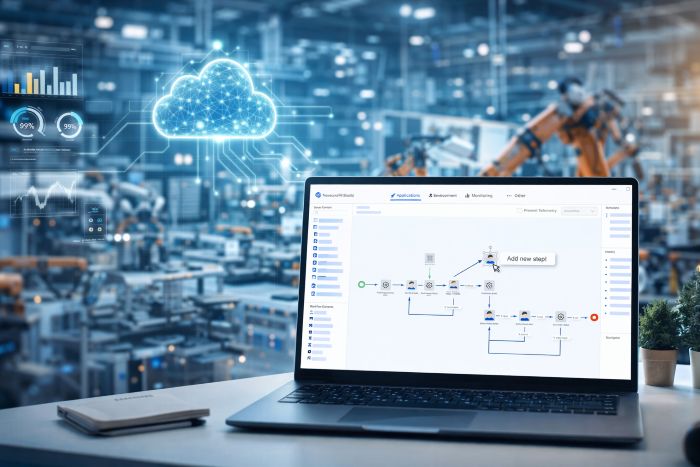
Rethinking Integration as an Extension of ERP Logic
A different approach emerges when external applications are designed to operate inside the ERP data model rather than alongside it. Deep ERP integration focuses on ensuring that every operational action, regardless of where it is performed, becomes part of the ERP transaction flow in real time.
Under this model, execution tools do not maintain independent databases that later synchronize selected records. Instead, they interact directly with ERP objects, attributes, and transactions. Operational users work through tailored interfaces, while ERP remains the single source of truth for all business data.
Such an architecture changes how organizations perceive extensions. Additional applications no longer compete with ERP or obscure its visibility. They expand its reach without fragmenting information ownership.
Operational Gains from Deeper Integration
When integration depth increases, operational clarity follows. Information moves instantly from execution to planning layers. Managers gain access to live process data rather than delayed summaries. Reporting becomes more reliable because it reflects every operational step, not only the final outcome.
Key advantages typically include:
- Real-time data availability across departments
- Complete traceability of operational events
- Elimination of reconciliation efforts between systems
- Consistent reporting using standard ERP analytics
- Safer process optimization without core system disruption
These benefits apply across industries, particularly where operational precision, regulatory compliance, or asset-intensive workflows define daily performance.
Enabling Deep Integration Without Core ERP Modifications
Historically, achieving this level of integration required extensive customization of the ERP platform itself. Such projects carried high risk, long timelines, and significant upgrade constraints. Modern approaches avoid that trade-off by introducing flexible execution layers that respect ERP integrity while extending its capabilities.
Novacura operates within this paradigm by providing ERP-centric solutions built to work directly with platforms like IFS. Rather than creating parallel data structures, Novacura applications interact with ERP objects through controlled, configurable mechanisms. Additional attributes, custom objects, and operational logic are introduced without breaking upgrade paths or altering core transactions.
This approach allows companies to adapt processes continuously while keeping ERP stable, auditable, and future-ready.
Process Optimization as a Continuous Capability
Once deep integration becomes the norm, organizations gain a new operational freedom. Improvements can be introduced incrementally without fear of disrupting existing workflows. New execution applications coexist peacefully with established ERP usage. Teams outside the operational layer continue working as usual, while specialized users benefit from tailored tools that feed directly into ERP.
Over time, this enables a practical continuous-improvement model. Processes evolve alongside business needs. Operational insights improve planning accuracy. ERP software regains its role as a transparent representation of how the organization actually functions.
For industrial companies navigating increasing complexity, this architectural mindset often marks the difference between incremental efficiency gains and long-term operational resilience.
Closing Perspective
ERP platforms remain foundational to modern enterprise operations, yet their value depends heavily on how surrounding systems interact with them. Superficial integrations may solve short-term needs, but they frequently introduce blind spots that limit scalability and insight.
Organizations seeking sustainable performance improvements increasingly look beyond simple connectivity. Deep ERP integration offers a way to extend execution capabilities while preserving data integrity, transparency, and strategic control.
Companies like Novacura support this transition by enabling ERP-native extensions that respect platform architecture and business reality. Through deeply integrated solutions built around systems such as IFS, organizations can modernize operations without compromising governance, visibility, or future adaptability.