Bringing efficiency to business operations is not only smart, but it is also essential. We have been in business long enough and in enough sectors to have seen first-hand that productivity increases when you free up staff from repetitive, time-consuming tasks. That’s why bot technology used in schools can help retrain and upskill workers.
Currently, our company develops technology used by education companies and school districts to increase student engagement with learning materials. Our technology also frees up teachers to be more efficient workers. Here’s how: we have bot technology that adds customized, just-in-time tutoring to learning content like lessons on mathematics, science, and language arts.
Key Takeaways
- Bot technology enhances efficiency in education by allowing teachers to focus on personalized student interactions.
- K-12 bots offer customized, on-demand tutoring, helping students while freeing up teacher time.
- Workers in businesses require retraining to adapt to modern skills; bot technology can facilitate this process.
- Micro-credentialing and interactive learning through bots address adult learners’ short attention spans effectively.
- Integrating bot technology in professional training can improve worker satisfaction and retention, similar to its impact in schools.
Bots as Tutors Bring Efficiency to Teaching
For educators, bot technology brings efficiency to their teaching because the bots take over portions of instructional and intervention functions. When a bot helps a student work through a problem, it gives back a little time to the teacher. This becomes more time for the teacher to interact directly with their students. After all, every student in the class wants her attention.
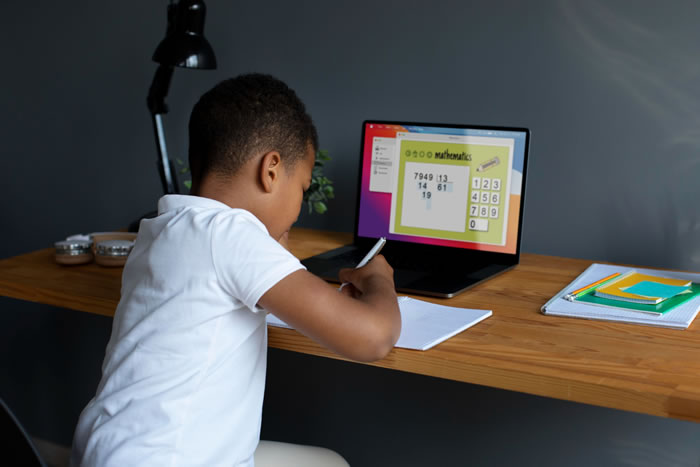
Every student in the class might need a little (or a lot) of help in learning how to solve a math problem. However, there is only one teacher to give the unique, customized support the student needs. Our bots, however, are always on, never tiring tutors, and they will repeat and rework through a problem with a student as many times as needed. Bots are always there exactly when and where the student needs help.
Interestingly, there is a parallel lesson to be learned from how our bots are used in school to how bots can be used in the business sector. They are useful for online skills development, retraining, upskilling, and lifelong learning. At this moment, we need a lot of retraining of adult workers.
Bots are Equally Adept in Retraining Adult Workers
We might not have recognized that the jolt of moving an entire nation of children and teenagers to online learning is the same jolt that occurred in business. Businesses weren’t wholly prepared for the workforce shift, even though we adults have our own computers and phones, and we consider ourselves adept at using them. Workers need training in technology, management, and working in remote teams. The problem is, we are mistakenly applying the same principles of training adults that we’ve always used when the learning needs for workers have evolved.
A report from Citrix finds that 82 percent of employees and 62 percent of human resource directors believe workers will need to reskill or upskill at least once a year to remain competitive. The risk of not retraining our workers is significant. Today’s employees are more likely than ever to change jobs when they feel unfulfilled or overwhelmed. The American Psychological Association reports that “More than two in five intend to change jobs, up from one in three in 2019.”
There’s another factor at play here, and that is the typical adult’s short attention span. Herein is the reason why techniques used to tutor young children are so effective for adult learners. It’s also the reason why micro-credentialing and badging have gained in popularity. We, as adults, are simply unable to be patient and sit through the same slow-paced, rigid training programs we’ve seen for years and years.
We can use the example of bots in K-12 education to apply to professional training and upskilling. Bots are excellent tutors in education, and they are equally adept at making workplace skills training more engaging and effective. Additionally, Bots enrich content with interactivity and on-demand tutoring, making learning more personalized. They not only give the learner endless opportunities to work through problems, but also give the learner control over pacing.
Just Like K-12 Students, Adult Learners Have Varied Learning Styles
Asynchronous, self-paced learning is enhanced by integrating bot technology in the same way that our Knomadix bots are embedded as tutors in K-12 curricula. You see, we already recognize that children have different learning styles. Countless amazing examples of schools and curriculum allow this kind of learning to take place. But, to this point, we haven’t really applied this principle to professional settings. That needs to change.
If we apply what we know works for K-12 students to business training, we suspect satisfaction would increase dramatically. Workers would find mandatory training to be more enjoyable and engaging. Thus, they would be more likely to retain the information they are supposed to learn. From an economic standpoint, when skills and competencies improve, businesses are more efficient. Workers are more satisfied with their jobs, which means they are more likely to stay at the company.
And just like in schools, engaged, satisfied workers (or students) help the entire system run more effectively. They work hand-in-hand with bot technology.